Question
A stone thrown into still water, creates a circular wave pattern moving radially outwards. If $r$ is the distance measured from the centre of the pattern. the amplitude of the wave aries as
Now, as crest spread, this energy $E$ remains constant. So,
$2 \pi r d r h^{2} \rho g=E$
$\Rightarrow \mathrm{h}=\sqrt{\frac{\mathrm{E}}{2 \pi \mathrm{rdr} \rho \mathrm{g}}}$ or $\mathrm{h} \propto \mathrm{r}^{-1 / 2}$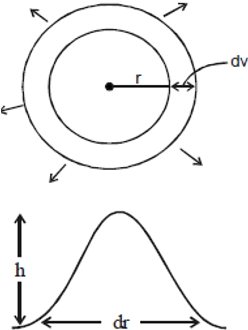
Generate a complete, print-ready paper with questions like this in minutes — across 16+ boards, with answer keys.