A straight wire of diameter $0.5\, mm$ carrying a current of $1\, A$ is replaced by another wire of $1\, mm$ diameter carrying the same current. The strength of magnetic field far away is
AIPMT 1997,AIPMT 1999, Easy
Download our app for free and get started
(d) The magnetic field is given by $B = \frac{{{\mu _0}}}{{4\pi }}\frac{{2i}}{r}$.
It is independent of the radius of the wire.
It is independent of the radius of the wire.

Download our appand get started for free
Experience the future of education. Simply download our apps or reach out to us for more information. Let's shape the future of learning together!No signup needed.*
Similar Questions
- 1A tightly wound $100$ turns coil of radius $10 \mathrm{~cm}$ carries a current of $7 \mathrm{~A}$. The magnitude of the magnetic field at the centre of the coil is (Take permeability of free space as $4 \pi \times 10^{-7} \mathrm{SI}$ units):View Solution
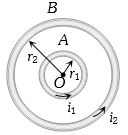
- 2$A$ and $B$ are two concentric circular conductors of centre $O$ and carrying currents ${i_1}$ and ${i_2}$ as shown in the adjacent figure. If ratio of their radii is $1 : 2$ and ratio of the flux densities at $O$ due to $A$ and $B$ is $1 : 3$, then the value of ${i_1}/{i_2}$ isView Solution
- 3When equal current is passed through two coils, equal magnetic field is produced at their centres. If the ratio of number of turns in the coils is $8: 15$, then the ratio of their radii will beView Solution
- 4Due to the flow of current in a circular loop of radius $R$, the magnetic induction produced at the centre of the loop is $B$. The magnetic moment of the loop is $({\mu _0} = {\rm{permeability}}\,{\rm{constant)}}$View Solution
- 5An electron is revolving round a proton, producing a magnetic field of $16\, weber/m^2$ in a circular orbit of radius $1\,\mathop A\limits^o $. It’s angular velocity will beView Solution
- 6If wire of length $L$ form a loop of radius $R$ and have $n$ turn. Find magnetic field at centre of loop if current flowing in loop is $I$View Solution
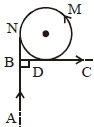
- 7A very long wire $ABDMNDC$ is shown in figure carrying current $I. AB$ and $BC$ parts are straight, long and at right angle. At $D$ wire forms a circular turn $DMND$ of radius $R. AB.$ $\mathrm{BC}$ parts are tangential to circular turn at $\mathrm{N}$ and $D$. Magnetic field at the centre of circle isView Solution
- 8Which of the following graphs shows the variation of magnetic induction $B$ with distance $r$ from a long wire carrying currentView Solution
- 9An electron is moving along positive $x$-axis. To get it moving on an anticlockwise circular path in $x-y$ plane, a magnetic filed is appliedView Solution
- 10A current loop consists of two identical semicircular parts each of radius $R,$ one lying in the $x-y$ plane and the other in $x-z$ plane. If the current in the loop is $i.$ The resultant magnetic field due to the two semicircular parts at their common centre isView Solution