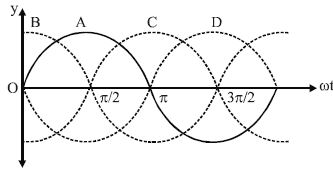
Three coherent waves of equal frequencies having amplitude $10 \,\, \mu m$, $4\,\,\mu m$ and $7 \,\,\mu m$ respectively, arrive at a given point with successive phase difference of $\pi /2$. The amplitude of the resulting wave in $mm$ is given by
Diffcult
Download our app for free and get started
The amplitudes of the waves are
$a_{1}=10 \mu m, a_{2}=4 \mu m$ and $a_{3}=7 \mu m$
and the phase difference between $1\, st$ and $2\, nd$ wave is $\frac{\pi}{2}$ and that between $2\, nd$
and $3\,rd$ wave is $\frac{\pi}{2} .$ Therefore, phase difference between $1\, st$ and $3\, rd$ is $\pi$.
Combining $1st$ with $3rd,$ their resultant amplitude is given by
$A_{1}^{2}=a_{1}^{2}+a_{3}^{2}+2 a_{1} a_{3} \cos \varphi$
or $A_{1}=\sqrt{10^{2}+7^{2}+2 \times 10 \times 7 \cos \pi}$
$=\sqrt{100+49-140}$
$=\sqrt{9}=3 \mu m$ in the direction of first.
Now combining this with $2\, nd$ wave we have, the resultant amplitude
$A^{2}=A_{1}^{2}+a_{2}^{2}+2 A_{1} a_{2} \frac{\cos \pi}{2}$
or $A=\sqrt{3^{2}+4^{2}+2 \times 3 \times 4 \cos 90^{\circ}}=\sqrt{9+16}$
$=5 \mu m$

Download our appand get started for free
Experience the future of education. Simply download our apps or reach out to us for more information. Let's shape the future of learning together!No signup needed.*
Similar Questions
- 1A uniform rope of mass $6\,kg$ hangs vertically from a rigid support. A block of mass $2\,kg$ is attached to the free end of the rope. A transverse pulse of wavelength $0.06\,m$ is produced at the lower end of the rope. The wavelength of the pulse when it reaches the top is (in $m$ )View Solution
- 2View SolutionIf the temperature increases, then what happens to the frequency of the sound produced by the organ pipe
- 3A person feels $2.5\%$ difference of frequency of a motor-car horn. If the motor-car is moving to the person and the velocity of sound is $320\, m/sec,$ then the velocity of car will beView Solution
- 4A tuning fork of known frequency $256\,Hz$ makes $5$ beats per second with the vibrating string of a guitar. The beat frequency decreases to $2$ beats per second when the tension in the guitar string slightly increased. The frequency of the guitar string before increasing the tension was ..... $Hz$View Solution
- 5A vibrating string of certain length $l$ under a tension $T$ resonates with a mode corresponding to the first overtone (third harmonic) of an air column of length $75\, cm$ inside a tube closed at one end. The string also generates $4\, beats$ per second when excited along with a tuning fork of frequency $n$. Now when the tension of the string is slightly increased the number of beats reduces to $2\, per second$. Assuming the velocity of sound in air to be $340\, m/s$, the frequency $n$ of the tuning fork in $Hz$ isView Solution
- 6The frequency of a tunning fork is $384$ per second and velocity of sound in air is $352 m/s$. How far the sound has traversed while fork completes $36$ vibration .... $m$View Solution
- 7View SolutionA sound is produced by plucking a string in a musical instrument, then
- 8The engine of a train moving with speed $10\,ms ^{-1}$ towards a platform sounds a whistle at frequency $400\,Hz$. The frequency heard by a passenger inside the train is $........\,Hz$ (neglect air speed. Speed of sound in air $330\,ms ^{-1}$ )View Solution
- 9A wave on a string is travelling and the displacement of particles on it is given by $x = A\, sin\, (2t -0.1\, x)$. Then the wavelength of the wave isView Solution
- 10Figure given below shows four progressive waves $A, B, C$ and $D$ with their phases expressed with respect to the wave $A$ . It can be calculated from the figure thatView Solution