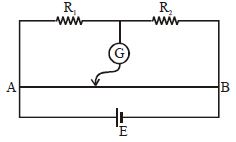
A student obtained following observations in an experiment of meter bridge to find the unknown resistance of the circuit The most accurate value of unknown resistance is ............ $\Omega$
| S.No. | $R$ | $l$ | $100-l$ | $S = \left( {\frac{{100 - l}}{l}} \right)R$ |
| $1$ | $20\,\Omega $ | $43$ | $57$ | $26.51\,\Omega $ |
| $2$ | $30\,\Omega $ | $51$ | $49$ | $28.82\,\Omega $ |
| $3$ | $40\,\Omega $ | $59$ | $41$ | $27.80\,\Omega $ |
| $4$ | $60\,\Omega $ | $70$ | $30$ | $25.71\,\Omega $ |
Medium


Download our appand get started for free
Experience the future of education. Simply download our apps or reach out to us for more information. Let's shape the future of learning together!No signup needed.*
Similar Questions
- 1An electric bulb is designed to draw power $P_0$ at voltage $V_0$. If the voltage is $V$ it draws a power $P$. ThenView Solution
- 2A wire of length $10 \mathrm{~cm}$ and radius $\sqrt{7} \times 10^{-4} \mathrm{~m}$ connected across the right gap of a meter bridge. When a resistance of $4.5 \ \Omega$ is connected on the left gap by using a resistance box, the balance length is found to be at $60 \mathrm{~cm}$ from the left end. If the resistivity of the wire is $\mathrm{R} \times 10^{-7} \Omega \mathrm{m}$, then value of $\mathrm{R}$ is :View Solution
- 3Three unequal resistors in parallel are equivalent to a resistance $1\, ohm$. If two of them are in the ratio $1 : 2$ and if no resistance value is fractional, the largest of the three resistances in $ohms$ isView Solution
- 4The electric field $E$, current density $J$ and conductivity $\sigma$ of a conductor are related asView Solution
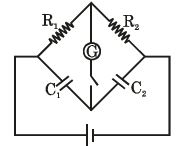
- 5View SolutionCircuit shown is in steady state, now when switch is closed, galvanometer shows no deflection, then correct relation is
- 6$50\,\Omega $ and $100\,\Omega $ resistors are connected in series. This connection is connected with a battery of $2.4\, volts$. When a voltmeter of $100\,\Omega $ resistance is connected across $100\,\Omega $ resistor, then the reading of the voltmeter will be ............. $V$View Solution
- 7The resistance of a wire is $R$. If the length of the wire is doubled by stretching, then the new resistance will beView Solution
- 8When a current $I$ is passed through a wire of constant resistance, it produces a potential difference $V$ across its ends. The graph drawn between $\log\, I$ and $\log\, V$ will beView Solution
- 9The resistance of a wire of uniform diameter $d$ and length $L$ is $R$. The resistance of another wire of the same material but diameter $2d$ and length $4L$ will beView Solution
- 10In the fig. shown for given values of $R_1$ and $R_2$ the balance point for jockey is at $40\, cm$ from $A$. When $R_2$ is shunted by a resistance of $10\,\Omega $, balance shifts to $50\, cm. R_1$ and $R_2$ are $(AB = 1\,m)$View Solution