Question
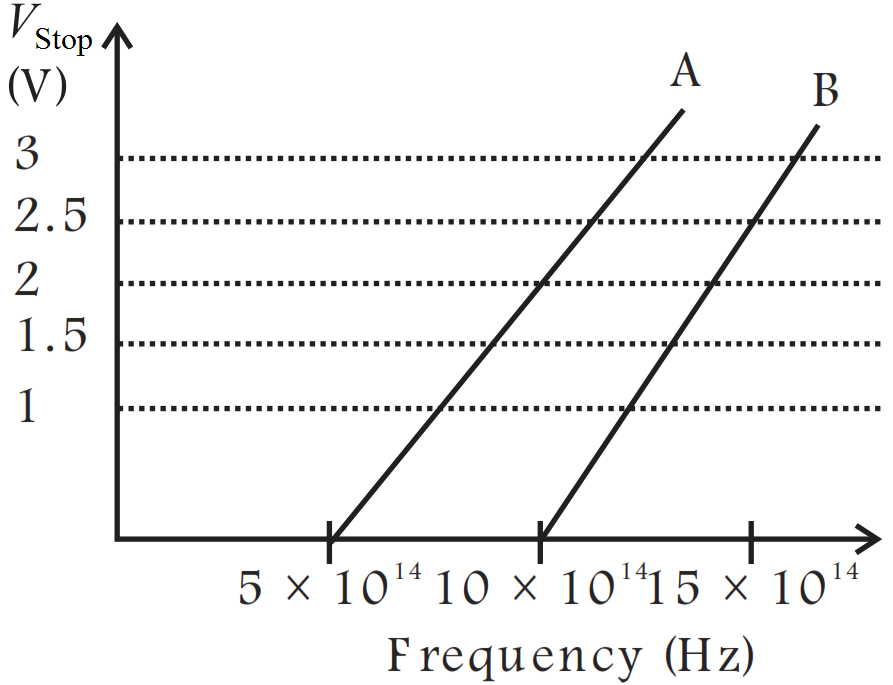
A student performs an experiment on photoelectric effect, using two materials A and B. A plot of Vstop vs ν is given in Fig.

  1. Which material A or B has a higher work function?
  2. Given the electric charge of an electron = 1.6 × 10-19C, find the value of h obtained from the experiment for both A and B.

Comment on whether it is consistent with Einstein’s theory:

Answer

  1. From the given figure, we have

Threshold frequency of A, v0A = 5 × 1014Hz and

Threshold frequency of B, v0B = 10 × 1014Hz

Now,Work function, $\phi=\text{hv}_0$

$\Rightarrow\ \phi_0\propto\text{v}_0$ [$\because$ h (Planck's constant) is constant]

Now, $\frac{\phi_{0\text{A}}}{\phi_{0\text{B}}}=\frac{5\times10^{14}}{10\times10^{14}}$

$\Rightarrow\ \frac{\phi_{0\text{A}}}{\phi_{0\text{B}}}=\frac{1}{2}$

$\therefore\ {\phi_{0\text{A}}}<{\phi_{0\text{B}}}$

Hence, the work function of B is higher than A.

  1. For metal A,

The slope is given by $\frac{\text{h}}{\text{e}}=\frac{2}{(10-5)10^{14}}$

$\Rightarrow\ \text{h}=\frac{2\text{e}}{5\times10^{14}}$

$=\frac{2\times1.6\times10^{-19}}{5\times10^{14}}\ \ \big[\because\ \text{e}=1.6\times10^{-19}\big]$

$=6.4\times10^{-34}\text{Js}$

Similarly, for metal B,

The slopw is given by slope $\frac{\text{h}}{\text{e}}=\frac{2.5}{(15-10)10^{14}}$

$\Rightarrow\ \text{h}=\frac{2.5\times\text{e}}{5\times10^{14}}$

$=\frac{2.5\times1.6\times10^{-19}}{5\times10^{14}}\ \ \big[\because\ 1.6\times10^{-19}\big]$

$=8\times10^{-34}\text{js}$

Since, the experimental value of h for metals A and B is different.

Hence, the given experiment is not consistent with theory.
Need a full question paper?

Generate a complete, print-ready paper with questions like this in minutes — across 16+ boards, with answer keys.

Start Generating Free

Similar questions

An LR circuit has L = 1.0H and $\text{R}=20\Omega.$ It is connected across an emf of 2.0V at t = 0. Find $\frac{\text{di}}{\text{dt}}$ at:
  1. t = 100ms
  2. t = 200ms
  3. t = 1.0s
A wire of length 10cm translates in a direction making an angle of 60° with its length. The plane of motion is perpendicular to a uniform magnetic field of 1.0T that exists in the space. Find the emf induced between the ends of the rod if the speed of translation is 20cm/s-1.
A coil of inductance 0.50H and resistance 100Ω is connected to a 240V, 50Hz ac supply.
  1. What is the maximum current in the coil?
  2. What is the time lag between the voltage maximum and the current maximum?
By explaining diamagnetic, paramagnetic and ferromagnetic substances, analyse their characteristic properties.###Define diamagnetic, paramagnetic and ferromagnetic substances and analyse their characteristics on the basis of (a) reason for magnetic property (b) relative magnetic permeability (c) magnetic susceptibility (d) intensity of magnetisation (e) magnetic induction.
Define magnetic permeability and magnetic susceptibility. Prove that $\mu_{r} = (1+\chi)$.
Two particles A and B, each having a charge Q, are placed a distance d apart. Where should a particle of charge q be placed on the perpendicular bisector of AB so that it experiences maximum force What is the magnitude of this maximum force?
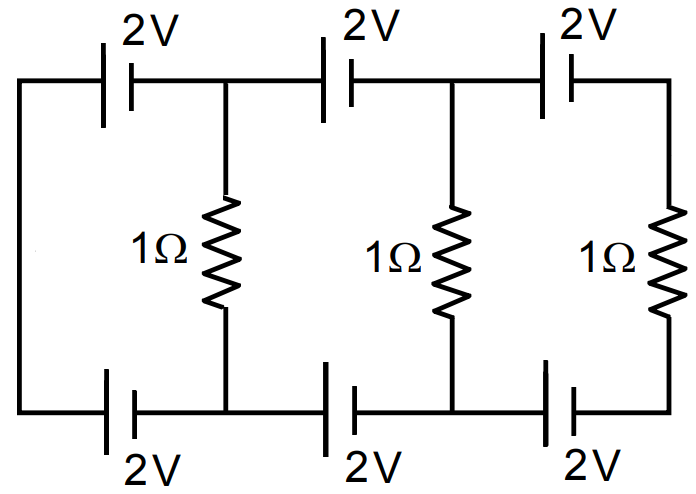
Find the circuit in the three resistors shown in the figure.

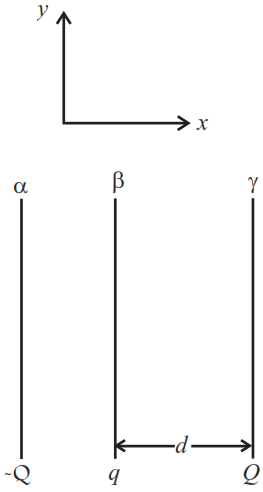
Two fixed, identical conducting plates $(\alpha\ \&\ \beta)$, each of surface area S are charged to -Q and q, respectively, where Q > q > 0. A third identical plate $(\gamma)$, free to move is located on the other side of the plate with charge q at a distance d (Fig.). The third plate is released and collides with the plate $\beta$. Assume the collision is elastic and the time of collision is sufficient to redistribute charge amongst $\beta\ \&\ \gamma$.

Find the charges on $\beta$ and $\gamma$ after the collision.
Use Moseley's law with b = 1 to find the frequency of the $\text{K}_\alpha$ X-ray of La(Z = 57) if the frequency of the $\text{K}_\alpha$ X-ray of Cu(Z = 29) is known to be 1.88 × 10¹⁸Hz.
A parallel-plate capacitor having plate area 400cm2 and separation between the plates 1.0mm is connected to a power supply of 100V. A dielectric slab of thickness 1.0mm and dielectric constant 5.0 is inserted into the gap:
  1. Find the increase in electrostatic energy.
  2. If the power supply is now disconnected and the dielectric slab is taken out, find the further increase in energy.
  3. Why does the energy increase in inserting the slab as well as in taking it out?