Question
A system exhibiting S.H.M. must possess

Answer

(b) System should be elastic and must possess inertia

Need a full question paper?

Generate a complete, print-ready paper with questions like this in minutes — across 16+ boards, with answer keys.
Start Generating Free

Similar questions

Which of the following reaction does not give aldehyde as a product
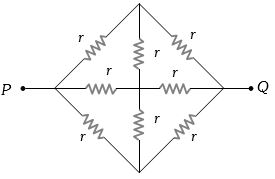
The equivalent resistance between the points $P$ and $Q$ in the network given here is equal to  ................ $\Omega$ (given $r = \frac{3}{2}\Omega $)
The intensity of sound wave while passing through an elastic medium falls down by $10\%$ as it covers one metre distance through the medium. If the initial intensity of the sound wave was $100$ decibels, its value after it has passed through $3$ metre thickness of the medium will be .... $decibel$
At a certain temperature for given wave length, the ratio of emissive power of a body to emissive power of black body in same circumstances is known as
The graph between $log\, R$ and $log\, A$ where $R$ is the nuclear radius and $A$ is the mass number is
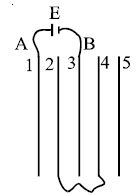
Five conducting parallel plates having area $A$ and separation between them $d$, are placed as shown in the figure. Plate number $2$ and $4$ are connected wire and between point $A$ and $B$, a cell of emf $E$ is connected. The charge flown through the cell is
Two bodies of masses ${m_1}$ and ${m_2}$ have equal kinetic energies. If ${p_1}$ and ${p_2}$ are their respective momentum, then ratio ${p_1}:{p_2}$ is equal to
Choose the correct relationship between Poisson ratio $(\sigma)$. bulk modulus $( K )$ and modulus of rigidity $(\eta)$ of a given solid object:
The flat bottom of cylinder tank is silvered and water $(\mu = 4/3)$ is filled in the tank upto a height $h$ .$A$ small bird is hovering at a height $3h$ from the bottom of the tank. When a small hole is opened near the bottom of the tank, the water level falls at the rate of $1\, cm/s$. The bird will perceive that his image's velocity is :
The molecules of a given mass of a gas have a $r.m.s.$ velocity of $200\, m/sec$ at $27°C$ and $1.0 \times {10^5}\,N/{m^2}$ pressure. When the temperature is $127°C$ and pressure is $0.5 \times {10^5}\,N/{m^2}$, the $r.m.s.$ velocity in $m/sec$ will be