MCQ
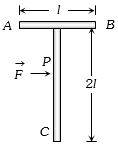
A $T$ shaped object with dimensions shown in the figure, is lying a smooth floor. A force $'\vec F'$ is applied at the point $P$ parallel to $AB,$ such that the object has only the translational motion without rotation. Find the location of $P$ with respect to $C$
  • $\frac{4l}{3}$
  • B
    $l$
  • C
    $\frac{2l}{3}$
  • D
    $\frac{3l}{2}$

Answer

Correct option: A.
$\frac{4l}{3}$
a
For translatory motion the force should be applied

on the centre of mass of the body. So we have to

calculate the location of centre of mass of $\mathrm{‘T’}$

shaped object.

Let mass of rod $\mathrm{AB}$ in $\mathrm{m}$ so the mass of $\mathrm{rod} \mathrm{CD}$

will be $2 \mathrm{m}$

Let $y_{1}$ is the centre of mass of rod $A B$ and $y_{2}$ is

the centre of mass of rod $CD.$ We can consider

that whole mass of the rod is placed at their respect

at their respective centre of mass i.e.. mass $\mathrm{m}$ is

placed at $y_{1}$ and mass $2 m$ is placed at $y_{2}$

Taking point $C$ at the origin position vector

 of point $y_{1}$ and $y_{2}$ can be written as

$\overrightarrow {{f_1}}  = \ell \hat j,\overrightarrow {{f_2}}  = \ell \hat j.\,\,and\,\,{m_1} = m\,\,and\,\,{m_2} = 2m$

Position vector of centre of mass of the system

${\overrightarrow f _{cm}} = \frac{{{m_1}\overrightarrow {{r_1}}  + {m_2}\overrightarrow {{r_2}} }}{{{m_1} + {m_2}}} = \frac{{{m_2}\ell \hat j + 2m\ell \hat j}}{{m + 2m}} = \frac{{4m\ell \hat j}}{{3m}} = \frac{4}{3}\ell \hat j$

Hence the distance of centre of mass from

$C=\frac{4}{3} \ell$
Need a full question paper?

Generate a complete, print-ready paper with questions like this in minutes — across 16+ boards, with answer keys.

Start Generating Free

Similar questions

The fact that the conductance of some metals rises to infinity at some temperature below a few Kelvin is called
At zero Kelvin a piece of germanium
Electric field strength due to a point charge of $5\,\mu C$ at a distance of $80\, cm$ from the charge is
A light ray is incident by grazing one of the face of a prism and after refraction ray does not emerge out, what should be the angle of prism while critical angle is $C$
$A$ child with mass $m$ is standing at the edge of a disc with moment of inertia $I$, radius $R$, and initial angular velocity $\omega$ . See figure given below. The child jumps off the edge of the disc with tangential velocity $v$ with respect to the ground. The new angular velocity of the disc is
Resolving power of a microscope depends upon
The resistance of $10\, metre$ long potentiometer wire is $1\,ohm/meter$. A cell of $e.m.f.$ $2.2\, volts$ and a high resistance box are connected in series to this wire. The value of resistance taken from resistance box for getting potential gradient of $2.2\, millivolt/metre$ will be ............... $\Omega $
In optical bench experiment index error is $+1\ cm$ and $-1\ cm$ , between object needle and lens, lens and image needle respectively. Observed values of $u$ and $v$ are $9\ cm$ and $17\ cm$ . Focal length of lens is .....$cm$
Given below are two statements. One is labelled as Assertion (A) and the other is labelled as Reason (R).
Assertion (A) : Knowing initial position $\mathrm{x}_{0}$ and initial momentum $\mathrm{p}_{0}$ is enough to determine the position and momentum at any time t for a simple harmonic motion with a given angular frequency $\omega$.
Reason (R) : The amplitude and phase can be expressed in terms of $\mathrm{x}_{0}$ an $\mathrm{p}_{0}$.
In the light of the above statements, choose the correct answer from the options given below :
An electron is moving in the north direction. It experiences a force in vertically upward direction. The magnetic field at the position of the electron is in the direction of