MCQ
A technician has only two resistance coils. By using them singly, in series or in parallel, he is able to obtain the resistance $3,4,12$ and $16 \,ohms$. The resistance of the two coils are ........... $ohms$
  • A
    $6$ and $10$
  • $4$ and $12$
  • C
    $7$ and $9$
  • D
    $4$ and $16$

Answer

Correct option: B.
$4$ and $12$
b
(b)

$\frac{R_1 R_2}{R_1+R_2}=3$

$R_1+R_2=16$

$R_1 R_2=48$

$R_1\left(16-R_1\right)=48$

$R_1^2-16 R_1+48=0$

$R_1=4,12$

Need a full question paper?

Generate a complete, print-ready paper with questions like this in minutes — across 16+ boards, with answer keys.

Start Generating Free

Similar questions

A large glass slab $(\mu=5 / 3)$ of thickness $8 \mathrm{~cm}$ is placed over a point source of light on a plane surface. It is seen that light emerges out of the top surface of the slab from a circular area of radius $\mathrm{Rcm}$. What is the value of $\mathrm{R}$ ?
Bohrs atomic model assumes:
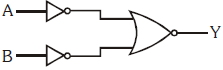
For the logic circuit shown, the truth table is :
The ratio of the de-Broglie wavelengths of proton and electron having same kinetic energy:

(Assume $m_p=m_e \times 1849$ )

The width of one of the two slits in a Young's double slit experiment is three times the other slit. If the amplitude of the light coming from a slit is proportional to the slit-width, the ratio of minimum to maximum intensity in the interference pattern is $x: 4$ where $x$ is ..... .
Lenz's law gives
If the ionisation potential of helium atom is $24.6\, volt,$ the energy required to ionise it will be
The electric field at the point associated with a light wave is given by

$E=200\left[\sin \left(6 \times 10^{15}\right) t+\sin \left(9 \times 10^{15}\right) t\right] \,Vm ^{-1}$

Given : $h=4.14 \times 10^{-15} \,eVs$

If this light falls on a metal surface having a work function of $2.50 \,eV$, the maximum kinetic energy of the photoelectrons will be ........... $eV$

A point charge $q_1=4 q_0$ is placed at origin. Another point charge $q_2=-q_0$ is placed at $x =12\,cm$. Charge of proton is $q_0$. The proton is placed on $x$-axis so that the electrostatic force on the proton in zero. In this situation, the position of the proton from the origin is $..........cm$.
An $e.m.f$. of $12$ $volts$ is induced in a given coil when the current in it changes at the rate of $48$ $amperes/ minute$. The self inductance of the coil is.....$henry$