MCQ
A thermo-dynamical system is changed from state $\left(P_1, V_1\right)$ to $\left(P_2, V_2\right)$ by two different process. The quantity which will remain same will be
  • A
    $\Delta Q$
  • B
    $\Delta W$
  • C
    $\Delta Q+\Delta W$
  • $\Delta Q-\Delta W$

Answer

Correct option: D.
$\Delta Q-\Delta W$
(d) Change in internal energy does not depend upon path so $\Delta U=\Delta Q-\Delta W$ remain constant.

Need a full question paper?

Generate a complete, print-ready paper with questions like this in minutes — across 16+ boards, with answer keys.
Start Generating Free

Similar questions

In an experiment, the following observation's were recorded : $L=$ $2.820 m , M=3.00 kg , l =0.087 cm$, Diameter $D=0.041 cm$Taking $g=9.81 m / s ^2$ using the formula , $\gamma=\frac{4 M g L}{\pi D^2 l}$, the maximum permissible error in $Y$ is
In an ac circuit, the r.m.s. value of current, $l$ is related to the peak current, $l$ by the relation
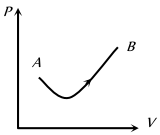
Consider a process shown in the figure. During this process the work done by the system

Image

A steady current flows in a metallic conductor of non$-$uniform crosssection. The quantity$/$ quantities constant along the length of the conductor is$/$are
light waves can be polarised as they are
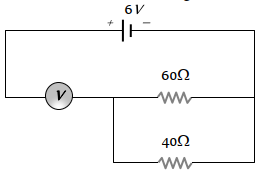
The measurement of voltmeter in the following circuit is

Image

A light pointer fixed to one prong of a tuning fork touches a vertical plate. The fork is set vibrating and the plate is allowed to fall freely. If eight oscillations are counted when the plate falls through $10 \mathrm{~cm}$, the frequency of the tuning fork is
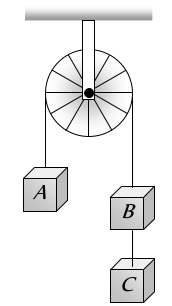
Three equal weights $A, B$ and $C$ of mass $2 kg$ each are hanging on a string passing over a fixed frictionless pulley as shown in the figure The tension in the string connecting weights $B$ and $C$ is
If two metallic plates of equal thicknesses and thermal conductivities $K_1$ and $K_2$ are put together face to face and a common plate is constructed, then the equivalent thermal conductivity of this plate will be
Image
A force $\vec{F}=6 \hat{i}+2 \hat{j}-3 \hat{k}$ acts on a particle and produces a displacement of $\vec{s}=2 \hat{i}-3 \hat{j}+x \hat{k}$. If the work done is zero, the value of $x$ is