A thick rope of density $\rho$ and length $L$ is hung from a rigid support. The Young's modulus of the material of rope is $Y$. The increase in length of the rope due to its own weight is
Easy
Download our app for free and get started
(b)
$\Delta \ell=\frac{ F ( L / 2)}{ AY }=\frac{( AL \rho g )( L / 2)}{ AY }$
$=\left(\frac{1}{2}\right) \rho g L ^2 / Y$

Download our appand get started for free
Experience the future of education. Simply download our apps or reach out to us for more information. Let's shape the future of learning together!No signup needed.*
Similar Questions
- 1Join details of Column$-II$ with given information in Column$-I$ appropriatelyView Solution
Column $-I$ Column $-II$ $(a)$ Stress is proportional to strain.
$(i)$ Elastic limit $(b)$ When the load of the wire is removed, the body does regain its original dimension. $(ii)$ Limit of pro-portionality $(iii)$ Plastic deformation - 2View SolutionIf the density of the material increases, the value of Young's modulus
- 3A wire suspended vertically from one of its ends is stretched by attaching a weight of $200\ N$ to the lower end. The weight stretches the wire by $1\ mm$. Then the elastic energy stored in the wire ......... $J$View Solution
- 4Which of the following curve represents the correctly distribution of elongation $(y)$ along heavy rod under its own weight $L \rightarrow$ length of rod, $x \rightarrow$ distance of point from lower end?View Solution
- 5The Young's modulus of a wire is $Y.$ If the energy per unit volume is $E$, then the strain will beView Solution
- 6The bulk moduli of ethanol, mercury and water are given as $0.9, 25$ and $2 .2$ respectively in units of $10^9\, Nm^{-2}$ . For a given value of pressure, the fractional compression in volume is $\frac{{\Delta V}}{V}$. Which of the following statements about $\frac{{\Delta V}}{V}$ for these three liquids is correct ?View Solution
- 7$1\, m^3$ water is brought inside the lake upto $200$ metres depth from the surface of the lake. What will be change in the volume when the bulk modulus of elastically of water is $22000$ atmosphere? (density of water is $1\times10^3\, kg/m^3$ atmosphere pressure $= 10^5\, N/m^2$ and $g = 10\, m/s^2$)View Solution
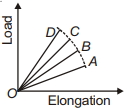
- 8View SolutionThe load versus elongation graph for four wires of same length and the same material is shown in figure. The thinnest wire is represented by line
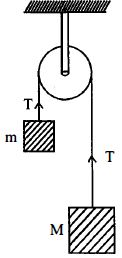
- 9Two blocks of masses $m$ and $M$ are connected by means of a metal wire of cross-sectional area $A$ passing over a frictionless fixed pulley as shown in the figure. The system is then released. If $M = 2\, m$, then the stress produced in the wire isView Solution
- 10Force constant of a spring $(K)$ is synonymous toView Solution