A thick rope of density $\rho$ and length $L$ is hung from a rigid support. The Young's modulus of the material of rope is $Y$. The increase in length of the rope due to its own weight is
Easy


Download our appand get started for free
Experience the future of education. Simply download our apps or reach out to us for more information. Let's shape the future of learning together!No signup needed.*
Similar Questions
- 1The bulk modulus of rubber is $9.1 \times 10^8\,N/m^2$. To what depth a rubber ball be taken in a lake so that its volume is decreased by $0.1\%$ ? ....... $m$View Solution
- 2The increase in length is $l$ of a wire of length $L$ by the longitudinal stress. Then the stress is proportional toView Solution
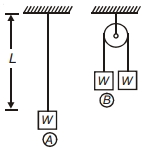
- 3If in case $A$, elongation in wire of length $L$ is $l$, then for same wire elongation in case $B$ will be ......View Solution
- 4Four identical hollow cylindrical columns of mild steel support a big structure of mass $50 \times 10^{3} {kg}$, The inner and outer radii of each column are $50\; {cm}$ and $100 \;{cm}$ respectively. Assuming uniform local distribution, calculate the compression strain of each column. [Use $\left.{Y}=2.0 \times 10^{11} \;{Pa}, {g}=9.8\; {m} / {s}^{2}\right]$View Solution
- 5An increases in pressure required to decreases the $200\,litres$ volume of a liquid by $0.004\%$ in container is ............ $kPa$ (Bulk modulus of the liquid $= 2100\,MPa$ )View Solution
- 6View SolutionThe elastic limit for a gas
- 7The Young's modulus of a rubber string $8\, cm$ long and density $1.5\,kg/{m^3}$ is $5 \times {10^8}\,N/{m^2}$, is suspended on the ceiling in a room. The increase in length due to its own weight will beView Solution
- 8The ratio of two specific heats of gas ${C_p}/{C_v}$ for argon is $1.6$ and for hydrogen is $1.4$. Adiabatic elasticity of argon at pressure $P$ is $E.$ Adiabatic elasticity of hydrogen will also be equal to $E$ at the pressureView Solution
- 9A uniform metal rod of $2\,\,mm^2$ cross section fixed between two walls is heated from $0\,^oC$ to $20\,^oC$ . The coefficient of linear expansion of rod is $12\,\,\times\,\,10^{-6}\,/^oC$ . Its Young's modulus of elasticity is $10^{11}\,\,N/m^2$ . The energy stored per unit volume of rod will be ....... $J/m^3$View Solution
- 10A material has Poisson's ratio $0.5$. If a uniform rod of it suffers a longitudinal strain of $3 \times 10^{-3}$, what will be percentage increase in volume is .......... $\%$View Solution