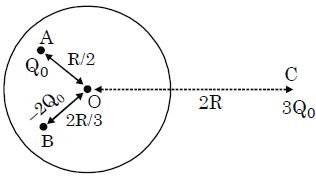
A thin conducting spherical shell (center at $O$ ) having charge $Q_0$ , radius $R$ and three point charges $Q_0$ , $-2Q_0$ , $3Q_0$ are also kept at point $A$ , $B$ and $C$ respectively as shown. Find the potential at any point on the conducting shell. (Potential at infinity is assumed to be zero)
Medium
Download our app for free and get started
Charge on outer surface of shell is
$Q_{0}+Q_{0}-2 Q_{0}=0$
So potential at surface $=\frac{\mathrm{K} 3 \mathrm{Q}_{0}}{2 \mathrm{R}}$
Download our app
and get started for free
Experience the future of education. Simply download our apps or reach out to us for more information. Let's shape the future of learning together!No signup needed.*
Two positrons $(e^+)$ and two protons $(p)$ are kept on four corners of a square of side $a$ as shown in figure. The mass of proton is much larger than the mass of positron. Let $q$ denotes the charge on the proton as well as the positron then the kinetic energies of one of the positrons and one of the protons respectively after a very long time will be-
After the switch shown in figure $A$ is closed, there is current $i$ through resistance $R$. Figure $B$ indicates current variation curves $a, b, c$ and $d$ for four sets of values of $R$ and capacitance $C$:
$(i)$ $R_0$ and $C_0$, $(ii)$ $2R_0$ and $C_0$,
$(iii)$ $R_0$ and $2C_0$, $(iv)$ $2R_0$ and $2C_0$.
Which set goes with which curve?
Three capacitors each of capacitance $1\,\mu F$ are connected in parallel. To this combination, a fourth capacitor of capacitance $1\,\mu F$ is connected in series. The resultant capacitance of the system is.......$\mu F$
A point charge is surrounded symmetrically by six identical charges at distance $r$ as shown in the figure. How much work is done by the forces of electrostatic repulsion when the point charge $q$ at the centre is removed at infinity
Consider the configuration of a system of four charges each of value $+q$ . The work done by external agent in changing the configuration of the system from figure $(1)$ to figure $(2)$ is
Two identical parallel plate capacitors of capacitance $C$ each are connected in series with a battery of emf, $E$ as shown below. If one of the capacitors is now filled with a dielectric of dielectric constant $k$, then the amount of charge which will flow through the battery is (neglect internal resistance of the battery)
A spherical conductor of radius $2\,m$ is charged to a potential of $120\,V.$ It is now placed inside another hollow spherical conductor of radius $6\,m.$ Calculate the potential to which the bigger sphere would be raised......$V$