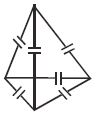
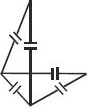
If the capacitance of each capacitor in the tetrahedron shown is $C$ , then effective capacitance of the network across any two junctions is ......$C$
Medium


Download our appand get started for free
Experience the future of education. Simply download our apps or reach out to us for more information. Let's shape the future of learning together!No signup needed.*
Similar Questions
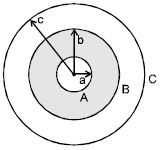
- 1$A$ and $C$ are concentric conducting spherical shells of radius $a$ and $c$ respectively. $A$ is surrounded by a concentric dielectric of inner radius $a$, outer radius $b$ and dielectric constant $k$. If sphere $A$ is given a charge $Q$, the potential at the outer surface of the dielectric is.View Solution
- 2Two capacitors of capacitances $3\,\mu \,F$ and $6\,\mu F$ are charged to a potential of $12 \,V$ each. They are now connected to each other, with the positive plate of each joined to the negative plate of the other. The potential difference across each will be......$volt$View Solution
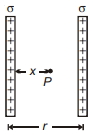
- 3For two infinitely long charged parallel sheets, the electric field at $P$ will beView Solution
- 4View SolutionThe capacitance of a parallel plate condenser does not depend on
- 5In the given circuit, charge $Q_2$ on the $2\ μF$ capacitor changes as $C$ is varied from $1\ μF$ to $3\ μF$. $Q_2$ as a function of '$C$' is given properly by: (figures are drawn schematically and are not to scale)View Solution
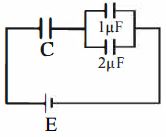
- 6Three capacitors, each of $3\,\mu F$, are provided. These cannot be combined to provide the resultant capacitance of.........$\mu F$View Solution
- 7Two conducting spheres of radii $5\, cm$ and $10\, cm$ are given a charge of $15\,\mu C$ each. After the two spheres are joined by a conducting wire, the charge on the smaller sphere is.......$\mu C$View Solution
- 8The capacitance of a parallel plate capacitor is $C$ when the region between the plate has air. This region is now filled with a dielectric slab of dielectric constant $k$. The capacitor is connected to a cell of $emf$ $E$, and the slab is taken outView Solution
- 9A capacitor is made of a tlat plate of area $A$ and a second plate having a stair-like structure as shown in figure. If the area of each stair is $\frac{A}{3}$ and the height is $\mathrm{d}$, the capacitance of the arrangement is:View Solution
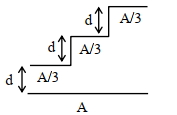
- 10Two metal spheres of radii ${R_1}$ and ${R_2}$ are charged to the same potential. The ratio of charges on the spheres isView Solution