Question
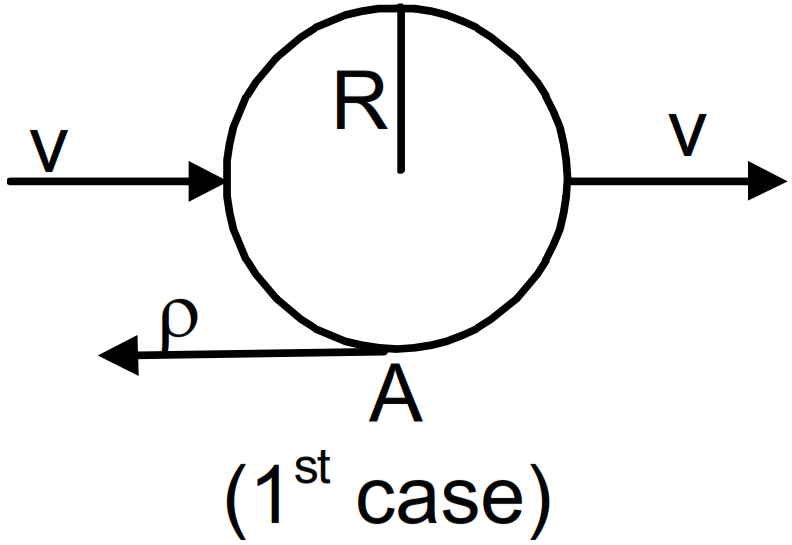
A thin spherical shell lying on a rough horizontal surface is hit by a cue in such a way that the line of action passes through the centre of the shell. As a result, the shell starts moving with a linear speed $v$ without any initial angular velocity. Find the linear speed of the shell after it starts pure rolling on the surface.
Answer


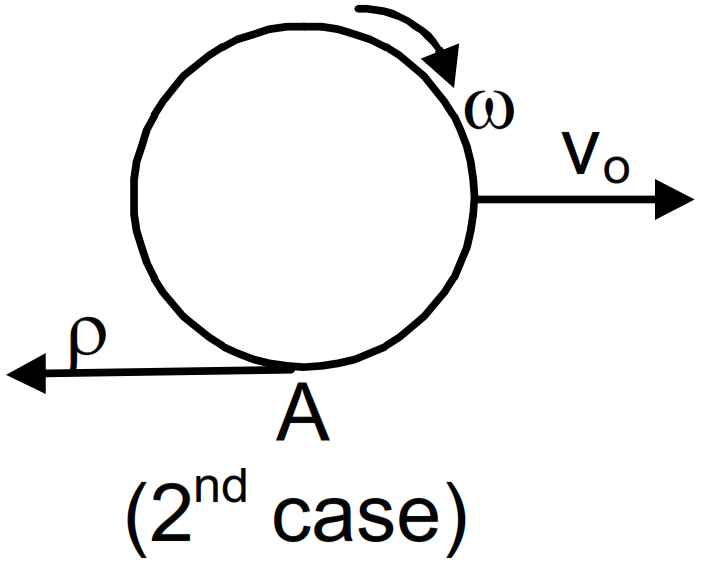
The shell will move with a velocity nearly equal to $v$ due to this motion a frictional force well act in the background direction, for which after some time the shell attains a pure rolling. If we consider moment about $A,$ then it will be zero.

Therefore, Net angular momentum about A before pure rolling $=$ net angular momentum after pure rolling.
Now, angular momentum before pure rolling about $A = M(V \times R)$ and angular momentum after pure rolling:
$\Big(\frac{2}{3}\Big)\text{MR}^2\times\Big(\frac{\text{V}_0}{\text{R}}\Big)+\text{MV}_0\text{R}$
$(V_0 = $velocity after pure rolling$)$
$\Rightarrow\text{MVR}=\frac{2}3{}\text{MV}_0\text{R}+\text{MV}_0\text{R}$
$\Rightarrow\Big(\frac{5}{3}\Big)\text{V}_0=\text{V}$
$\Rightarrow\text{V}_0=\frac{3\text{V}}{5}$

Need a full question paper?

Generate a complete, print-ready paper with questions like this in minutes — across 16+ boards, with answer keys.

Start Generating Free

Similar questions

What is drift velocity? Explain the dependence of drift velocity and electric field on the mobility.
An infinite line charge produces a field of 9 x10⁴ N C-1at a distance of 2 cm. Calculate the linear charge density.
Should the energy of a photon be called its kinetic energy or its internal energy?
Prove that, if an insulated, uncharged conductor is placed near a charged conductor and no other conductors are present, the uncharged body must be intermediate in potential between that of the charged body and that of infinity.
A cylinder containing a gas is lifted from the first floor to the second floor. What is the amount of work done on the gas? What is the amount of work done by the gas? Is the internal energy of the gas increased? Is the temperature of the gas increased?
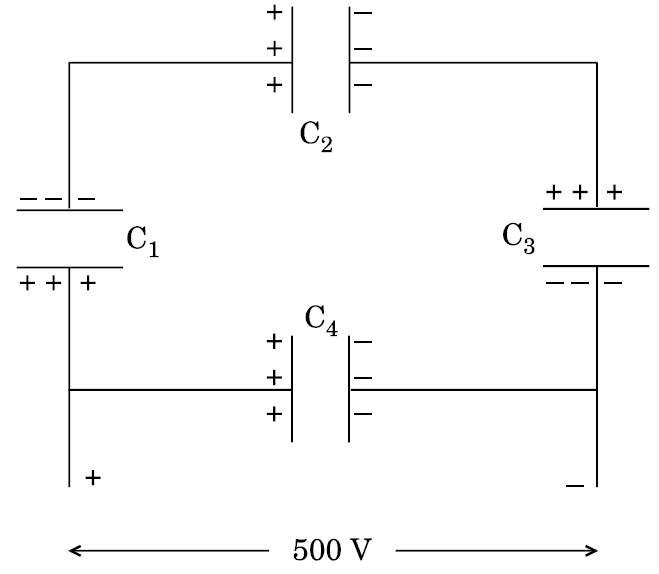
A network of four 10 $\mu$F capacitors is connected to a 500 V supply as shown in the figure. Determine the
  1. equivalent capacitance of the network and.
  2. charge on each capacitor.
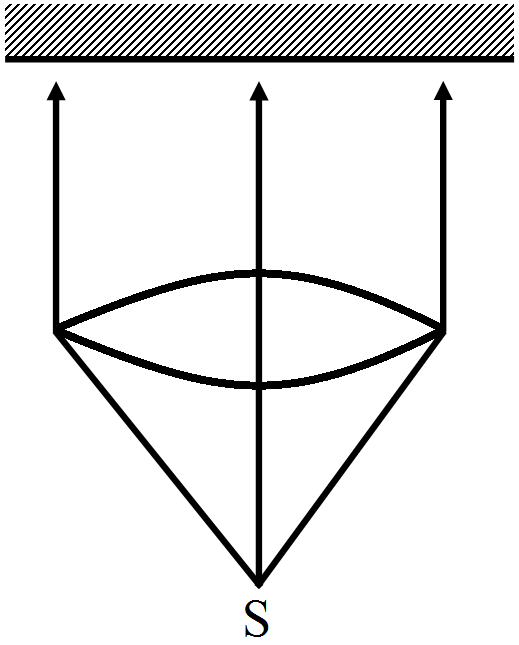
A totally reflecting, small plane mirror placed horizontally faces a parallel beam of light, as shown in the figure. The mass of the mirror is $20g.$ Assume that there is no absorption in the lens and that $30\%$ of the light emitted by the source goes through the lens. Find the power of the source needed to support the weight of the mirror. Take $g = 10\ m/s^2.$
If three helium nuclei combine to form a carbon nucleus, energy is liberated. Why can't helium nuclei combine on their own and minimise the energy?
Obtain expression $\vec{J}=\sigma \vec{E}$ of Ohm's law on the basis of drift velocity.
A plate of area $10\ cm^2$ is to be electroplated with copper $($density $9000\ kg/m^3)$ to a thickness of $10$ micrometres on both sides, using a cell of $12V$. Calculate the energy spent by the cell in the process of deposition. If this energy is used to heat $100g$ of water, calculate the rise in the temperature of the water. $\ce{ECE}$ of copper $= 3 \times 10^{-7}kg C^1 $ and specific heat capacity of water $= 4200Jkg^1.$