Question
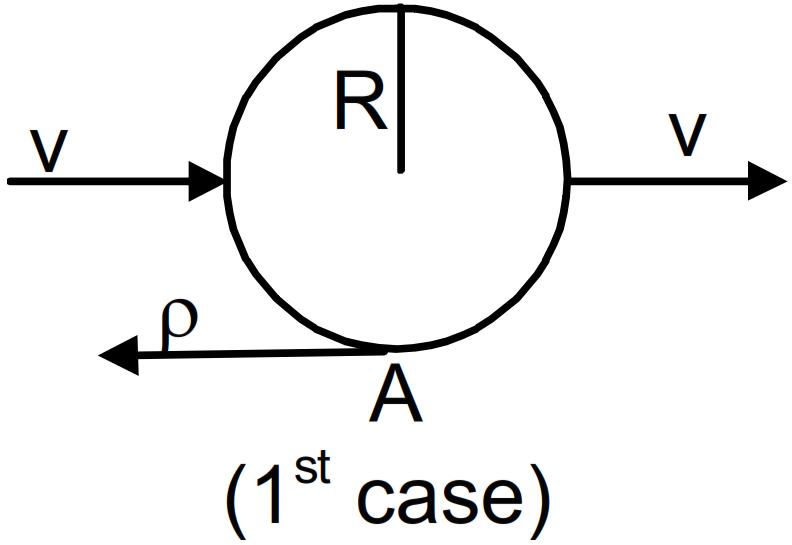
A thin spherical shell lying on a rough horizontal surface is hit by a cue in such a way that the line of action passes through the centre of the shell. As a result, the shell starts moving with a linear speed v without any initial angular velocity. Find the linear speed of the shell after it starts pure rolling on the surface.

Answer


The shell will move with a velocity nearly equal to v due to this motion a frictional force well act in the background direction, for which after some time the shell attains a pure rolling. If we consider moment about A, then it will be zero.
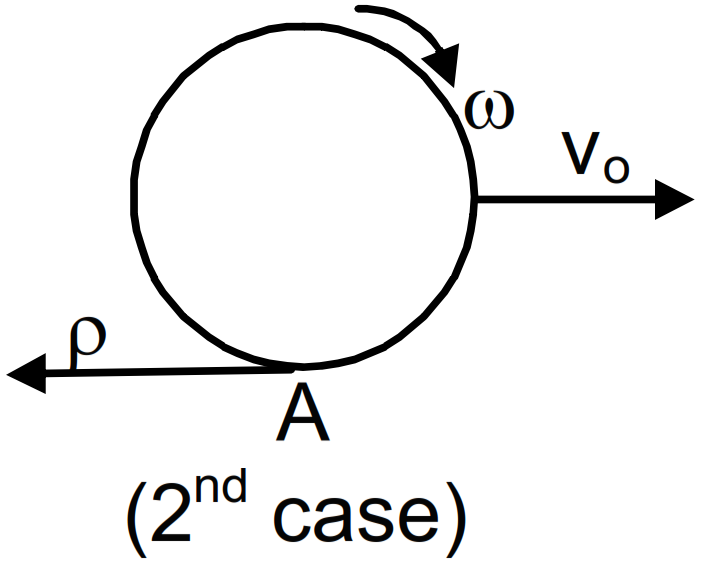
Therefore, Net angular momentum about A before pure rolling = net angular momentum after pure rolling.

Now, angular momentum before pure rolling about A = M(V × R) and angular momentum after pure rolling:

$\Big(\frac{2}{3}\Big)\text{MR}^2\times\Big(\frac{\text{V}_0}{\text{R}}\Big)+\text{MV}_0\text{R}$

(V0 = velocity after pure rolling)

$\Rightarrow\text{MVR}=\frac{2}3{}\text{MV}_0\text{R}+\text{MV}_0\text{R}$

$\Rightarrow\Big(\frac{5}{3}\Big)\text{V}_0=\text{V}$

$\Rightarrow\text{V}_0=\frac{3\text{V}}{5}$

Need a full question paper?

Generate a complete, print-ready paper with questions like this in minutes — across 16+ boards, with answer keys.

Start Generating Free

Similar questions

A car starting from rest, accelerates at the rate f through a distances, then continues at constant speed for sometimet and then decelerate at the rate $\frac{\text{f}}{2}$ to come to rest. If the total distance is 5s, then prove that $\text{s}=\frac{1}{2}\text{ft}^2.$
A cylinder of length 20cm and radius 10cm is rotating about its central axis at an angular speed of 100rad/s. What tangential force will stop the cylinder at a uniform rate in 10 seconds? The moment of inertia of the cylinder about its axis of rotation is 0.8kgm2.
A black body at 2000K emits maximum energy at a wavelength of $1.56\mu\text{m}.$ At what temperature will it emit maximum energy at a wavelength of $1.8\mu\text{m}\ ?$
Find the moment of inertia of a uniform square plate of mass m and edge a about one of its diagonals.
The wheel of a car is rotating at a speed of 20 revolutions/second. If due to acceleration its rotation speed becomes 75 revolutions/second in 10 seconds, then find the angular acceleration and angular displacement after this time
A child stands at the centre of a turntable with his two arms outstretched. The turntable is set rotating with an angular speed of 40rev/min. How much is the angular speed of the child if he folds his hands back and thereby reduces his moment of inertia to 2/5 times the initial value? Assume that the turntable rotates without friction.
Earth can be thought of as a sphere of radius 6400km. Any object (or a person) is performing circular motion around the axis of earth due to earth’s rotation (period 1 day). What is acceleration of object on the surface of the earth (at equator) towards its centre? what is it at latitude $\theta?$ How does these accelerations compare with g = 9.8m/ s2?
What is the pressure inside the drop of mercury of radius 3.00 mm at room temperature? Surface tension of mercury at that temperature (20 °C) is $4.65 \times 10^{-1} Nm ^{-1}$. The atmospheric pressure is 1.01 $\times 10^5 Pa$. Also give the excess pressure inside the drop.
A passenger arriving in a new town wishes to go from the station to a hotel located 10 km away on a straight road from the station. A dishonest cabman takes him along a circuitous path 23 km long and reaches the hotel in 28 min. What is (a) the average speed of the taxi, (b) the magnitude of average velocity? Are the two equal?
Why are the magnification properties of microscopes and telescopes defined in terms of the ratio of angles and not in terms of the ratio of sizes of objects and images?