Question
A thin spherical shell of radius R lying on a rough horizontal surface is hit sharply and horizontally by a cue. Where should it be hit so that the shell does not slip on the surface?
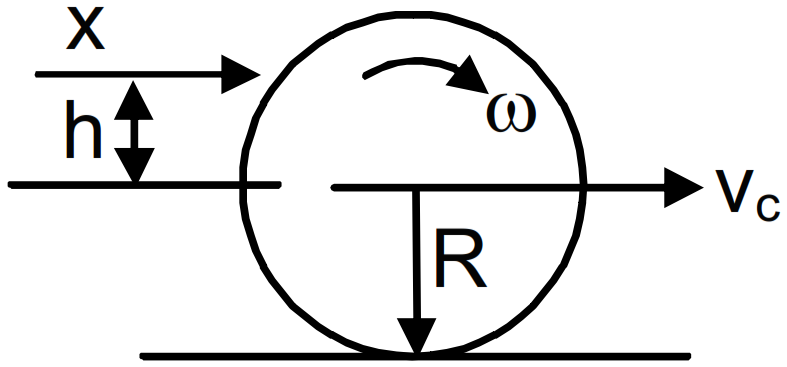
Let the cue strikes at a height ‘h’ above the centre, for pure rolling, $\text{V}_{\text{c}}=\text{R}_{\omega}$
Applying law of conservation of angular momentum at a point A,
$\text{mv}_{\text{c}}\text{h}-\ell\omega=0$
$\text{mv}_{\text{c}}\text{h}=\frac{2}{3}\text{mR}^2\times\Big(\frac{\text{v}_{\text{c}}}{\text{R}}\Big)$
$\text{h}=\frac{2\text{R}}{3}$
Generate a complete, print-ready paper with questions like this in minutes — across 16+ boards, with answer keys.
Time period of a particle in SHM depends on the force constant k and mass m of the particle: $\text{T}=2\pi\sqrt{\frac{\text{m}}{\text{k}}}.$ A simple pendulum executes SHM approximately. Why then is the time period of a pendulum independent of the mass of the pendulum?