Questions

M.C.Q (1 Marks)

Take a timed test

12 questions · self-marked practice — reveal the answer and mark yourself.

MCQ 11 Mark
Satellites orbiting the earth have a finite life and sometimes debris of satellites fall to the earth. This is because,
  • A
    of viscous forces causing the speed of the satellite and hence height to gradually decrease.
  • B
    the solar cells and batteries in satellites run out.
  • C
    of collisions with other satellites.
  • D
    the laws of gravitation predict a trajectory spiralling inwards.
Answer
(d) the laws of gravitation predict a trajectory spiralling inwards.
Explanation: Due to the viscous atmosphere, friction force due to the atmosphere acts on the satellite which reduces its orbital speed and hence the energy of revolution around a planet. Due to the decrease in the energy of the satellite, its height gradually decreases.
View full question & answer
MCQ 21 Mark
The phase difference between two waves, represented by
$
\begin{aligned}
& y_1=10^{-6} \sin \left[100 t+\left(\frac{x}{50}\right)+0.5\right] m \\
& y_2=10^{-6} \cos \left[100 t+\left(\frac{x}{50}\right)\right] m
\end{aligned}
$
where x is expressed in metres and $t$ is expressed in seconds, is approximately
  • A
    1.07 rad
  • B
    1.5 rad
  • C
    0.5 rad
  • D
    2.07 rad
Answer
1.07 rad
$
\begin{aligned}
& \text { Explanation: } y_1=10^{-6} \sin \left[100 t+\left(\frac{x}{50}\right)+0.5\right] m \\
& y_2=10^{-6} \cos \left[100 t+\left(\frac{x}{50}\right)\right] m \\
& =10^{-6} \sin \left[100 t+\left(\frac{x}{50}\right)+\left(\frac{\pi}{2}\right)\right] \\
& \Delta \phi=\frac{\pi}{2}-0.05=\frac{3.14}{2}-0.5=1.57-0.5 \\
& =1.07 rad
\end{aligned}
$
View full question & answer
MCQ 31 Mark
Consider a spacecraft in an elliptical orbit around the earth. At the low point, or perigee, of its orbit, it is 400 km above the earth's surface; at the high point, or apogee, it is 4000 km above the earth's surface. Using conservation of energy, find the speed at perigee and the speed at apogee. It is necessary to have the spacecraft escape from the earth completely.
  • A
    $9840 m / sec$ (perigee), $9760 m / sec$ (apogee)
  • B
    $7840 m / sec$ (perigee), $5760 m / sec$ (apogee)
  • C
    $10840 m / sec$ (perigee), $8760 m / sec$ (apogee)
  • D
    $8840 m / sec$ (perigee), $6760 m / sec$ (apogee)
Answer
(a) $10840 m / sec$ (perigee), $8760 m / sec$ (apogee)
Explanation: To escape Earth, we need total energy of zero.
$
\text { ( } E_{\text {final }}=0 \text { because } U \longrightarrow 0 \text { as } R \longrightarrow \infty \text { and } K \longrightarrow 0 \text { as } v=0 \text { at } R \longrightarrow \infty \text { ) }
$
So,
$
K_{p}+U_{p}=0
$
Looking for the new velocity at perigee;
$
\begin{aligned}
& \frac{1}{2} m v_{p, \text { escapc }}^2=\frac{G M m}{R_p} \\
& v_{p, \text { escape }}=\sqrt{\frac{2 G M}{R_p}}=\sqrt{\frac{2 \times 6.67 \times 10^{-11} \times 5.97 \times 10^{24}}{6.78 \times 10^6}} \\
& =1.084 \times 10^4 m / sec=10840 m / sec
\end{aligned}
$
The similar calculation at apogee gives
\begin{array}{l}
v_{\text {d, scaps }}=\sqrt{\frac{2 G GM}{R_a}}=\sqrt{\frac{2 \times 6.67 \times 10^{-11} \times 5.97 \times 10^{24}}{10.38 \times 10^6}} \\
=8.76 \times 10^3 m / sec=8760 m / sec
\end{array}
View full question & answer
MCQ 41 Mark
According to Newton, the viscous force acting between liquid layers of area A and velocity gradient $\frac{\Delta v}{\Delta x}$ is given by $F=-\eta A \frac{\Delta v}{\Delta x}$, where $\eta$ is constant called coefficient of viscosity. The dimensional formula of $\eta$ is
  • A
    $\left[ ML ^{-2} T^{-2}\right]$
  • B
    $\left[ M ^0 L^0 T^0\right]$
  • C
    $\left[ ML ^{-1} T^{-1}\right]$
  • D
    $\left[ ML ^2 T^{-2}\right]$
View full question & answer
MCQ 51 Mark
An open tank filled with water (depsity $\rho$ ) has a narrow hole at a depth of h below the water surface. The velocity of water flowing out is
  • A
    2 gh
  • B
    $\sqrt{2 g h}$
  • C
    $h \rho g$
  • D
    gh
Answer
(b) $\sqrt{2 g h}$
Explanation: Velocity of efflux, $v =\sqrt{2 g h}$
View full question & answer
MCQ 61 Mark
A thin uniform rod of length $2 l$ and mass M is acted upon a constant torque. The angular velocity changes from zero to $\omega$ in time $t$. The value of torque is:
  • A
    $\frac{M l^2 \omega}{3 t}$
  • B
    $\frac{2 M l^2 \omega}{3 t}$
  • C
    $\frac{M l^2 \omega}{12 t}$
  • D
    $\frac{M l^2 \omega}{t}$
Answer
(a) $\frac{M 2^2 \omega}{3 t}$
Explanation:
As Torque $(\tau)$ is equal to the product of Moment of Inertia (I) and Angular acceleration ( $\alpha$ )
$
\begin{aligned}
\tau & =I \alpha \\
\tau & =I \frac{\Delta \omega}{\Delta t} \\
\tau & =\left[\frac{M(2 l)^2}{12}\right]\left[\frac{\omega}{t}\right] \\
\tau & =\frac{M l^2 \omega}{3 t}
\end{aligned}
$
View full question & answer
MCQ 71 Mark
A spherical black body with a radius of 12 cm radiates 450 watt power at 500 K. If the radius were halved and the temperature doubled, the power radiated in watt would be
  • A
    225
  • B
    450
  • C
    1800
  • D
    1000
Answer
(c) 1800
Explanation: Power radiated, $P =\sigma A T^4$
$\begin{aligned} & \therefore P^{\prime}=\sigma\left(\frac{A}{4}\right)(2 T)^4\left[A \propto r ^2\right] \\ & =4 P =4 \times 450 W=1800 W\end{aligned}$
View full question & answer
MCQ 81 Mark
Two closed organ pipes, when sounded simultaneously gave 4 beats per sec. If longer pipe has a length of 1 m , then length of shorter pipe is $( v =300 m / s )$
  • A
    80 cm
  • B
    94.9 cm
  • C
    90 cm
  • D
    185.5 cm
Answer
(b) 94.9 cm
Explanation: $\nu=\frac{v}{4 L}=\frac{300}{4 \times 1}=75 Hz$
For shorter pipe,
$
\begin{aligned}
& \nu+4=\frac{300}{4 L^{\prime}} \\
& \text { or } 75+4=\frac{300}{4 L} \\
& L^{\prime}=\frac{300}{4 \times 79} m=94.9 cm
\end{aligned}
$
View full question & answer
MCQ 91 Mark
If a gymnast sitting on a rotating stool with his arms outstretched, suddenly lowers his hands:
  • A
    The angular velocity decreases
  • B
    His moment of inertia decreases
  • C
    The angular momentum increases
  • D
    The angular velocity stays constant
Answer
(b) His moment of inertia decreases
Explanation: When gymnast lowers his hand the distance of the mass from rotational axis decrease. Hence his moment of inertia decreases and angular velocity increases to conserve angular momentum.
View full question & answer
MCQ 101 Mark
At critical temperature, the surface tension of a liquid
  • A
    is zero
  • B
    is infinity
  • C
    cannot be determined
  • D
    is same as that any other temperature
Answer
(a) is zero
Explanation: At the critical temperature, the surface tension of a liquid becomes zero.
View full question & answer
MCQ 111 Mark
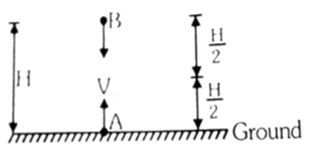
A body $A$ is thrown up vertically from the ground with a velocity $v _0$ and another body $B$ is simultaneously dropped from a height H . They meet at a height $\frac{H}{2}$, if $v _0$ is equal to:
  • A
    $\sqrt{2 g H}$
  • B
    $\sqrt{\frac{2 g}{H}}$
  • C
    $\sqrt{g H}$
  • D
    $\frac{1}{2} \sqrt{g H}$
Answer
$\sqrt{g H}$
Explanation:
Let the two bodies A and B respectively meet at a time, at a height $\frac{H}{2}$ ground.
Image
Using $S = ut +\frac{1}{2} a t^2$
For a body $A , u = V _0, a =- g , S =\frac{H}{2}$
$
\therefore \frac{H}{2}=v_0 t-\frac{1}{2} g t^2\ldots(i)
$
For a body B, u $=0, a =+\frac{g}{g}, S=\frac{H}{2}$
$
\therefore \frac{H}{2}=\frac{1}{2} gt^2\ldots(ii)
$
Equating equation (i) and (ii) we get
$V_0 t-\frac{1}{2} g t^2=\frac{1}{2} g t^2$
$
V_0 t=gt^2 \text { or } t=\frac{V_0}{g}
$
Substituting the value of $t$ is equation (i), we get
$
\begin{aligned}
& \frac{H}{2}=V_0 \times\left(\frac{V_0}{g}\right)-\frac{1}{2} g\left(\frac{V_0}{g}\right)^2=\frac{V_0^2}{V_0}-\frac{1}{2} \frac{V_0^2}{g} \\
& \frac{H}{2}=\frac{1}{2} \frac{V_0^2}{g} \text { or } v_0^2=gH \\
& V_0=\sqrt{g H}
\end{aligned}
$
View full question & answer
MCQ 121 Mark
A body is moving forwards and backward. Change in frequency observed of source is 2%. What is velocity of the body? (Speed of sound is 300 m/s)
  • A
    3 m/s
  • B
    2.5 m/s
  • C
    2 m/s
  • D
    6 m/s
Answer
$3 m / s$
Explanation: When the source is moving forward towards the observer, the apparent frequency is $f_1=\frac{v}{v-v_{ s }} \times f$
When source moves backwards $f_2=\frac{v}{v+v_s} \times f$
$
f_2-f_1=f v\left[\frac{1}{v+v_s}-\frac{1}{v-v_s}\right]=f v\left[\frac{-2 v_s}{v^2-v_s^2}\right]
$
As $v_{ s }<< v$, so
$
\begin{aligned}
& \frac{f_2-f_1}{f}=\left|\frac{2 v_s}{v}\right|=\frac{2}{100} \\
& v_s=\frac{v}{100}=\frac{300}{100}=3 m / s
\end{aligned}
$
View full question & answer
M.C.Q (1 Marks) - Physics STD 11 Science Questions - Vidyadip