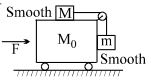
Imagine $a$ situation in which the horizontal surface of block $M_0$ is smooth and its vertical surface is rough with $a$ coefficient of friction $\mu$ Consider a special situation in which both the faces of the block $M_0$ are smooth, as shown in adjoining figure. Mark out the correct statement $(s)$
Diffcult


Download our appand get started for free
Experience the future of education. Simply download our apps or reach out to us for more information. Let's shape the future of learning together!No signup needed.*
Similar Questions
- 1View SolutionA car sometimes overturns while taking a turn. When it overturns, it is
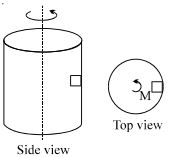
- 2A hollow vertical cylinder of radius $R$ is rotated with angular velocity $\omega$ about an axis through its center. What is the minimum coefficient of static friction necessary to keep the mass $M$ suspended on the inside of the cylinder as it rotates?View Solution
- 3A lift is moving downwards with an acceleration equal to acceleration due to gravity. A body of mass $m$ kept on the floor of the lift is pulled horizontally. If the coefficient of friction is $\,\mu $, then the frictional resistance offered by the body isView Solution
- 4A body is sliding down an inclined plane (angle of inclination $45^o$). If the coefficient of friction is $0.5$ and $g = 9.8\, m/s^2$. then the acceleration of the body downwards in $m/s^2$ isView Solution
- 5A block is kept on an inclined plane of inclination $\theta$ of length l. The velocity of particle at the bottom of inclined is (the coefficient of friction is $\mu$)View Solution
- 6$A$ block of mass $M$ is placed on $a$ horizontal surface and it is tied with an inextensible string to $a$ block of mass, as shown in figure. A block of mass $m_0$ is also placed on $M$ If $\mu < \mu_{min}$ (the minimum friction required to keep the block $m$ stationary), then the downward acceleration of $m$ isView Solution

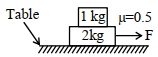
- 7The coefficient of static friction between two blocks is $0.5$ and the table is smooth. The maximum horizontal force that can be applied to move the blocks together is $\ldots \ldots . N$. (take $\left.g=10\, {ms}^{-2}\right)$View Solution
- 8A vehicle is moving with speed $v$ on a curved road of radius $r$. The coefficient of friction between the vehicle and the road is $\mu$. The angle $\theta$ of banking needed is given byView Solution
- 9A car is negotiating a curved road of radius $R$. The road is banked at an angle $\theta .$ The coefficient of friction between the tyres of the car and the road is $\mu _s.$ The maximum safe velocity on this road isView Solution
- 10View SolutionA stone tied to a string is rotated in a circle. If the string is cut, the stone flies away from the circle because