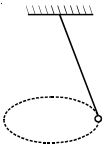
In a conical pendulum, the bob is rotated with different angular velocities and tension in the string is calculated for different values of $\omega$ . Which of them is correct graph between $T$ & $\omega .$
Medium
Download our app for free and get started

Download our appand get started for free
Experience the future of education. Simply download our apps or reach out to us for more information. Let's shape the future of learning together!No signup needed.*
Similar Questions
- 1A heavy box is to dragged along a rough horizontal floor. To do so, person $A$ pushes it at an angle $30^o$ from the horizontal and requires a minimum force $F_A$, while person $B$ pulls the box at an angle $60^o$ from the horizontal and needs minimum force $F_B$. If the coefficient of friction between the box and the floor is $\frac{{\sqrt 3 }}{5}$ , the ratio $\frac{{{F_A}}}{{{F_B}}}$ isView Solution
- 2A $2 \mathrm{~kg}$ brick begins to slide over a surface which is inclined at an angle of $45^{\circ}$ with respect to horizontal axis. The co-efficient of static friction between their surfaces is:View Solution
- 3A uniform rope of length l lies on a table. If the coefficient of friction is $\mu $, then the maximum length ${l_1}$ of the part of this rope which can overhang from the edge of the table without sliding down isView Solution
- 4A car is moving on a horizontal circular road of radius $0.1 \,km$ with constant speed. If coefficient of friction between tyres of car and road is $0.4$, then speed of car may be ......... $m / s$ $\left(g=10 \,m / s ^2\right)$View Solution
- 5A stone of mass $0.25\; kg$ tied to the end of a string is whirled round in a circle of radius $1.5 \;m$ with a speed of $40\; rev./min$ in a hortzontal plane. What is the tenston in the string? What is the maximum speed in $m/s $ with which the stone can be whirled around if the string can withstand a maximum tension of $200\; N ?$View Solution
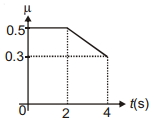
- 6A block is projected with speed $20 \,m / s$ on a rough horizontal surface. The coefficient of friction $(\mu)$ between the surfaces varies with time $(t)$ as shown in figure. The speed of body at the end of $4$ second will be ............ $m / s$ ( $g=$ $10 \,m / s ^2$ )View Solution
- 7View SolutionWhen a cube is in limiting equilibrium on an inclined plane and it is about to topple. The coefficient of friction between cube and plane is:-
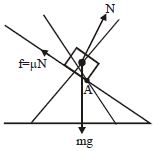
- 8View SolutionWhich of the following is self adjusting in nature?
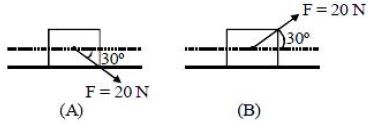
- 9A block of mass $5\, kg$ is $(i)$ pushed in case $(A)$ and $(ii)$ pulled in case $(B)$, by a force $F = 20\, N$, making an angle of $30^o$ with the horizontal, as shown in the figures. The coefficient of friction between the block and floor is $\mu = 0.2$. The difference between the accelerations of the block, in case $(B)$ and case $(A)$ will be $....... ms^{-2}$ .$(g = 10\, ms^{-2})$View Solution
- 10View SolutionA passenger inside a bus moving with uniform speed suddenly finds that a ball at rest, starts moving towards his left. It means that the bus now is