Question
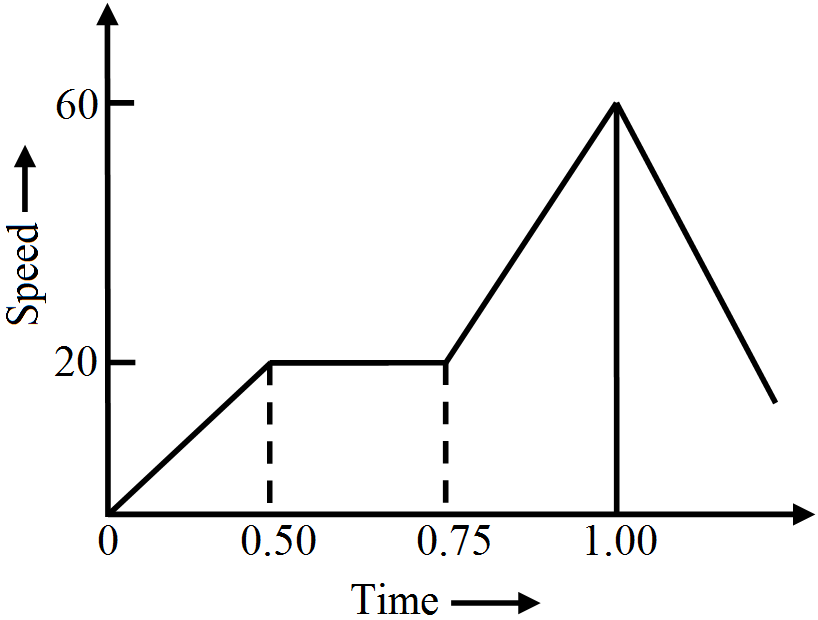
A train moves from one station to another in two hours time. Its speed during the motion is shown in the graph. Determine the maximum acceleration during the journey. Also calculate the distance covered during the time interval from $0.75h$ to $1\ hour$.
Answer

We know that the slope of the velocity-time graph gives acceleration. Change in velocity in this interval ( 0.75 h to 1 hour) $=(60-20) \mathrm{km} / \mathrm{h}^{-1}=40 \mathrm{~km} / \mathrm{h}^{-1} $
$\therefore$ Acceleration in this interval $=\frac{40 \mathrm{~km} / \mathrm{h}^{-1}}{\frac{1}{4} \mathrm{~h}}=160 \mathrm{~km} / \mathrm{h}^{-2}$
Distance covered during the time interval from 0.75 h to $1 \mathrm{~h}=$ Area under the corresponding v - t graph $=\frac{1}{1}(20+60) 0.25=10 \mathrm{~km}$.

Need a full question paper?

Generate a complete, print-ready paper with questions like this in minutes — across 16+ boards, with answer keys.

Start Generating Free

Similar questions

A Carnot's engine whose sink is at a temperature of 300K has an efficiency of 40%. By how much should the temperature of the source be increased so as to increase the efficiency to 60%?
The length and breadth of a rectangular block are 25.2cm and 16.8cm, which have both been measured to an accuracy of 0.1cm. Find the area of the rectangular block.
The magnifying power of a converging lens used as a simple microscope is $\Big(1+\frac{\text{D}}{\text{f}}\Big).$ A compound microscope is a combination of two such converging lenses. Why don't we have magnifying power $\Big(1+\frac{\text{D}}{\text{f}_\text{o}}\Big) \Big(1+\frac{\text{D}}{\text{f}_\text{o}}\Big)?$ In other words, why can the objective not be treated as a simple microscope but the eyepiece can?
The final volume of a system is equal to the initial volume in a certain process. Is the work done by the system necessarily zero? Is it necessarily non-zero.
A constant retarding force of $50N$ is applied to a body of mass $20kg$ moving initially with a speed of $15ms^{-1}$. How long does the body take to stop?
A perfect Carnot engine utilizes an ideal gas. The source temperature is $500K$ and sink temperature is $375K$. If the engine takes $600K$ cal per cycle from the source, compute:
  1. The efficiency of the engine.
  2. Work done per cycle.
  3. Heat rejected to the sink per cycle.
A tank is filled with water up to a height of H meter and there is a hole in it at a height from the bottom. Find the volume of water coming out of that hole and how far from the tank will it fall on the ground?
Find the displacement and distance travelled by a body in 10 seconds, using the v - t graph given below:
Derive a relation for the time taken by a projectile to reach the highest point and the maximum height attained.
On complete combustion a litre of petrol gives off heat equivalent to $3 \times 107J$. In a test drive a car weighing $1200kg$. including the mass of driver, runs $15km$ per litre while moving with a uniform speed on a straight track. Assuming that friction offered by the road surface and air to be uniform, calculate the force of friction acting on the car during the test drive, if the efficiency of the car engine were $0.5$