Question
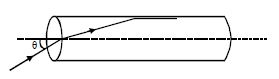
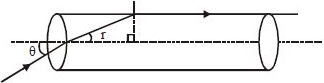
A transparent solid cylindrical rod has a refractive index of $\frac{4}{\sqrt {3}}$ It is surrounded by a medium of refractive index $2$. A light ray is incident at the mid-point of one end of the rod as shown in the figure.

The incident angle $\theta $ for which the light ray grazes along the wall of the rod is
Answer

$\sin \theta=\frac{4}{\sqrt{3}} \sin r$

$\sin (90-r) \times \frac{4}{\sqrt{3}}=\sin 90 \times 2$

$\cos r=\frac{\sqrt{3}}{2}$

$r=30^{\circ}$

$\sin \theta=\frac{4}{\sqrt{3}} \sin 30^{\circ}$

$\sin \theta=\frac{2}{\sqrt{3}}$

$\theta=\sin ^{-1} \frac{2}{\sqrt{3}}$

Need a full question paper?

Generate a complete, print-ready paper with questions like this in minutes — across 16+ boards, with answer keys.

Start Generating Free

Similar questions

The unit of permittivity of free space is
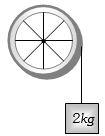
A block of mass $2\,kg$ hangs from the rim of a wheel of radius $0.5\,m$. On releasing from rest the block falls through $5\,m$ height in $2\,s$. The moment of inertia of the wheel will be ...... $kg - {m^2}$
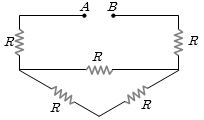
What is the equivalent resistance between $A$ and $B$ in the figure below if $R = 3\,\Omega $
A neutron collides head on with a stationary hydrogen atom in ground state
A $metre$ scale is suspended vertically from a horizontal axis passing through one end of it. Its time period would be ....... $\sec$
Body $A$ of mass $4 \;\mathrm{m}$ moung with speed $u$ collides with another body $B$ of mass $2\; \mathrm{m}$, at rest. The collision is head on and elastic in nature. After the collision the fraction of energy lost by the colliding body $A$ is
A cyclist riding the bicycle at a speed of $14\sqrt 3  ms^{-1}$takes a turn around a circular road of radius  $20\sqrt 3 $ m without skidding. Given $g = 9.8 ms^{-2},$ what is his inclination to the vertical ....... $^o$
The temperature of argon, kept in a vessel, is raised by $1^\circ C$ at a constant volume. The total heat supplied to the gas is a combination of translational and rotational energies. Their respective shares are
A large open tank has two holes in the wall. One is a square hole of side $L$  at a depth $y $ from the top and the other is a circular hole of radius $ R$  at a depth $ 4y $ from the top. When the tank is completely filled with water the quantities of water flowing out per second from both the holes are the same. Then $ R$ is equal to
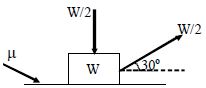
A block of weight $W$ is kept on a rough horizontal surface (friction coefficient $\mu$). Two forces $W/2$ each are applied as shown in the figure. Choose the $CORRECT$ statement :-