A tube closed at one end and containing air is excited. It produces the fundamental note of frequency $512 Hz$. If the same tube is open at both the ends the fundamental frequency that can be produced is .... $Hz$
Easy
Download our app for free and get started
(a) Fundamental frequency of open pipe is double that of the closed pipe.

Download our appand get started for free
Experience the future of education. Simply download our apps or reach out to us for more information. Let's shape the future of learning together!No signup needed.*
Similar Questions
- 1A tuning fork sounded together with a tuning fork of frequency $256$ emits two beats. On loading the tuning fork of frequency $256,$ the number of beats heard are $1$ per second. The frequency of tuning fork isView Solution
- 2Two waves are approaching each other with a velocity of $16 m/s$ and frequency $n.$ The distance between two consecutive nodes isView Solution
- 3The equation of the progressive wave, where $t$ is the time in second, $x$ is the distance in metre is $y=A \cos 240\left(t-\frac{x}{12}\right)$. The phase difference (in $SI$ units) between two positions $0.5 \,m$ apart is ...........View Solution
- 4Two whistles $A$ and $B$ each have a frequency of $500\,\,Hz$. $A$ is stationary and $B$ is moving towards the right (away from $A$) at a speed of $50\,\, m/s$. An observer is between the two whistles moving towards the right with a speed of $25\,\, m/s.$ The velocity of sound in air is $350 \,\,m/s$. Assume there is no wind. Then which of the following statements are true:View Solution
- 5If two waves having amplitudes $2A$ and $A$ and same frequency and velocity, propagate in the same direction in the same phase, the resulting amplitude will beView Solution
- 6Two vibrating strings of the same material but lengths $L$ and $2L$ have radii $2r$ and $r$ respectively. They are stretched under the same tension. Both the strings vibrate in their fundamental modes, the one of length $L$ with frequency $n_1$ and the other with frequency $n_2$. The ratio $n_1/n_2$ is given byView Solution
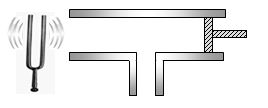
- 7Vibrating tuning fork of frequency $n$ is placed near the open end of a long cylindrical tube. The tube has a side opening and is fitted with a movable reflecting piston. As the piston is moved through $8.75 cm$, the intensity of sound changes from a maximum to minimum. If the speed of sound is $350 \,m/s. $ Then $n$ is .... $Hz$View Solution
- 8A tuning fork of known frequency $256\,Hz$ makes $5$ beats per second with the vibrating string of a guitar. The beat frequency decreases to $2$ beats per second when the tension in the guitar string slightly increased. The frequency of the guitar string before increasing the tension was ..... $Hz$View Solution
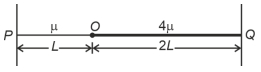
- 9Two uniform strings of mass per unit length $\mu$ and $4 \mu$, and length $L$ and $2 L$, respectively, are joined at point $O$, and tied at two fixed ends $P$ and $Q$, as shown in the figure. The strings are under a uniform tension $T$. If we define the frequency $v_0=\frac{1}{2 L} \sqrt{\frac{T}{\mu}}$, which of the following statement($s$) is(are) correct?View Solution
$(A)$ With a node at $O$, the minimum frequency of vibration of the composite string is $v_0$
$(B)$ With an antinode at $O$, the minimum frequency of vibration of the composite string is $2 v_0$
$(C)$ When the composite string vibrates at the minimum frequency with a node at $O$, it has $6$ nodes, including the end nodes
$(D)$ No vibrational mode with an antinode at $O$ is possible for the composite string
- 10Following statements are given for a stationary waveView Solution
$(a)$ Every particle has a fixed amplitude which is different from the amplitude of its nearest particle.
$(b)$ All the particles cross their mean position at the same time.
$(c)$ All the particles are oscillating with same amplitude.
$(d)$ There is no net transfer of energy across any plane.
$(e)$ There are some particles which are always at rest.
Which of the following is correct