A tuning fork gives $4$ beats with $50\, cm$ length of a sonometer wire if the length of the wire is shortened by $1\, cm$. the no. of beats still the same. The frequency of the fork is -............. $\mathrm{Hz}$
Medium


Download our appand get started for free
Experience the future of education. Simply download our apps or reach out to us for more information. Let's shape the future of learning together!No signup needed.*
Similar Questions
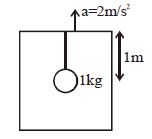
- 1In the figure shown a mass $1\ kg$ is connected to a string of mass per unit length $1.2\ gm/m$ . Length of string is $1\ m$ and its other end is connected to the top of a ceiling which is accelerating up with an acceleration $2\ m/s^2$ . A transverse pulse is produced at the lowest point of string. Time taken by pulse to reach the top of string is .... $s$View Solution
- 2Two tuning forks $A$ and $B$ give $4$ beats per second. The frequency of $A$ is $256 Hz$. On loading $B$ slightly, we get $5$ beats in $2$ seconds. The frequency of $B$ after loading is .... $Hz$View Solution
- 3View SolutionA closed organ pipe and an open organ pipe are tuned to the same fundamental frequency. What is the ratio of lengths
- 4A sound source emits sound waves in a uniform medium. If energy density is $E$ and maximum speed of the particles of the medium is ${v_{\max }}.$The plot between $E$ and ${v_{\max }}$ is best represented byView Solution
- 5A pipe of length $1.5\ m$ closed at one end is filled with gas and resonates in its fundamental mode with a tuning fork. Another open organ pipe of same dimensions filled with air resonates in its fundamental mode with same tuning fork. If experiment is performed at $30\,^oC$ (speed of sound in air is $360\ m/sec$ at $30\,^oC$), the speed of sound at $0\,^oC$ in gas is ...... $m/sec$ (Neglect end correction)View Solution
- 6A string of length $1\, m$ and mass $5\, g$ is fixed at both ends. The tension in the string is $8.0\, N$. The string is set into vibration using an external vibrator of frequency $100\, Hz$. The separation between successive nodes on the string is close to .... $cm$View Solution
- 7An organ pipe $P_1$ closed at one end vibrating in its first overtone. Another pipe $P_2$ open at both ends is vibrating in its third overtone. They are in a resonance with a given tuning fork. The ratio of the length of $P_1$ to that of $P_2$ is :View Solution
- 8The extension in a string, obeying Hooke's law, is $x$. The speed of sound in the stretched string is $v$. If the extension in the string is increased to $1.5x$, the speed of sound will beView Solution
- 9Two interfering waves have the same wavelength, frequency, and amplitude. They are traveling in the same direction but are $90^o$ out of phase. Compared to the individual waves, the resultant wave will have the same.View Solution
- 10A source and listener are both moving towards each other with speed $v/10$, where $v$ is the speed of sound. If the frequency of the note emitted by the source is $f$, the frequency heard by the listener would be nearlyView Solution