Question
A tuning fork of unknown frequency makes 5 beats per second with another tuning fork which can cause a closed organ pipe of length 40cm to vibrate in its fundamental mode. The beat frequency decreases when the first tuning fork is slightly loaded with wax. Find its original frequency. The speed of sound in air is 320m/s.
Answer

Given length of the closed organ pipe, $\text{l}=40\text{cm}=40\times10^{-2}\text{m}$$\text{V}_\text{air}=320$
So, its frequency $\rho=\frac{\text{V}}{4\text{l}}=\frac{320}{4\times40\times10^{-2}}=200\ \text{Hertz}.$ As the tuning fork produces 5 beats with the closed pipe, its frequency must be 195Hz or 205Hz. Given that, as it is loaded its frequency decreases. So, the frequency of tuning fork = 205Hz.

Need a full question paper?

Generate a complete, print-ready paper with questions like this in minutes — across 16+ boards, with answer keys.

Start Generating Free

Similar questions

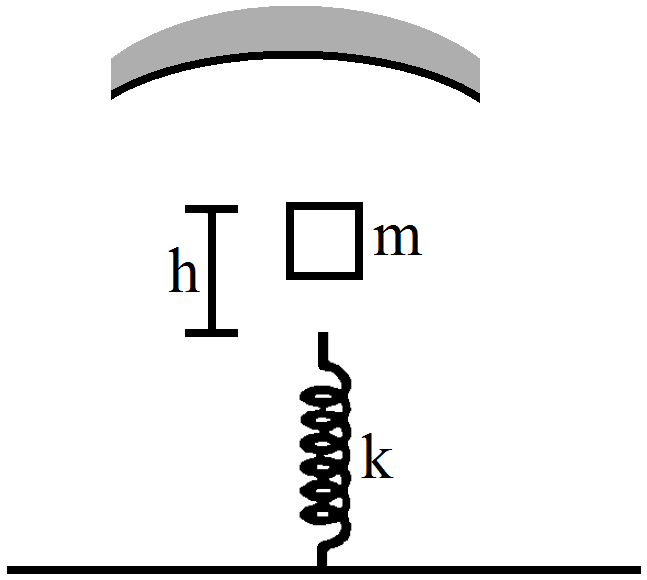
A mass $m = 50g$ is dropped on a vertical spring of spring constant $500\ N/m$ from a height $h = 10\ cm$ as shown in figure. The mass sticks to the spring and executes simple harmonic oscillations after that. A concave mirror of focal length $12\ cm$ facing the mass is fixed with its principal axis coinciding with the line of motion of the mass, its pole being at a distance of $30\ cm$ from the free end of the spring. Find the length in which the image of the mass oscillates.
Consider a solid sphere of radius r and mass m that has a charge q distributed uniformly over its volume. The sphere is rotated about its diameter with an angular speed $\omega.$ Show that the magnetic moment $\mu$ and the angular momentum l of the sphere are related as $\mu=\frac{\text{q}}{2\text{m}}\text{l}.$
A hemispherical portion of the surface of a solid glass sphere $(\mu=1.5)$ of radius r is silvered to make the inner side reflecting. An object is placed on the axis of the hemisphere at a distance 3r from the centre of the sphere. The light from the object is refracted at the unsilvered part, then reflected from the silvered part and again refracted at the unsilvered part. Locate the final image formed.
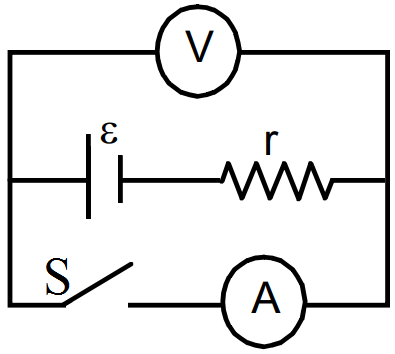
Figure. shows an arrangement to measure the emf $\epsilon$ and internal resistance r of a battery. The voltmeter has a very high resistance and the ammeter also has some resistance. The voltmeter reads 1.52V when the switch S is open. When the switch is closed, the voltmeter reading drops to 1.45V and the ammeter reads 1.0A. Find the emf and the internal resistance of the battery.
It is required to construct a $10\mu\text{F}$ capacitor which can be connected across a 200V battery. Capacitors of capacitance $10\mu\text{F}$ are available but they can withstand only 50V. Design a combination which can yield the desired result.
1 litre of an ideal gas $(\gamma=1.5)$ at $300K$ is suddenly compressed to half its original volume.
  1. Find the ratio of the final pressure to the initial pressure.
  2. If the original pressure is $100kPa$, find the work done by the gas in the process.
  3. What is the change in internal energy?
  4. What is the final temperature?
  5. The gas is now cooled to $300K$ keeping its pressure constant. Calculate the work done during the process.
  6. The gas is now expanded isothermally to achieve its original volume of $1$ litre. Calculate the work done by the gas.
  7. Calculate the total work done in the cycle.
Define resonance. Explain resonant frequency and write characteristics of resonant circuit.
Figure. shows two vessels $A$ and $B$ with rigid walls containing ideal gases. The pressure, temperature and the volume are $p_A, T_A, V$ in the vessel $A$ and $p_B, T_B, V$ in the vessel $B$. The vessels are now connected through a small tube. Show that the pressure $p$ and the temperature $T$ satisfy $\frac{\text{p}}{\text{T}}=\frac{1}{2}\Big(\frac{\text{P}_\text{A}}{\text{T}_\text{A}}+\frac{\text{p}_\text{B}}{\text{T}_\text{B}}\Big)$ when equilibrium is achieved.
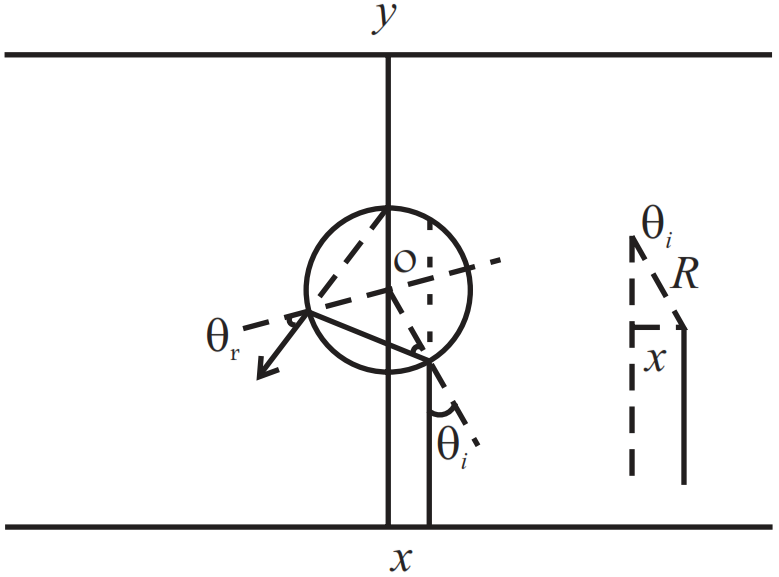
An infinitely long cylinder of radius R is made of an unusual exotic material with refractive index -1 (Fig). The cylinder is placed between two planes whose normals are along the y direction. The center of the cylinder O lies along the y-axis. A narrow laser beam is directed along the y direction from the lower plate. The laser source is at a horizontal distance x from the diameter in the y direction. Find the range of x such that light emitted from the lower plane does not reach the upper plane.
Explain with the help of a diagram the formation of depletion region and barrier potential in a $p-n$ junction diode.