Question
A U-shaped wire is dipped in a soap solution, and removed. The thin soap film formed between the wire and the light slider supports a weight of $1.5 × 10⁻²N$ (which includes the small weight of the slider). The length of the slider is $30cm$. What is the surface tension of the film?
Answer

The weight that the soap film supports, $\mathrm{W}=1.5 \times 10^{-2} \mathrm{~N}$ Length of the slider, $\mathrm{I}=30 \mathrm{~cm}=0.3 \mathrm{~m} \mathrm{~A}$ soap film has two free surfaces.
$\therefore$ Total length $=2 \mathrm{I}=2 \times 0.3=0.6 \mathrm{~m}$ Surface tension, $S=\frac{\text { Force of Weight }}{21}$
$=1.5 \times \frac{10^{-2}}{0.6}=2.5 \times 10-2 \mathrm{~N} / \mathrm{m}$ Therefore, the surface tension of the film is $2.5 \times 10-2 \mathrm{~N} \mathrm{~m}^{-1}$.

Need a full question paper?

Generate a complete, print-ready paper with questions like this in minutes — across 16+ boards, with answer keys.

Start Generating Free

Similar questions

Two blocks of mares 10kg and 20kg are placed on the X-axis. The first mass is moved on the axis by a distance of 2cm. By what distance should the second mass be moved to keep the position of the centre of mass unchanged?
Molecules in air in the atmosphere are attracted by gravitational force of the earth. Explain why all of them do not fall into the earth just like an apple falling from a tree.
An ideal gas is taken through a cyclic thermodynamic process through four steps. The amount of heat involved in these steps are $Q_1=5960 \mathrm{~J}, Q_2=-5585 \mathrm{~J} . Q_3=-2980 \mathrm{~J}$ and $Q_4=3645$ respectively. The corresponding quantities of work involved are $W_1=200 \mathrm{~J}, \mathrm{~W}_2=-825 \mathrm{~J}, \mathrm{~W}_3=-1100 \mathrm{~J}$ and $\mathrm{W}_4$ respectively. Find the value of $\mathrm{W}_4$. What is the efficiency of the cycle?
Show that the ratio of the magnetic dipole moment to the angular momentum (l = mvr) is a universal constant for hydrogen-like atoms and ions. Find its value.
Considering the pressure p to be proportional to the density, find the pressure p at a height h if the pressure on the surface of the earth is $p_0$.
The maximum speed and acceleration of a particle executing simple harmonic motion are $10cm/s$ and $50cm/s^2$. Find the position(s) of the particle when the speed is 8cm/s.
A gas cylinder has walls that can bear a maximum pressure of $1.0 \times 10^6Pa$. It contains a gas at $8.0 \times 10^5Pa$ and $300K$. The cylinder is steadily heated. Neglecting any change in the volume, calculate the temperature at which the cylinder will break.
State law of conservation of linear momentum. Derive the law of conservation of momentum from Newton's third law of motion.
The surface density (mass/ area) of a circular disc of radius a depends on the distance from the centre as p(r) = A + Br. Find its moment of inertia about the line perpendicular to the plane of the disc through its centre.
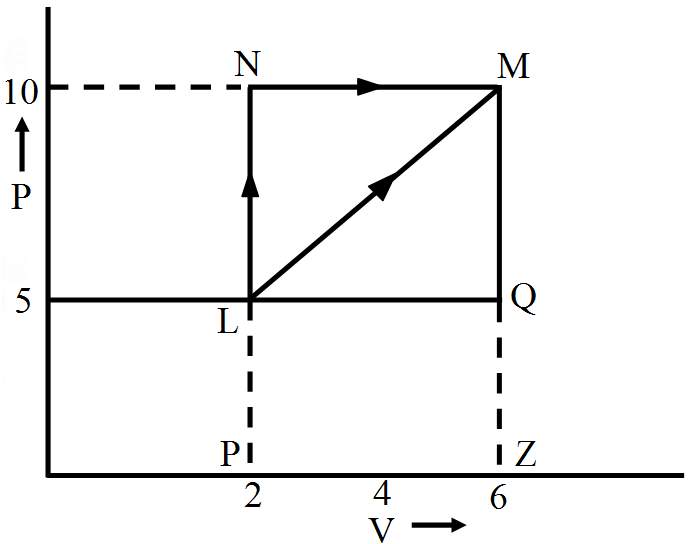
An ideal gas changes its state from $L$ to $M$ by two path $\text{LNM}$ and $LM$.
  1. Is the work done same for two paths?
  2. The internal energy of gas at $L$ is $20J$ and the amount of heat needed to change its state through $LM$ is $400J$. What is the internal energy of gas at $M$?