Question
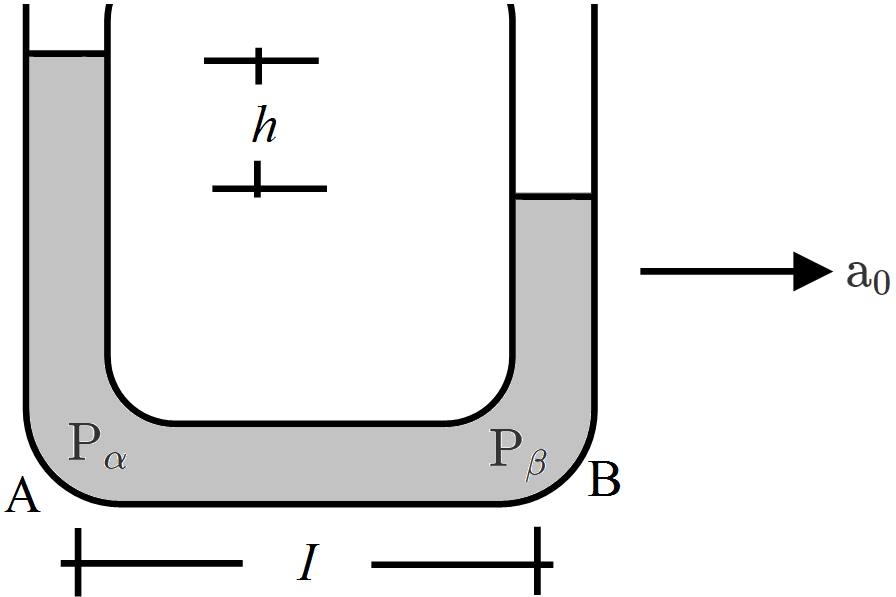
A U- tube containing a liquid is accelerated horizontally with a constant acceleration $a_0$. If the separation between the vertical limbs is $1$, find the difference in the heights of the liquid in the two arms.
Answer

Let the pressure at the base of the back limb at A = P, and the pressure at the base of the front limb at B = Ps. The separation between the vertical limbs AB = (given). When the U- tube is accelerated at an acceleration a, the difference of pressure between horizontal points A and B is given as,
$\text{P}_\text{a}-\text{P}_\beta=\text{l}\rho\text{a}_0$


where p is the density of the liquid. Due to this pressure difference, the liquid in limb A will rise to a heighth more than in limb B. The pressure difference due to this height difference balances the difference of pressure between points A and B.
The pressure due to thhis height $\text{h}=\rho\text{gh},$ Equating we get,
$\rho\text{gh}=\text{p}_\text{a}-\text{p}_\beta=\text{l}\rho\text{a}_0$
$\Rightarrow\text{gh}=\text{la}_0$
$\text{h}=\text{a}_0\text{l}/\text{g}$

Need a full question paper?

Generate a complete, print-ready paper with questions like this in minutes — across 16+ boards, with answer keys.
Start Generating Free

Similar questions

A spherical planet has mass $\text{M}_p$ and diameter $\text{D}_p$. A particle of mass m falling freely near the surface of this planet will experience an acceleration due to gravity, equal to whom?
Estimate the time taken by the oscillating pendulum to shift from x = 0 to $\text{x}=\frac{\text{A}}{2}$ where A is the amplitude.
The mutual inductance between two coils is 2.5H. If the current in one coil is changed at the rate of 1A/s, what will be the emf induced in the other coil?
A glass flask of volume $250 \mathrm{~cm}^3$ is just filled with mercury at $20^{\circ} \mathrm{C}$. How much mercury overflows when the temperature of the system is raised to $100^{\circ} \mathrm{C}$ ? The coefficient of volume expansion of glass is $12 \times 10^{-6}\left({ }^{\circ} \mathrm{C}\right)^{-1}$ and that of mercury is $18 \times 10^{-5}\left({ }^{\circ} \mathrm{C}\right)^{-1}$.
Find the fundamental, first overtone and second overtone frequencies of an open organ pipe of length 20cm. Speed of sound in air is 340m/s.
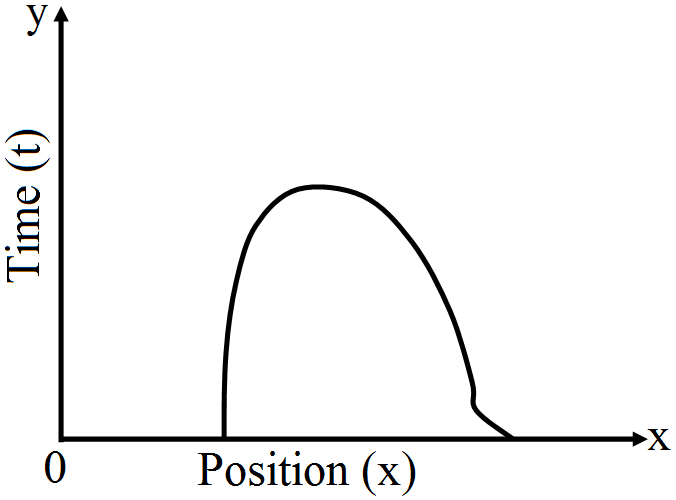
Is the time variation of position shown in figure observed in nature possible?
Examine whether the following functions of $Y$ represent a travelling wave.
  1. $(\text{x}-\text{vt})^2$
  2. $\frac{1}{\text{x}+\text{vt}}$
A neutron having kinetic energy 12.5eV collides with a hydrogen atom at rest. Nelgect the difference in mass between the neutron and the hydrogen atom and assume that the neutron does not leave its line of motion. Find the possible kinetic energies of the neutron after the event.
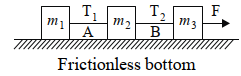
In the figure, three blocks are tied with two strings $A$ and $B . m_1=10 kg, m_2=5 kg, m_3=5 kg$. The bottom is frictionless. If $m _3$ is pulled to the right by applying a horizontal force of 50 N then calculate the tension in the strings.
Image
Calculate the temperature whose value is the same on the Celsius and Fahrenheit scale?