A uniform chain of length $L$ which hanges partially from a table, is kept in equilibrium by friction. The maximum length that can withstand without slipping is $l$ , then coefficient of friction between the table and the chain is
Medium


Download our appand get started for free
Experience the future of education. Simply download our apps or reach out to us for more information. Let's shape the future of learning together!No signup needed.*
Similar Questions
- 1A block of mass $m$ slides along a floor while a force of magnitude $F$ is applied to it at an angle $\theta$ as shown in figure. The coefficient of kinetic friction is $\mu_{ K }$. Then, the block's acceleration $'a'$ is given by: ($g$ is acceleration due to gravity)View Solution

- 2A body of mass $10\,kg$ is moving with an initial speed of $20\,m / s$. The body stops after $5\,s$ due to friction between body and the floor. The value of the coefficient of friction is (Take acceleration due to gravity $g =10\; ms ^{-2}$)View Solution
- 3A cyclist riding the bicycle at a speed of $14 \sqrt{3} \,m / s$ takes a turn around a circular road of radius $20 \sqrt{3} \,m$ without skidding. What is his inclination to the vertical?View Solution
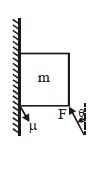
- 4A block of mass $m$ (initially at rest) is sliding up (in vertical direction) against a rough vertical wall with the help of a force $F$ whose magnitude is constant but direction is changing. $\theta = {\theta _0}t$ where $t$ is time in sec. At $t$ = $0$ , the force is in vertical upward direction and then as time passes its direction is getting along normal, i.e., $\theta = \frac{\pi }{2}$ .The value of $F$ so that the block comes to rest when $\theta = \frac{\pi }{2}$ , isView Solution
- 5One end of string of length $l$ is connected to a particle of mass $'m'$ and the other end is connected to a small peg on a smooth horizontal table. If the particle moves in circle with speed $'v',$ the net force on the particle (directed towards centre) will be ($T$ represents the tension in the string)View Solution
- 6A block of weight $W$ rests on a horizontal floor with coefficient of static friction $\mu .$ It is desired to make the block move by applying minimum amount of force. The angle $\theta $ from the horizontal at which the force should be applied and magnitude of the force $F$ are respectively.View Solution
- 7A coin placed on a rotating table just slips if it is placed at a distance $4r$ from the centre. On doubling the angular velocity of the table, the coin will just slip when at a distance from the centre equal toView Solution
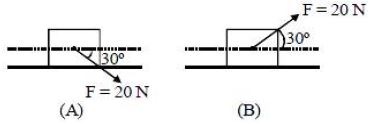
- 8A block of mass $5\, kg$ is $(i)$ pushed in case $(A)$ and $(ii)$ pulled in case $(B)$, by a force $F = 20\, N$, making an angle of $30^o$ with the horizontal, as shown in the figures. The coefficient of friction between the block and floor is $\mu = 0.2$. The difference between the accelerations of the block, in case $(B)$ and case $(A)$ will be ........ $ms^{-2}$ .$(g = 10\, ms^{-2})$View Solution
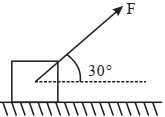
- 9As shown in the figure a block of mass $10\,kg$ lying on a horizontal surface is pulled by a force $F$ acting at an angle $30^{\circ}$, with horizontal. For $\mu_{ s }=0.25$, the block will just start to move for the value of $F..........\,N$ : $\left[\right.$ Given $\left.g =10\,ms ^{-2}\right]$View Solution
- 10A car is moving with a constant speed of $20\,m / s$ in a circular horizontal track of radius $40\,m$. A bob is suspended from the roof of the car by a massless string. The angle made by the string with the vertical will be : (Take $g =10$ $\left.m / s ^2\right)$View Solution