A coin placed on a rotating table just slips if it is placed at a distance $4r$ from the centre. On doubling the angular velocity of the table, the coin will just slip when at a distance from the centre equal to
Medium
Download our app for free and get started
The coin placed on the rotating table slips when inertial force $\operatorname{mr} \omega^{2}$ is greater than or equal to the static force of friction $\mu m g .$ Mathematically,
$\operatorname{mr} \omega^{2} \geq \mu m g \text { or } r \geq \frac{\mu g}{\omega^{2}}$
The coin just slips when $\mathrm{r}=\frac{\mu \mathrm{g}}{\omega^{2}}$
For radii $r_{1}$ and $r_{2},$ let angular velocities be $\omega_{1}$ and $\omega_{2}$ respectively.
$\frac{\mathrm{r}_{2}}{\mathrm{r}_{1}}=\frac{\omega_{1}^{2}}{\omega_{2}^{2}}=\left(\frac{\omega_{1}}{\omega_{2}}\right)^{2}$
${\omega_{2}^{2}}=\left(\frac{\omega_{1}}{\omega_{2}}\right)^{2}$
Hence, $r_{1}=4 r,$ when $\omega_{1}=\omega$ and for $r_{2}, \omega_{2}=2 \omega$
$\frac{r_{2}}{4 r}=\left(\frac{\omega}{2 \omega}\right)^{2}=\frac{1}{4}$
$\therefore r_2=r$

Download our appand get started for free
Experience the future of education. Simply download our apps or reach out to us for more information. Let's shape the future of learning together!No signup needed.*
Similar Questions
- 1A body is pulled along a rough horizontal surface with a velocity $6\,m/s$. If the body comes to rest after travelling $9\,m$ , then coefficient of sliding friction, is- (Take $g = 10\,m/s^2$ )View Solution
- 2The upper portion of an inclined plane of inclination $\alpha $ is smooth and the lower portion is rough. A particle slides down from rest from the top and just comes to rest at the foot. If the ratio of the smooth length to rough length is $m : n$ , the coefficient of friction isView Solution
- 3A fireman of mass $60\, kg$ slides down a pole. He is pressing the pole with a force of $600 \,N$. The coefficient of friction between the hands and the pole is $0.5$, with what acceleration will the fireman slide down ........ $m/s^2$View Solution
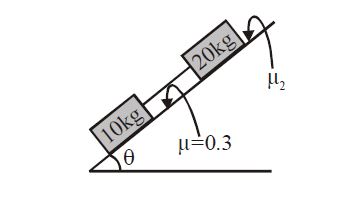
- 4Value of $\theta$ is increased gradually from $\theta = 0$ At $\theta=tan^{-1}(\frac{1}{2})$ both the block just start slipping. Then value of $\mu_2$ is : $(g = 10 m/s^2)$View Solution
- 5Two blocks $A$ and $B$ of masses $5 \,kg$ and $3 \,kg$ respectively rest on a smooth horizontal surface with $B$ over $A$. The coefficient of friction between $A$ and $B$ is $0.5$. The maximum horizontal force (in $kg$ wt.) that can be applied to $A$, so that there will be motion of $A$ and $B$ without relative slipping, isView Solution
- 6A body of mass $\mathrm{m}$ is kept on a rough horizontal surface (coefficient of friction $=\mu$ ) A horizontal force is applied on the body, but it does not move. The resultant of normal reaction and the frictional force acting on the object is given by $\mathrm{F},$ where $\mathrm{F}$ isView Solution
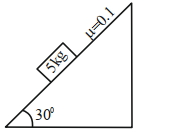
- 7A block of mass $5 \mathrm{~kg}$ is placed on a rough inclined surface as shown in the figure.If $\vec{F}_1$ is the force required to just move the block up the inclined plane and $\vec{F}_2$ is the force required to just prevent the block from sliding down, then the value of $\left|\vec{F}_1\right|-\left|\vec{F}_2\right|$ is : [Use $g=10 \mathrm{~m} / \mathrm{s}^2$ ]View Solution
- 8View SolutionWhich of the following is correct, when a person walks on a rough surface
- 9A car has to move on a level turn of radius $450\,m.$ If the coefficient of static friction between tyre and the road is $\mu = 0.2.$ Find the maximum speed the car can take without skidding is given by ........ $m/s$View Solution
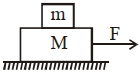
- 10Two blocks $( m =0.5\, kg$ and $M =4.5\, kg$ ) are arranged on a horizontal frictionless table as shown in figure. The coefficient of static friction between the two blocks is $\frac{3}{7} .$ Then the maximum horizontal force that can be applied on the larger block so that the blocks move together is ......... $N.$ (Round off to the Nearest Integer) [Take g as $9.8\, ms ^{-2}$ ]View Solution