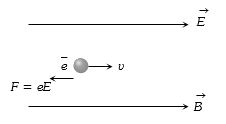
A uniform electric field and a uniform magnetic field are produced, pointed in the same direction. An electron is projected with its velocity pointing in the same direction
A
The electron will turn to its right
B
The electron will turn to its left
C
The electron velocity will increase in magnitude
D
The electron velocity will decrease in magnitude
AIEEE 2005, Easy
Download our app for free and get started
D
The electron velocity will decrease in magnitude
d (d) Since electron is moving is parallel to the magnetic field, hence magnetic force on it ${F_m} = 0$.
The only force acting on the electron is electric force which reduces it’s speed.
Download our app
and get started for free
Experience the future of education. Simply download our apps or reach out to us for more information. Let's shape the future of learning together!No signup needed.*
The relation between voltage sensitivity (${\sigma _V}$) and current sensitivity $({\sigma _i})$ of a moving coil galvanometer is (Resistance of Galvanometer = $G$)
A thin, straight conductor lies along the axis of a hollow conductor of radius $R$. The two carry equal currents in the same direction. The magnetic field $B$ is plotted against the distance $r$ from the axis. Which of the following best represents the resulting curve?
A particle of mass $m$ and charge $q$ moves with a constant velocity $v$ along the positive $x$ direction. It enters a region containing a uniform magnetic field $B$ directed along the negative $z$ direction, extending from $x = a$ to $x = b$. The minimum value of $v$ required so that the particle can just enter the region $x > b$ is
Two ions have equal masses but one is singly ionized and second is doubly ionized. They are projected from the same place in a uniform transverse magnetic field with same velocity then:
$(a)$ Both ions will go along circles of equal radii
$(b)$ The radius of circle described by the single ionized charge is double of radius of circle described by doubly ionized charge
$(c)$ Both circle do not touches to each other
$(d)$ Both circle touches to each other
An ammeter whose resistance is $180\,\Omega $ gives full scale deflection when current is $2\, mA$. The shunt required to convert it into an ammeter reading $20\, mA$ (in $ohms$) is
When the current flowing in a circular coil is doubled and the number of turns of the coil in it is halved, the magnetic field at its centre will become
In a region, steady and uniform electric and magnetic fields are present. These two fields are parallel to each other. A charged particle is released from rest in this region. The path of the particle will be a