A uniform electric field pointing in positive $x$-direction exists in a region. Let $A$ be the origin, $B$ be the point on the $x$-axis at $x = + 1$ $cm$ and $C$ be the point on the $y$-axis at $y = + 1\,cm$. Then the potentials at the points $A$, $B$ and $C$ satisfy
IIT 2001, Easy
Download our app for free and get started
(b) Potential decreases in the direction of electric field. Dotted lines are equipotential lines
${V_A} = {V_C}$ and ${V_A} > {V_B}$
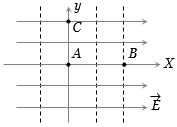
${V_A} = {V_C}$ and ${V_A} > {V_B}$

Download our appand get started for free
Experience the future of education. Simply download our apps or reach out to us for more information. Let's shape the future of learning together!No signup needed.*
Similar Questions
- 1Two insulated charged conducting spheres of radii $20\,cm$ and $15\,cm$ respectively and having an equal charge of $10\,C$ are connected by a copper wire and then they are separated. ThenView Solution
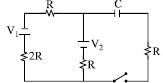
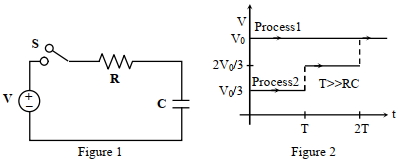
- 2Consider a simple $RC$ circuit as shown in Figure $1$.View Solution
Process $1$: In the circuit the switch $S$ is closed at $t=0$ and the capacitor is fully charged to voltage $V_0$ (i.e. charging continues for time $T \gg R C$ ). In the process some dissipation ( $E_D$ ) occurs across the resistance $R$. The amount of energy finally stored in the fully charged capacitor is $EC$.
Process $2$: In a different process the voltage is first set to $\frac{V_0}{3}$ and maintained for a charging time $T \gg R C$. Then the voltage is raised to $\frac{2 \mathrm{~V}_0}{3}$ without discharging the capacitor and again maintained for time $\mathrm{T} \gg \mathrm{RC}$. The process is repeated one more time by raising the voltage to $V_0$ and the capacitor is charged to the same final
take $\mathrm{V}_0$ as voltage
These two processes are depicted in Figure $2$.
($1$) In Process $1$, the energy stored in the capacitor $E_C$ and heat dissipated across resistance $E_D$ are released by:
$[A]$ $E_C=E_D$ $[B]$ $E_C=E_D \ln 2$ $[C]$ $\mathrm{E}_{\mathrm{C}}=\frac{1}{2} \mathrm{E}_{\mathrm{D}}$ $[D]$ $E_C=2 E_D$
($2$) In Process $2$, total energy dissipated across the resistance $E_D$ is:
$[A]$ $\mathrm{E}_{\mathrm{D}}=\frac{1}{2} \mathrm{CV}_0^2$ $[B]$ $\mathrm{E}_{\mathrm{D}}=3\left(\frac{1}{2} \mathrm{CV}_0^2\right)$ $[C]$ $\mathrm{E}_{\mathrm{D}}=\frac{1}{3}\left(\frac{1}{2} \mathrm{CV}_0^2\right)$ $[D]$ $\mathrm{E}_{\mathrm{D}}=3 \mathrm{CV}_0^2$
Given the answer quetion ($1$) and ($2$)
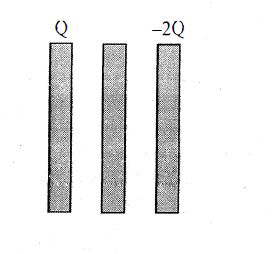
- 3The identical metal plates with large surface areas are kept parallel to each other as shown in figure. The left most plate is given a charge $Q$ , the rightmost a charge $-2Q$ and the middle one remains neutral. Find the charge appearing on the outer surface of the rightmost plateView Solution
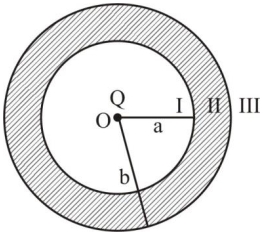
- 4As shown in the figure, a point charge $Q$ is placed at the centre of conducting spherical shell of inner radius a and outer radius $b$. The electric field due to charge $Q$ in three different regions I, II and III is given by: $( I : r < a , II : a < r < b , III : r > b )$View Solution
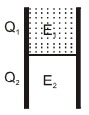
- 5A parallel plate capacitor has a dielectric slab of dielectric constant $K$ between its plates that covers $1 / 3$ of the area of its plates, as shown in the figure. The total capacitance of the capacitor is $C$ while that of the portion with dielectric in between is $C _1$. When the capacitor is charged, the plate area covered by the dielectric gets charge $Q_1$ and the rest of the area gets charge $Q_2$. Choose the correct option/options, igonoring edge effects.View Solution
$(A)$ $\frac{E_1}{E_2}=1$ $(B)$ $\frac{E_1}{E_2}=\frac{1}{K}$ $(C)$ $\frac{Q_1}{Q_2}=\frac{3}{K}$ $(D)$ $\frac{ C }{ C _1}=\frac{2+ K }{ K }$
- 6View SolutionA parallel plate capacitor after charging is kept connected to a battery and the plates are pulled apart with the help of insulating handles. Now which of the following quantities will decrease?
- 7The electric potential varies in space according to the relation $V = 3x + 4y$. A particle of mass $0.1\,\, kg$ starts from rest from point $(2, 3·2)$ under the influence of this field. The charge on the particle is $+1\,\, μC$. Assume $V$ and $(x, y)$ are in $S.I.$ $units$ . The time taken to cross the $x-$ axis is.....$s$View Solution
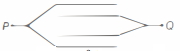
- 8Four metallic plates each of surface area (of one side) $A$, are placed at a distance $d$ apart from each other. The two outer plates are connected to a point $P$ and the two inner plates are connected to another point as shown in figure below. Then, the capacitance of the system isView Solution
- 9The potential at a point, due to a positive charge of $100\,\mu C$ at a distance of $9\,m$, isView Solution
- 10View SolutionIn the transient shown the time constant of the circuit is :