Question
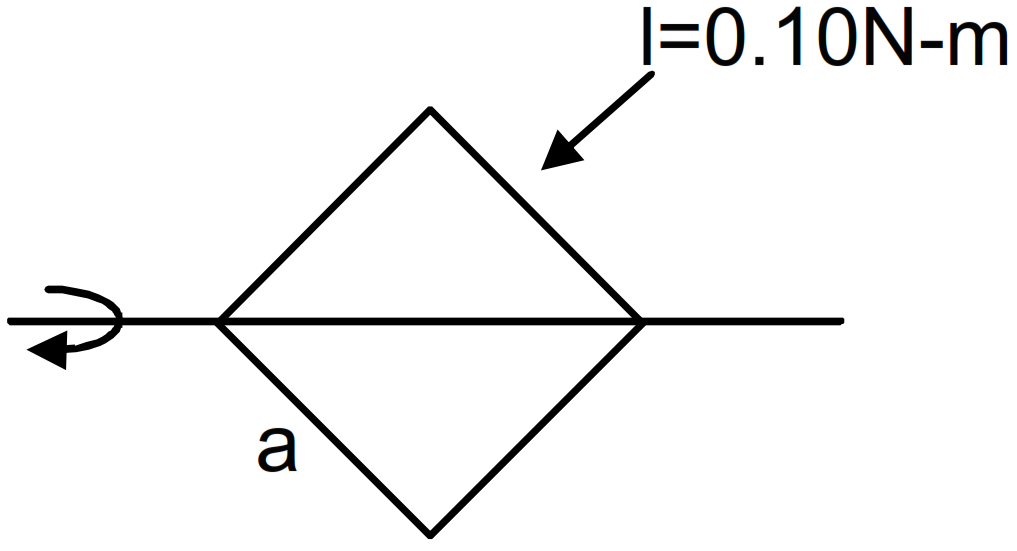
A uniform square plate of mass 2.0kg and edge 10cm rotates about one of its diagonals under the action of a constant torque of 0.10N-m. Calculate the angular momentum and the kinetic energy of the plate at the end of the fifth second after the start.
Answer


I = 0.10N-m; a = 10cm = 0.1m; m = 2kg
Therefore $\Big(\frac{\text{ma}^2}{12}\Big)\times\alpha=0.10\text{N-m}$
$\Rightarrow\alpha=60\text{rad/s}$
Therefore $\omega=\omega_0+\alpha\text{t}$
$\Rightarrow\omega=60\times5=300\text{rad/s}$
Therefore angular momentum $=\text{l}\omega=\Big(\frac{0.10}{60}\Big)\times300=0.50\text{kg-m}^2/\text{s}$
And 0 kinetic energy $\frac{1}{2}\text{l}\omega^2=\frac{1}{2}\times\Big(\frac{0.10}{60}\Big)\times300^2=75\ \text{Joules}.$

Need a full question paper?

Generate a complete, print-ready paper with questions like this in minutes — across 16+ boards, with answer keys.

Start Generating Free

Similar questions

As the earth rotates about its axis, a person living in his house at the equator goes in a circular orbit of radius equal to the radius of the earth. Why does he/ she not feel weightless as a satellite passenger does?
Two simple harmonic motions are represented by:$\text{x}_1=10\sin\Big(4\pi\text{t}+\frac{\pi}{4}\Big)$
$\text{x}_2=5(\sin4\pi\text{t}+\sqrt{3}\cos4\pi\text{t})$
What is the ratio of the amplitudes?
A 100W light bulb is placed at the centre of a spherical chamber of radius 20cm. Assume that 60% of the energy supplied to the bulb is converted into light and that the surface of the chamber is perfectly absorbing. Find the pressure exerted by the light on the surface of the chamber.
A source of sound is coming towards a stationary observer with a constant velocity. Deduce the formula for the apparent frequency heard by observer.
Give examples of a one-dimensional motion where: The particle moving along positive x-direction comes to rest periodically and moves backward.
A clock with an iron pendulum keeps the correct time at $20^{\circ} C$. How much will it lose or gain if the temperature changes to $40^{\circ} C$ ? Coefficient of cubical expansion of iron $=36 \times 10^{-6}{ }^{\circ} C ^{-1}$.
A ball is projected vertically upward with a speed of $50m/s$. Find:
  1. The maximum height.
  2. The time to reach the maximum height.
  3. The speed at half the maximum height. Take $g = 10m/s^2$.
Iron emits $\text{K}_\alpha$ X-ray of energy 6.4keV and calcium emits $\text{K}_\alpha$ X-rays of energy 3.69 keV. Calculate the times taken by an iron $\text{K}_\alpha$ photon to cross through a distance of 3km.
A capacitance C charged to a potential difference V is discharged by connecting its plates through a resistance R. Find the heat dissipated in one time constant after the connections are made. Do this by calculating $\int\text{i}^2\text{R}$ dt and also by finding the decrease in the energy stored in the capacitor.
A force $\overrightarrow{\text{F}}=\overrightarrow{\text{v}}\times\overrightarrow{\text{A}}$ is exerted on a particle in addition to the force of gravity, where v is the velocity of the particle and $\overrightarrow{\text{A}}$ is a constant vector in the horizontal direction. With what minimum speed a particle of mass m be projected so that it continues to move undeflected with a constant velocity?