A uniform tube of length $60.5\,cm$ is held vertically with its lower end dipped in water. A sound source of frequency $500\,Hz$ sends sound waves into the tube. When the length of tube above water is $16\,cm$ and again when it is $50\,cm,$ the tube resonates with the source of sound. Two lowest frequencies (in $Hz$), to which tube will resonate when it is taken out of water, are (approximately).
AIEEE 2012, Medium
Download our app for free and get started
Two lowest frequencies to which tube will resonates are $272\,Hz$ and $544\,Hz$

Download our appand get started for free
Experience the future of education. Simply download our apps or reach out to us for more information. Let's shape the future of learning together!No signup needed.*
Similar Questions
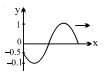
- 1The equation of a wave travelling along the positive x-axis, as shown in figure at $t = 0$ is given byView Solution
- 2A tuning fork of frequency $280\,\, Hz$ produces $10$ beats per sec when sounded with a vibrating sonometer string. When the tension in the string increases slightly, it produces $11$ beats per sec. The original frequency of the vibrating sonometer string is ... $Hz$View Solution
- 3Two sound waves of wavelengths $5m$ and $6m$ formed $30$ beats in $3$ seconds. The velocity of sound is .... $ms^{-1}$View Solution
- 4A travelling wave is described by the equation $y(x, t)=[0.05 \sin (8 x-4 t] \;m$View Solution
The velocity of the wave is $.....ms ^{-1}$ [all the quantities are in SI unit]
- 5The driver of a bus approaching a big wall notices that the frequency of his bus's horn changes from $420\, Hz$ to $490\, Hz ,$ when he hears it after it gets reflected from the wall. Find the speed of the bus (in $kmh^{-1}$) if speed of the sound is $330\, ms ^{-1}$.View Solution
- 6An organ pipe is closed at one end has fundamental frequency of $1500 Hz$. The maximum number of overtones generated by this pipe which a normal person can hear is :View Solution
- 7View SolutionThe minimum intensity of sound is zero at a point due to two sources of nearly equal frequencies, when
- 8View SolutionIn a stretched string,
- 9A wire having a linear mass density $9.0 \times 10^{-4} \;{kg} / {m}$ is stretched between two rigid supports with a tension of $900\; {N}$. The wire resonates at a frequency of $500\;{Hz}$. The next higher frequency at which the same wire resonates is $550\; {Hz}$. The length of the wire is $...... {m}$View Solution
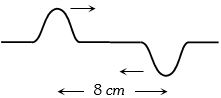
- 10Two pulses in a stretched string whose centres are initially $8 cm$ apart are moving towards each other as shown in the figure. The speed of each pulse is $2 cm/s$. After $2$ seconds, the total energy of the pulses will beView Solution