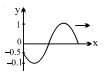
The equation of a wave travelling along the positive x-axis, as shown in figure at $t = 0$ is given by
Medium
Download our app for free and get started
$y=\sin (\omega t-k x+\phi)$
$v=\omega \cos (\omega t-k x+\phi)$
at $t=0, x=0, y=-0.5, v>0 \Rightarrow \phi=-\frac{\pi}{6}$
$\therefore y=\sin \left(\omega t-k x-\frac{\pi}{6}\right)$

Download our appand get started for free
Experience the future of education. Simply download our apps or reach out to us for more information. Let's shape the future of learning together!No signup needed.*
Similar Questions
- 1Which of the following functions for $y$ can never represent a travelling wave?View Solution
$(a)$ $\left(x^2-v t\right)^2$
$(b)$ $\log \left[\frac{(x+v t)}{x_0}\right]$
$(c)$ $e^{\left\{-\frac{(x+v t)}{x_0}\right\}^2}$
$(d)$ $\frac{1}{x+v t}$
- 2Transverse waves of same frequency are generated in two steel wires $A$ and $B$. The diameter of $A$ is twice of $B$ and the tension in $A$ is half that in $B$. The ratio of velocities of wave in $A$ and $B$ isView Solution
- 3A sound source $S$ is moving along a straight track with speed $v,$ and is emitting sound of frequency $v_{o}$ (see figure). An observer is standing at a finite clistance, at the point $O$, from the track. The time variation of frequency heard by the observer is best represented byView Solution
$\left(t_{0}\right.$ represents the instant when the distance between the source and observer is minimum)
- 4When an air column at $15\,^oC$ and a tunning fork are sounded together then $4$ beats per second are produced, the frequency of the fork is less then that of air column. When the temperature falls to $10\,^oC$ , then the beat frequency decreases by one. The frequency of the fork will be ..... $Hz$ $[V_{sound}$ at $0\,^oC = 332\,m/s]$View Solution
- 5Statement $-1$ : Due to the motion of listener, the frequency of the sound waves (as received by listener) emitted by stationary source is affected.View Solution
Statement $-2$ : Due to the motion of source, wavelength of the sound waves (emitted by source) as received by stationary listener is affected.
Statement $-3$ : If receiver and source both are moving, the observed frequency must be different from the original frequency of source.
Treat motion of source or listener as always along a line joining them for all above cases.
- 6The disc of a siren containing $60$ holes rotates at a constant speed of $360\,rpm$. The emitted sound is in unison with a tuning fork of frequency .... $Hz$View Solution
- 7A set of $20$ tuning forks is arranged in a series of increasing frequencies. If each fork gives $4$ beats with respect to the preceding fork and the frequency of the last fork is twice the frequency of the first, then the frequency of last fork is $\dots \; Hz$.View Solution
- 8A whistle emitting a loud sound of frequency $540 \,Hz$ is whirled in a horizontal circle of radius $2 \,m$ and at a constant angular speed of $15 \,rad / s$. The speed of sound is $330 \,m / s$. The ratio of the highest to the lowest frequency heard by a listener standing at rest at a large distance from the centre of the circle isView Solution
- 9In an organ pipe whose one end is at $x = 0$, the pressure is expressed by $p = {p_0}\cos \frac{{3\pi x}}{2} \,\,sin\,\, 300\pi t$ where $x$ is in meter and $t$ in $sec$. The organ pipe can beView Solution
- 10A string is stretched between fixed points separated by $75.0\,\, cm.$ It is observed to have resonant frequencies of $420\,\, Hz$ and $315\,\, Hz$. There are no other resonant frequencies between these two. The lowest resonant frequency for this string is .... $Hz$View Solution