Question
A uniform wheel of radius R is set into rotation about its axis at an angular speed $\omega.$ This rotating wheel is now placed on a rough horizontal surface with its axis horizontal. Because of friction at the contact, the wheel accelerates forward and its rotation decelerates till the wheel starts pure rolling on the surface. Find the linear speed of the wheel after it starts pure rolling.
Answer

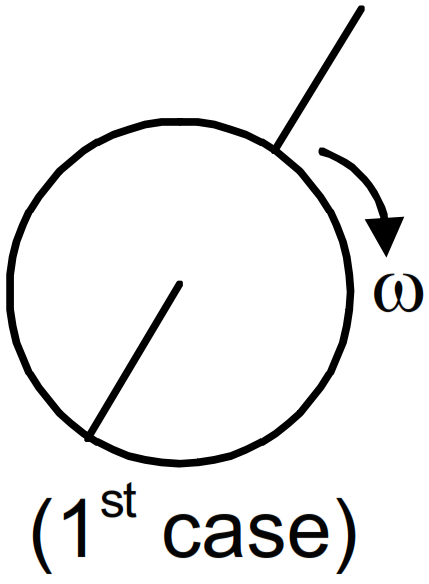
A uniform wheel of radius R is set into rotation about its axis (case-I) at an angular speed $\omega.$
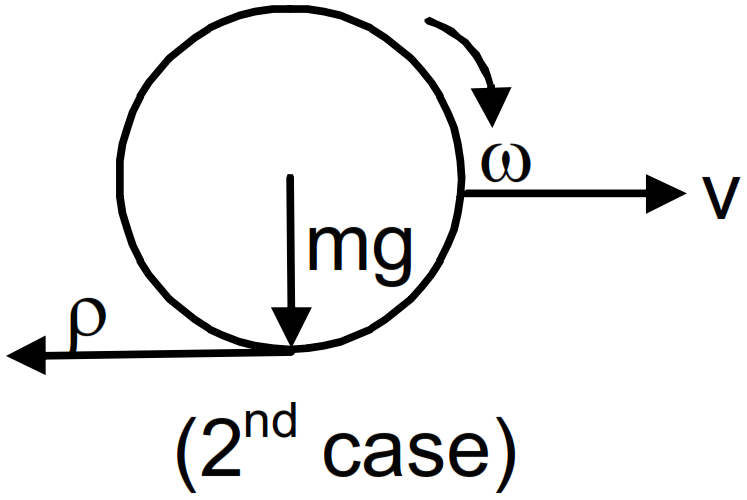
This rotating wheel is now placed on a rough horizontal. Because of its friction at contact, the wheel accelerates forward and its rotation decelerates. As the rotation decelerates the frictional force will act backward. If we consider the net moment at A then it is zero. Therefore the net angular momentum before pure rolling & after pure rolling remains constant Before rolling the wheel was only rotating around its axis. Therefore Angular momentum $=\ell\omega=\Big(\frac{1}{2}\Big)\text{MR}^2\omega\ \dots(1)$ After pure rolling the velocity of the wheel let v Therefore angular momentum $=\ell_{\text{cm}}\omega+\text{m}(\text{v}\times\text{R})$$=\Big(\frac{1}{2}\Big)\text{m}\text{R}^2\Big(\frac{\text{v}}{\text{R}}\Big)+\text{mvR}=\frac{3}{2}\text{mvR}\ \dots(2)$
Because, Eq. (1) and (2) are equal Therefore, $\frac{3}{2}\text{mvR}=\frac{1}{2}\text{mR}^2\omega$$\Rightarrow\text{V}=\omega\frac{\text{R}}{3}$

Need a full question paper?

Generate a complete, print-ready paper with questions like this in minutes — across 16+ boards, with answer keys.

Start Generating Free

Similar questions

A capacitor of capacitance C is given a charge Q. At t = 0, it is connected to an uncharged capacitor of equal capacitance through a resistance R. Find the charge on the second capacitor as a function of time.
Explain quantitatively the order of magnitude difference between the diamagnetic susceptibility of $N_2 (~5 \times 10^{-9}) \ ($at $\text{STP})$ and $Cu (~10^{-5}).$
  1. Derive an expression for equivalent capacitance of three capacitors when connected in series.
  2. Derive an expression for equivalent capacitance of three capacitors when connected in parallel.
A suitcase kept on a shop's rack is measured 50cm × 25cm × 10cm by the shop's owner. A traveller takes this suitcase in a train moving with velocity 0.6c.
If the suitcase is placed with its length along the train's velocity, find the dimensions measured by:
  1. The traveller and.
  2. A ground observer.
The gravitational pontential in a region is given by V = (20N/kg) (x + y).
  1. Show that the equation is dimensionally correct.
  2. Find the gravitational field at the point (x, y). Leave your answer in terms of the unit vectors $\overrightarrow{\text{i}},\ \overrightarrow{\text{j}},\ \overrightarrow{\text{k}}.$
  3. Calculate the magnitude of the gravitational force on a particle of mass 500g placed at the origin.
Two charges $2.0 \times 10^{-6}C$ and $1.0 \times 10^{-6}C$ are placed at a separation of $10\ cm.$ Where should a third charge be placed such that it experiences no net force due to these charges?
The work function of caesium metal is $2.14 eV$. When light of frequency $6 \times 10^{14 }Hz$ is incident on the metal surface, photoemission of electrons occurs. What is the
  1. Maximum kinetic energy of the emitted electrons,
  2. Stopping potential, and
  3. Maximum speed of the emitted photoelectrons?
An astronomical telescope is to be designed to have a magnifying power of $50$ in normal adjustment. If the length of the tube is $102\ cm,$ find the powers of the objective and the eyepiece.
An electron of kinetic energy 100eV circulates in a path of radius 10cm in a magnetic field. Find the magnetic field and the number of revolutions per second made by the electron.
A free $^{238}U$ nucleus kept in a train emits an alpha particle. When the train is stationary, $a$ nucleus decays and $a$ passenger measures that the separation between the alpha particle and the recoiling nucleus becomes $x$ at time $t$ after the decay. If the decay takes place while the train is moving at a uniform velocity $v,$ the distance between the alpha particle and the recoiling nucleus at $a$ time $t$ after the decay as measured by the passenger is: