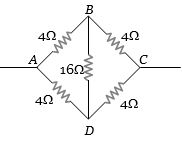
A uniform wire of $16\,\Omega $ is made into the form of a square. Two opposite corners of the square are connected by a wire of resistance $16\,\Omega $. The effective resistance between the other two opposite corners is ............... $\Omega$
Medium
Download our app for free and get started
According to the principle of Wheatstone’s bridge, the effective resistance between the given points is $4\,\Omega$.

Download our appand get started for free
Experience the future of education. Simply download our apps or reach out to us for more information. Let's shape the future of learning together!No signup needed.*
Similar Questions
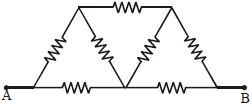
- 1In the network shown in the following figure, each resistance is $1\,ohm.$ The effective resistance between $A$ and $B$ isView Solution
- 2The e.m.f. of a cell is $E\, volts$ and internal resistance is $r$ $ohm$. The resistance in external circuit is also $r$ $ohm$. The p.d. across the cell will beView Solution
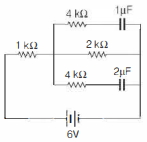
- 3What are the charges stored in the $1 \,\mu F$ and $2 \,\mu F$ capacitors in the circuit below, once the currents become steady?View Solution
- 4View SolutionAssertion : In a simple battery circuit, the point of the lowest potential is negative terminal of the battery.
Reason : The current flows towards the point of the higher potential, as it does in such a circuit from the negative to the positive terminal.
- 5At what rate the potential difference between the plates of a capacitor be changed to set up a displacement current of $1\, A$ in a capacitor of $2\,\mu F$ ?View Solution
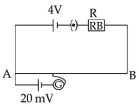
- 6As shown in the figure, a potentiometer wire of resistance $20\,\Omega$ and length $300\,cm$ is connected with resistance box (R.B.) and a standard cell of emf $4\,V$. For a resistance ' $R$ ' of resistance box introduced into the circuit, the null point for a cell of $20\,mV$ is found to be $60\,cm$. The value of ' $R$ ' is $.....\Omega$View Solution
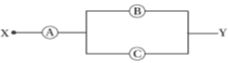
- 7$A, \,B$ and $C$ are voltmeters of resistance $R, \,1 .5R$ and $3R$ respectively as shown in the figure. When some potential difference is applied between $X$ and $Y,$ the voltmeter readings are $V_A, \,V_B$ and $V_C$ respectively. ThenView Solution
- 8A current of $2\,A$ flows through a wire of crosssectional area $25.0\,mm ^2$. The number of free electrons in a cubic meter are $2.0 \times 10^{28}$. The drift velocity of the electrons is $...............\times 10^{-6}\,ms ^{-1}$ (given, charge on electron $=1.6 \times 10^{-19}\,C$ )View Solution
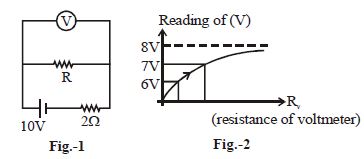
- 9In the given figure $-1$, resistance of shown voltmeter is variable. Variation of whose reading with respect to its resistance is shown in figure $-2$. The value of $R$ is ............... $\Omega$View Solution
- 10If two bulbs of wattage $25$ and $30$, each rated at $220\, volts$, are connected in series with a $440$ $volt$ supply, which bulb will fuseView Solution