MCQ
A uniformly accelerated body has $..........$
  • A
    Constant speed
  • B
    Constant velocity
  • Constant force
  • D
    Constant momentum

Answer

Correct option: C.
Constant force
Since the body is accelerated, the speed and velocity will vary.
Momentum depends on velocity;
hence the momentum will also vary.
The force remains constant as $F = ma.$

Need a full question paper?

Generate a complete, print-ready paper with questions like this in minutes — across 16+ boards, with answer keys.
Start Generating Free

Similar questions

Bernoulli's Principle is based on :
A monoatomic gas performs a work of $\frac{Q}{4}$ where $Q$ is the heat supplied to it. The molar heat capaticy of the gas will be $R$ during this transformation. Where $R$ is the gas constant.
Water is flowing through a tube of non-uniform cross-section ratio of the radius at entry and exit end of the pipe is $ 3 : 2.$  Then the ratio of velocities at entry and exit of liquid is
Which of the following quantities has the same dimensions as that of energy
A stone is dropped into well in which the level of water is at a distance $h$ below the top of well. If $y$ is the velocity of sound, the time $T$ after which the splash is heard is given by:
A bicyclist comes to a skidding stop in $10m.$ During this process, the force on the bicycle due to the road is $200N$ and is directly opposed to the motion. The work done by the cycle on the road is:
Physical independence of force is a consequence of
A string fixed at both ends vibrates in three loops. The wave length is $10\, cm$ . The length of string is .... $cm$
Two spheres of same size one of mass $2\ kg$ and another of mass $4\ kg$ are dropped simultaneously from the top of Qutab Minar $($height $= 72m)$. When they are $1m$ above the ground, the two spheres have the same:
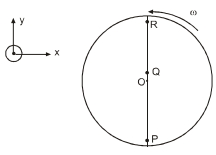
Consider a disc rotating in the horizontal plane with a constant angular speed $\omega$ about its centre $O$. The disc has a shaded region on one side of the diameter and an unshaded region on the other side as shown in the figure. When the disc is in the orientation as shown, two pebbles $P$ and $Q$ are simultaneously projected at an angle towards $R$. The velocity of projection is in the $y$-z plane and is same for both pebbles with respect to the disc. Assume that $(i)$ they land back on the disc before the disc completed $\frac{1}{8}$ rotation. $(ii)$ their range is less than half disc radius, and $(iii)$ $\omega$ remains constant throughout. Then