MCQ
A Vernier calipers has $1 \mathrm{~mm}$ marks on the main scale. It has $20$ equal divisions on the Vernier scale which match with $16$ main scale divisions. For this Vernier calipers, the least count is
  • A
    $0.02 \mathrm{~mm}$
  • B
    $0.05 \mathrm{~mm}$
  • C
    $0.1 \mathrm{~mm}$
  • $0.2 \mathrm{~mm}$

Answer

Correct option: D.
$0.2 \mathrm{~mm}$
d
$\text { L.C. } $$ =1 \text { M.S.D }-1 \text { V.S.D } $

$ =\left(1-\frac{16}{20}\right) \text { M.S.D } $

$ =\left(1-\frac{4}{5}\right)(1 \mathrm{~mm})=0.2 \mathrm{~mm}$

Need a full question paper?

Generate a complete, print-ready paper with questions like this in minutes — across 16+ boards, with answer keys.

Start Generating Free

Similar questions

A simple pendulum is attached to the roof of a lift. If time period of oscillation, when the lift is stationary is $T$. Then frequency of oscillation, when the lift falls freely, will be
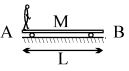
The figure shows a man of mass $m$ standing at the end $A$ of a trolley of mass $M$ placed at rest on a smooth horizontal surface. The man starts moving towards the end $B$ with a velocity $u_{rel}$ with respect to the trolley. The length of the trolley is $L$. When the man starts moving, then the velocity of the trolley $v_2$ with respect to ground will be
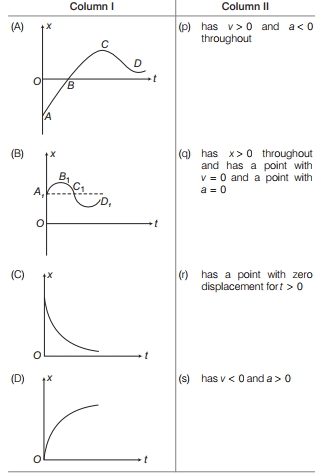
Refer to the graph in figure. Match the following
The temperature at which the root mean square velocity of a molecule will be doubled than at $100°C$
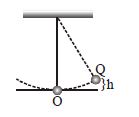
The bob of a simple pendulum is displaced from its equilibrium position $O$ to a position $Q$ which is at height $h$ above $O$ and the bob is then released. Assuming the mass of the bob to be $m$ and time period of oscillations to be $2.0\  s$, the tension in the string when the bob passes through $O$ is
If the momentum of a body is increased $n$ times, its kinetic energy increases
Water is moving with a speed of $5.18 ms^{-1}$ through a pipe with a cross-sectional area of $4.20 cm^2$. The water gradually descends $ 9.66 m $ as the pipe increase in area to $7.60 cm^2$. The speed of flow at the lower level is ....... $ms^{-1}$
The displacement of a particle is proportional to the cube of time elapsed. How does the acceleration of the particle depends on time obtained
At which temperature the speed of sound in hydrogen will be same as that of speed of sound in oxygen at $100\,^oC$  ..... $^oC$
In a reversible isochoric change