MCQ
It is found that $|\text{A}+\text{B}|=|\text{A}|.$ This necessarily implies,
  • A
    $\text{B}=0$
  • B
    A, B are antiparallel.
  • C
    A, B are perpendicular.
  • D
    $\text{A.B}≤0$

Answer

  1. $(\vec{\text{A}}\times\vec{\text{B}})\times\vec{\text{C}}$ is not zero unless $\vec{\text{B}},\ \vec{\text{C}}$ are parallel.

Explanation:

$|\vec{\text{A}}+\vec{\text{B}}|=|\vec{\text{A}}|$

Applying dot product,

$|\vec{\text{A}}+\vec{\text{B}}|.|\vec{\text{A}}+\vec{\text{B}}|=|\vec{\text{A}}|.|\vec{\text{A}}|$

$\Rightarrow\ |\vec{\text{A}}|^2+2\vec{\text{A}}.\vec{\text{B}}+|\vec{\text{B}}|^2=|\text{A}|^2$

$\Rightarrow\ |\vec{\text{B}}|^2=-2\vec{\text{A}}.\vec{\text{B}}$

$\Rightarrow\ |\vec{\text{B}}|=0$

Therefore, option (a) is correct.

Need a full question paper?

Generate a complete, print-ready paper with questions like this in minutes — across 16+ boards, with answer keys.
Start Generating Free

Similar questions

If the ratio of specific heat of a gas at constant pressure to that at constant volume is $\gamma $, the change in internal energy of a mass of gas, when the volume changes from $V$ to $2V$ constant pressure $ p$, is
A cycle wheel of radius 0.4 m completes one revolution in one second then the acceleration of a point on the cycle wheel will be
The work done in which of the following processes is equal to the internal energy of the system?
Two $SHM$ are represented by equations, $y_1 = 6\cos \left( {6\pi t + \frac{\pi }{6}} \right)\,,{y_2} = 3\left( {\sqrt 3 \sin 3\pi t + \cos 3\pi t} \right)$
Two satellites revolve around a planet in coplanar circular orbits in anticlockwise direction. Their period of revolutions are $1\, hour$ and $8\, hours$ respectively. The radius of the orbit of nearer satellite is $2 \times 10^{3}\, {km}$. The angular speed of the farther satellite as observed from the nearer satellite at the instant when both the satellites are closest is $\frac{\pi}{{x}}\, {rad} \,{h}^{-1}$ where ${x}$ is ..... .
According to second law of thermodynamics:
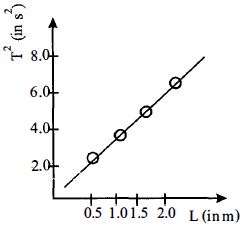
In an experiment for determining the gravitational acceleration $g$ of a place with the help of a simple pendulum, the measured time period square is plotted against the string length of the pendulum in the figure. What is the value of $g$ at the place? ...... $m/s^2$
A pendulum has time period $T$. If it is taken on to another planet having acceleration due to gravity half and mass $ 9 $ times that of the earth then its time period on the other planet will be
Three particles ${P}, {Q}$ and ${R}$ are moving along the vectors ${A}=\hat{{i}}+\hat{{j}}, {B}=\hat{{j}}+\hat{{k}}$ and ${C}=-\hat{{i}}+\hat{{j}}$ respectively. They strike on a point and start to move in different directions. Now particle $P$ is moving normal to the plane which contains vector $\vec{A}$ and $\vec{B} .$ Similarly particle $Q$ is moving normal to the plane which contains vector $\vec{A}$ and $\vec{C} .$ The angle between the direction of motion of $P$ and $Q$ is $\cos ^{-1}\left(\frac{1}{\sqrt{x}}\right)$. Then the value of $x$ is ...... .
During an adiabatic process, the pressure of a gas is proportional to the cube of its absolute temperature. The value of $\frac{\text{C}_{\text{p}}}{\text{C}_\text{v}}$ for that gas is: