Question
$(a)$ What is meant by compound microscope? Draw a ray diagram of image formation by a compound microscope. Briefly describe its working and derive the formula for its total magnification.
$(b)$ How does the resolving power of a microscope change when :
$(i)$ The diameter of the objective lens decreases,
$(ii)$ The wavelength of incident light increases? Justify your answer in each case.
Answer

$(a)$ Compound microscope : It is an optical instrument made of two lenses which forms a magnified image of a nearby microscopic object. The angle of view formed by this image on the observer's eye is very large, as a result the eye can see the big object.
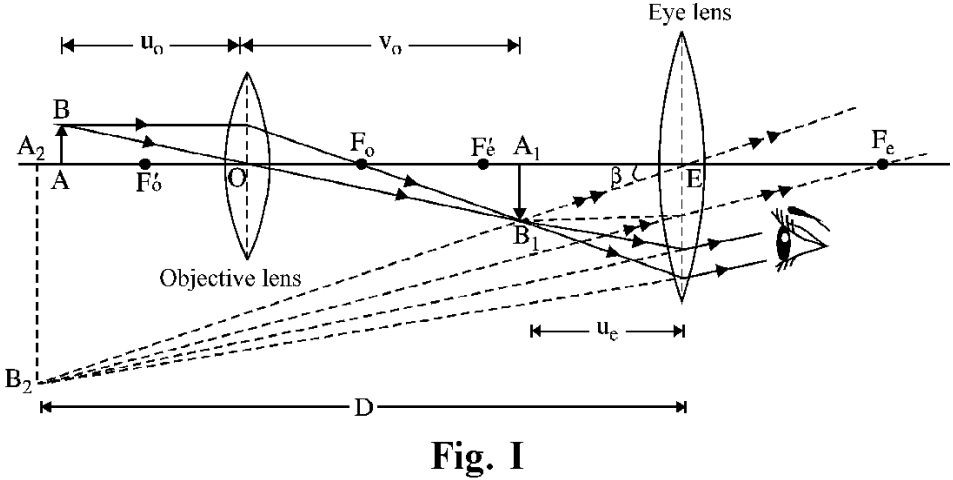
Ray diagram of image formation by compound microscope :
Image
Image
Working method:
As shown in the figure, the object $AB$ is placed in front of the objective lens at a distance beyond the focal length of the lens.
The rays emanating from the object get refracted through this lens and form $A _1 B_1$ real, inverted and magnified images of the object. This image acts as an object for the eye lens.
Now we adjust the eye lens in such a way that images $A _1 B_1$ are formed between the focus of the eye lens and the center of light.
The eye lens actually functions as a simple microscope and now its magnified virtual image $A _2 B_2$ is formed.
The position of the eye lens is adjusted such that the final image $A _2 B_2$ formed at a distance $D$ from the eye $A _2 B_2$ is erect with respect to the images $A _1 B_1$ but inverted with respect to the object $AB$ .
Magnifying power :
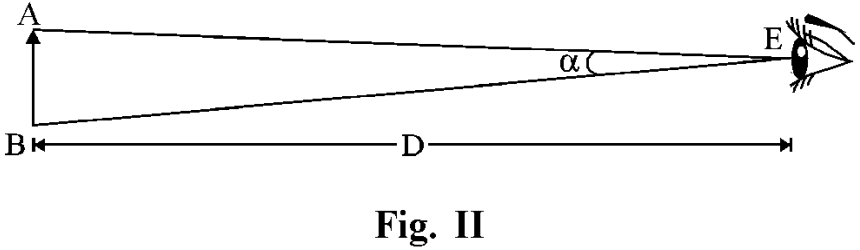
​​​​​​​The magnifying power of a compound microscope is the ratio of the angle of view formed on the eye by the final image formed by it and the angle of view formed on the eye by the object $($when the object is at the minimum is equal to distance of clear vision and is being seen directly without the instrument$)$.
Hence magnifying power i.e. angular magnification
$m=\frac{\text { The angle made by the final image at the eye }}{\text { The angle made by the object at the eye }}$
$($when the object is at distance $D)$
Suppose the last image $A _2 B_2$ make an angle $B$ at eyepiece $E$. Since the eye is close to the eyepiece, hence $\beta$ can be considered as the angle formed by $A _2 B_2$ on the eye $($Fig. $I)$. If the object $AB$ is placed at the minimum distance $D$ of clear vision from the eye and makes an angle $\alpha$ at the eye when held straight by the eye $($Fig. $II),$ then the magnifying power of the microscope
$m=\frac{\beta}{\alpha} \ldots(1)$
Since the object is small, the angles $\alpha, \beta$ will also be very small.
Therefore, in their place we can take their tangent $(\tan)$
Therefore $\alpha=\tan \alpha$ and $\beta=\tan \beta$
$\therefore m=\frac{\tan \beta}{\tan \alpha} \ldots(2)$
But $($Fig. $II)$ from right angled triangle ABE,
$\tan \alpha=\frac{A B}{D}\ldots(3)$
and $($Fig. $I)$ from right angled triangle $B _1 A_1 E$,
$\tan \beta=\frac{A_1 B_1}{EA_1}\ldots(4)$
After putting the values of equation $(3)$ and $(4)$ in equation $(2),$
$ m=\frac{A_1 B_1 / EA_1}{AB / D}=\frac{A_1 B_1}{AB}\left(\frac{D}{EA_1}\right) \ldots(5)$
If the distances of the object AB and the images $A _1 B_1$ from the objective $O$ are $u_0$ and $v_0$ respectively, then taking their proper signs,
$\frac{ A _1 B_1}{ AB }=\frac{+v_0}{-u_0}$
$\left(\because \frac{\text { Size of the image }}{\text { Size of the object }}=\frac{\text { Distance of the lens from } \\ \text { image }}{\text { Distance of the object from } \\ \text { the lens }}\right)$
If the distance of $A _1 B_1$ from the eyepiece $E\ ($for this, the virtual object$)$ is $u_{ e }$ then with appropriate sign
$EA _1=-u_e$
$\therefore$ Putting these values in equation $(5)$ and taking $D$ as negative,
$m=\frac{+v_0}{-u_0}\left(\frac{- D }{-u_e}\right)$
or $ m=\left[\frac{v_0}{u_0}\left(\frac{D}{u_e}\right)\right] \ldots(6)$
$(b)$ The resolving power of the microscope is $\propto \frac{n \sin \theta}{\lambda}$ where $\theta$ a half angle of the cone.
$(i)$ If the diameter of the objective lens decreases then the resolving power of the microscope also decreases, since the resolving power is directly proportional to the diameter.
$(ii)$ Resolving power $\propto \frac{1}{\lambda}$.
This means that as the value of wavelength $(\lambda)$ increases, the resolution power of that decreases.

Need a full question paper?

Generate a complete, print-ready paper with questions like this in minutes — across 16+ boards, with answer keys.

Start Generating Free

Similar questions

Write Gauss' law in electrostatics. With the help of a suitable example and a diagram, show that the outward flux due to point charge ' $q$ ' in a closed surface in vaccum does not depend on the size and shape of the surface and its magnitude is $\frac{q}{\epsilon_0}$.
A bullet of mass $10g$ moving horizontally at a speed of $5017m/s$ strikes a block of mass $490g$ kept on a frictionless track as shown in figure. The bullet remains inside the block and the system proceeds towards the semicircular track of radius $0.2m$. Where will the block strike the horizontal part after leaving the semicircular track ?
When a circuit element ‘X’ is connected across an a.c. source, a current of $\sqrt{2}\text{A}$ flows through it and this current is in phase with the applied voltage. When another element ‘Y’ is connected across the same a.c. source, the same current flows in the circuit but it leads the voltage by $\frac{\pi}{2}$ radians.
  1. Name the circuit element X and Y.
  2. Find the current that flows in the circuit when the series combination of X and Y is connected across the same a.c. voltage.
  3. Net impedance.
An ammeter is to be constructed that can read currents up to 2.0A. If the coil has resistance of $25\Omega$ and takes 1mA for full-scale deflection, what should be the resistance of the shunt used?
Two point charges $q_1$ and $q_2$, of magnitude $+10^{-8} C$ and $-10^{-8} C$, respectively, are placed $0.1 m$ apart. Calculate the electric fields at points A, B and C shown in Fig. 1.11.
Image
A ball is thrown horizontally from a point $100\ m$ above the ground with a speed of $20m/s$. Find:
  1. The time it takes to reach the ground.
  2. The horizontal distance it travels before reaching the ground.
  3. The velocity $($direction and magnitude$)$ with which it strikes the ground.
The half $-$ life of ${40}K$ is $1.30 \times 10^9y$. A sample of $1.00g$ of pure $\text{KCI}$ gives $160\  \text{counts/ s}$. Calculate the relative abundance of ${40}K ($fraction of ${40}K$ present$)$ in natural potassium.
A capacitor is made of two circular plates of radius $R$ each, separated by a distance $d < < R$. The capacitor is connected to a constant voltage. $A$ thin conducting disc of radius $r < < R$. and thickness $t < < r$ is placed at a centre of the bottom plate. Find the minimum voltage required to lift the disc if the mass of the disc is $m$.
  1. Deduce an expression for the frequency of revolution of a charged particle in a magnetic field and show that it is independent of velocity or energy of the particle.
  2. Draw a schematic sketch of a cyclotron. Explain, giving the essential details of its construction, how it is used to accelerate the charged particles.
The speed of sound in hydrogen at $0^\circ C$ is $1280\ ms^{-1}.$ The density of hydrogen at $\text{STP}$ is $0.089\ kg/m^{-3}.$ Calculate the molar heat capacities $C_p$ and $C_v$ of hydrogen.