Questions

5 Marks Questions

Take a timed test

19 questions · self-marked practice — reveal the answer and mark yourself.

Question 15 Marks
Define total internal reflection. Establish the relation between $u, v$ and $f$ for a spherical mirror. Draw the necessary ray diagram. ### Define lateral displacement. Derive the lens maker formula.
$
\frac{1}{f}=\left(n_{21}-1\right)\left(\frac{1}{R_1}-\frac{1}{R_2}\right)
$
Draw the necessary ray diagram. (Where the signs have their usual meanings.)
Answer
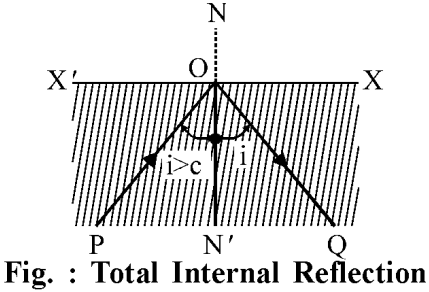
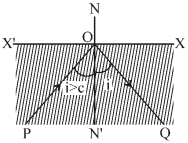
Total Internal Reflection : When the value of the angle of incidence in a dense medium is increased slightly beyond the critical angle, then the entire incident light gets reflected according to the laws of reflection and returns back to the dense medium. As shown in the fig. below. This phenomenon is called total internal reflection of light.
Image
Fig. : Total internal reflection
Relation between $u, v$ and $f$ for the Spherical Mirror :
Formula for spherical mirror :
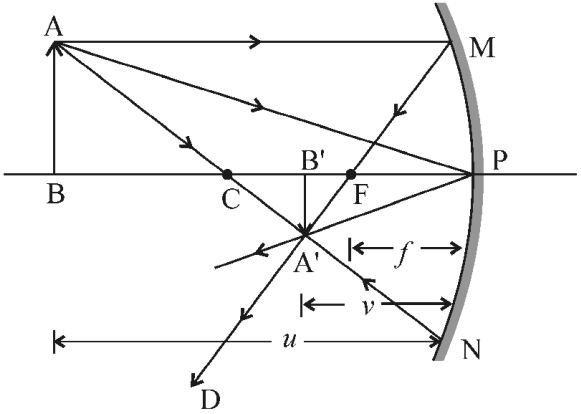
The relationship between $u, v$ and $f$ is shown in the figure to form an image from a concave mirror. At point B on the principal axis, a parallel ray AM from the object AB hits the surface of the mirror AM and passes through the focus after reflection. Ray AC from point A hits the mirror and returns to the same path due to being normal. These two reflected rays meet each other at point $A^{\prime}$. Hence the image of $A B$ becomes $B ^{\prime} A ^{\prime}$. Draw lines joining AP and AP . In the figure $\triangle MPF$ and $\triangle A ^{\prime} F ^{\prime} B , \angle A ^{\prime} FB ^{\prime}=\angle MFP$ due to opposite angle (mirror is of small aperture) hence MP is a straight line.
Since $\angle FPM =\angle A ^{\prime} FB B ^{\prime}$ is a right angle, so due to which $\triangle MPF , \triangle AF ^{\prime} B ^{\prime}$ is a similar triangle.
Therefore,$\frac{B^{\prime} A^{\prime}}{PM}=\frac{B^{\prime} F}{FP}$
$
\text { or } \quad \frac{B^{\prime} A^{\prime}}{BA}=\frac{B^{\prime} F}{FP}(\because PM=AB) \ldots(1)
$
Because $\angle APB =\angle APB ^{\prime}$, right angled triangles ABP and ABP are also similar.
Therefore, $\quad \frac{ B ^{\prime} A ^{\prime}}{ BA }=\frac{ B ^{\prime} P }{ BP } \ldots(2) $
By comparing equation (1) and (2), we will get
$
\frac{B^{\prime} F}{F P}=\frac{B^{\prime} P-F P}{F P}=\frac{B^{\prime} P}{B P} \ldots(3)
$
Equation (3) involves the magnitudes of distances. According to Cartesian sign convention, the signs of these three will be negative, hence
$
B^{\prime} P=-v, FP=-f, BP=-u
$
Image
Fig. : Ray diagram of image formation by a concave mirror
Using these in equation (3), we get
$\frac{-v+f}{-f}=\frac{-v}{-u}$
or $\quad \frac{v-f}{f}=\frac{v}{u}$
$\frac{v}{f}-1=\frac{v}{u}$
or $\quad\frac{v}{f}=\frac{v}{u}+1=\frac{v+u}{u}$
or $\quad \frac{1}{f}=\frac{v+u}{u v}=\frac{v}{u v}+\frac{u}{u v}$
or $\quad \frac{1}{v}+\frac{1}{u}=\frac{1}{f}$ $\ldots(4)$
This relation is called mirror equations
OR

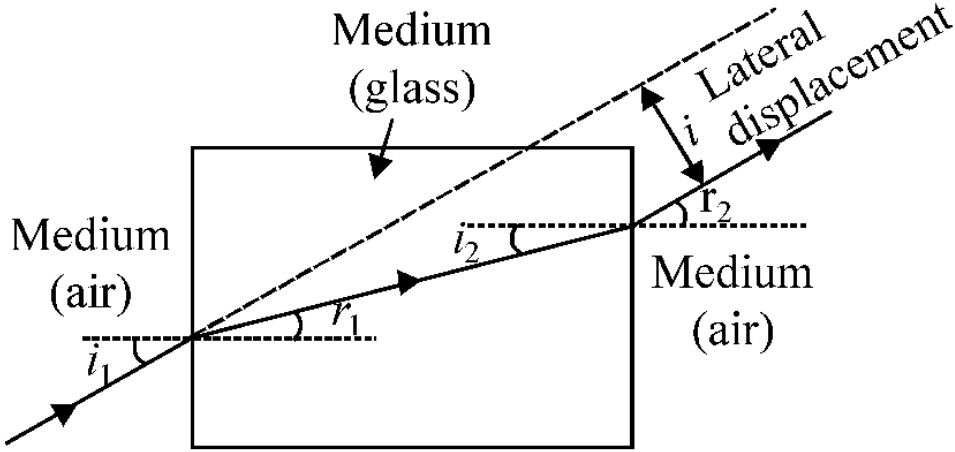
A ray of light travels in a definite straight line. After refraction through the glass slab, it emerges in a direction parallel to the original direction but slightly displaced from the line. This is called lateral displacement.
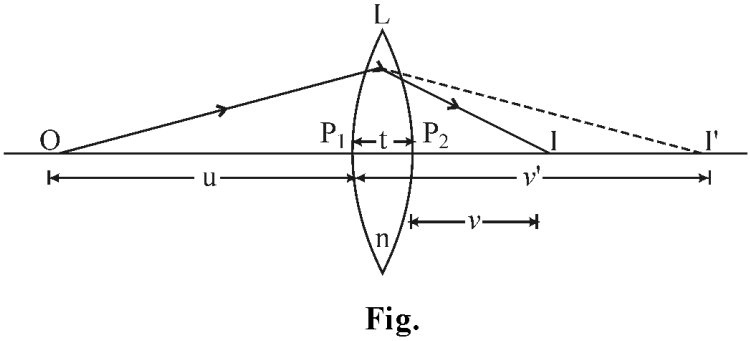
When the medium on either side of the lens is same : In the following figure, a thin lens L is placed in the air. Refractive index of the lens material relative to air is $n$ and the radii of curvature of its first and second surfaces are $R _1$ and $R _2$ respectively. Let the thickness of the lens be $t$.
Image
A point object $O$ is placed on the principal axis of the lens at a distance $u$ from the pole $P _1$ of its first surface. Due to refraction on the first surface, the image of object $O$ is formed at $I ^{\prime}$. Let the distance of $I ^{\prime}$ from the pole $P _1$ of the surface be $v^{\prime}$. Then according to the formula of refraction at a single spherical surface
$
\frac{n}{v^{\prime}}-\frac{1}{u}=\frac{n-1}{R_1} \ldots(1)
$
The image thus formed is $I^{\prime}$ for the second surface of the lens whose radius of curvature is $R _2$ will work as an object. The distance of I' from the pole $P _2$ of the other surface will be $\left(v^{\prime}-t\right)$. The image of second surface of I is I' at a distance from $v$. In this way the final image of the O of entire lens becomes at I .
On the second surface, because the light ray enters the air through the refractive index $n$, hence in the formula of refraction, writin $1 / n$ at place of $n$.
$
\frac{1 / n}{v}-\frac{1}{\left(v^{\prime}-1\right)}=\frac{\frac{1}{n}-1}{R_2} \ldots(2)
$
For thin lenses. The value of $t$ is negligible compared to $v^{\prime}$. So in comparison of $v$, on omitting $t$, the equation (2) will be as follows :
$\frac{1}{v}-\frac{n}{v^{\prime}}=\frac{-(n-1)}{ R _2} \ldots(3) $
By adding equations (1) and (3)
$
\frac{1}{v}-\frac{1}{u}=(n-1)\left(\frac{1}{R_1}-\frac{1}{R_2}\right) \ldots(4)
$
When the object is placed at infinity, the image will be formed at the second focus (principal focus) of the lens. That is $u=\infty$, then $v=f$, where $f$ is the second focal length (primary focal length) of the lens.
Putting the value in equation (4)
$
\frac{1}{f}-\frac{1}{\infty}=(n-1)\left(\frac{1}{R_1}-\frac{1}{R_2}\right)
$
or $\quad \frac{1}{f}=(n-1)\left(\frac{1}{R_1}-\frac{1}{R_2}\right) \ldots(5) $
Which is called lens makers formula.

View full question & answer
Question 25 Marks
$(a)$ What is meant by compound microscope? Draw a ray diagram of image formation by a compound microscope. Briefly describe its working and derive the formula for its total magnification.
$(b)$ How does the resolving power of a microscope change when :
$(i)$ The diameter of the objective lens decreases,
$(ii)$ The wavelength of incident light increases? Justify your answer in each case.
Answer
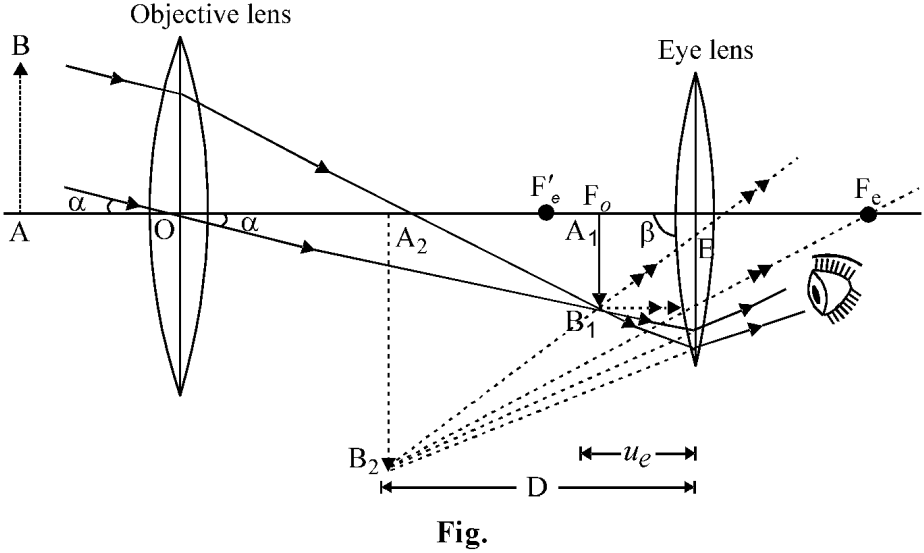
$(a)$ Compound microscope : It is an optical instrument made of two lenses which forms a magnified image of a nearby microscopic object. The angle of view formed by this image on the observer's eye is very large, as a result the eye can see the big object.
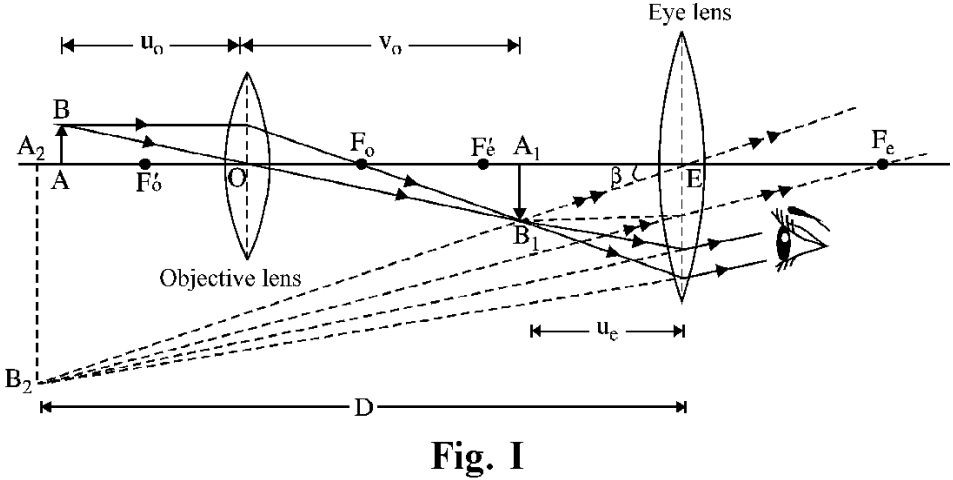
Ray diagram of image formation by compound microscope :
Image
Image
Working method:
As shown in the figure, the object $AB$ is placed in front of the objective lens at a distance beyond the focal length of the lens.
The rays emanating from the object get refracted through this lens and form $A _1 B_1$ real, inverted and magnified images of the object. This image acts as an object for the eye lens.
Now we adjust the eye lens in such a way that images $A _1 B_1$ are formed between the focus of the eye lens and the center of light.
The eye lens actually functions as a simple microscope and now its magnified virtual image $A _2 B_2$ is formed.
The position of the eye lens is adjusted such that the final image $A _2 B_2$ formed at a distance $D$ from the eye $A _2 B_2$ is erect with respect to the images $A _1 B_1$ but inverted with respect to the object $AB$ .
Magnifying power :
​​​​​​​The magnifying power of a compound microscope is the ratio of the angle of view formed on the eye by the final image formed by it and the angle of view formed on the eye by the object $($when the object is at the minimum is equal to distance of clear vision and is being seen directly without the instrument$)$.
Hence magnifying power i.e. angular magnification
$m=\frac{\text { The angle made by the final image at the eye }}{\text { The angle made by the object at the eye }}$
$($when the object is at distance $D)$
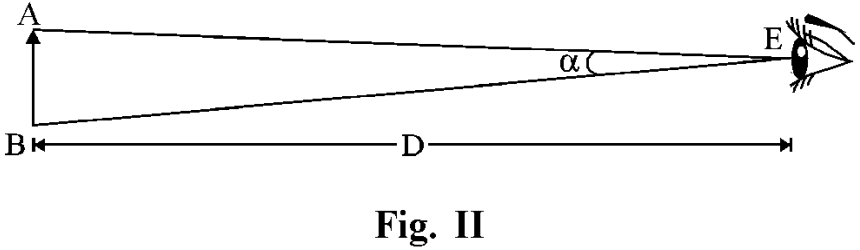
Suppose the last image $A _2 B_2$ make an angle $B$ at eyepiece $E$. Since the eye is close to the eyepiece, hence $\beta$ can be considered as the angle formed by $A _2 B_2$ on the eye $($Fig. $I)$. If the object $AB$ is placed at the minimum distance $D$ of clear vision from the eye and makes an angle $\alpha$ at the eye when held straight by the eye $($Fig. $II),$ then the magnifying power of the microscope
$m=\frac{\beta}{\alpha} \ldots(1)$
Since the object is small, the angles $\alpha, \beta$ will also be very small.
Therefore, in their place we can take their tangent $(\tan)$
Therefore $\alpha=\tan \alpha$ and $\beta=\tan \beta$
$\therefore m=\frac{\tan \beta}{\tan \alpha} \ldots(2)$
But $($Fig. $II)$ from right angled triangle ABE,
$\tan \alpha=\frac{A B}{D}\ldots(3)$
and $($Fig. $I)$ from right angled triangle $B _1 A_1 E$,
$\tan \beta=\frac{A_1 B_1}{EA_1}\ldots(4)$
After putting the values of equation $(3)$ and $(4)$ in equation $(2),$
$ m=\frac{A_1 B_1 / EA_1}{AB / D}=\frac{A_1 B_1}{AB}\left(\frac{D}{EA_1}\right) \ldots(5)$
If the distances of the object AB and the images $A _1 B_1$ from the objective $O$ are $u_0$ and $v_0$ respectively, then taking their proper signs,
$\frac{ A _1 B_1}{ AB }=\frac{+v_0}{-u_0}$
$\left(\because \frac{\text { Size of the image }}{\text { Size of the object }}=\frac{\text { Distance of the lens from } \\ \text { image }}{\text { Distance of the object from } \\ \text { the lens }}\right)$
If the distance of $A _1 B_1$ from the eyepiece $E\ ($for this, the virtual object$)$ is $u_{ e }$ then with appropriate sign
$EA _1=-u_e$
$\therefore$ Putting these values in equation $(5)$ and taking $D$ as negative,
$m=\frac{+v_0}{-u_0}\left(\frac{- D }{-u_e}\right)$
or $ m=\left[\frac{v_0}{u_0}\left(\frac{D}{u_e}\right)\right] \ldots(6)$
$(b)$ The resolving power of the microscope is $\propto \frac{n \sin \theta}{\lambda}$ where $\theta$ a half angle of the cone.
$(i)$ If the diameter of the objective lens decreases then the resolving power of the microscope also decreases, since the resolving power is directly proportional to the diameter.
$(ii)$ Resolving power $\propto \frac{1}{\lambda}$.
This means that as the value of wavelength $(\lambda)$ increases, the resolution power of that decreases.
View full question & answer
Question 35 Marks
Draw a labelled diagram of a refracting telescope. Obtain an expression for its magnifying power. Write two main disadvantages of refracting telescope as compared to reflecting telescope. What is meant by telescope? Draw the ray diagram of image formation by a refracting telescope. Briefly describe its working and derive the formula for its magnifying power.
Answer
Ray diagram of refracting telescope :
Image
Magnifying Power :
Magnifying power $'m\ '$ of the telescope is equal to the ratio of the angle of view made at the eye by the final image formed by it and the angle of view made at the eye by the object $($when the object is in its actual position$)$.
$\therefore m=\frac{\text { Angle of vision formed by the final image of the eye }}{\text { Angle of vision made by the object on the eye, when the object is in its original position }}$
Since it is the ratio of two angles, it is also called angular magnification.
Since the eye is near the eyepiece $E ,$ the angle of view formed on the eyepiece by the final image $A_2 B_2$ can be considered as the angle of vision $\beta$ formed on the eye by $A _2 B_2$.
Along with this, because the object $AB$ is located at a very far distance $($infinity$)$ from the telescope, hence the angle of vision $\alpha$ made by the object $AB$ on the objective $O$ can be considered as the angle made by the object on the eye.
Hence magnifying power
$m=\frac{\text { Angle of vision formed on the eyepiece by the final image } A _2 B_2}{\text { Angle of vision formed by the object on the objective }}$
i.e. $m=\frac{\beta}{\alpha}$
Since the angles $\alpha$ and $\beta$ are very small, hence its tangent $(\tan )$ can be taken in place of them.
Then $ m=\frac{\tan \beta}{\tan \alpha}$
but in the fig. at right angle
$\angle A _1 OB _1=\alpha\ (\because$ opposite angle $)$
Therefore from right angle $\Delta OA _1 B_1$,
$\tan \alpha=\frac{A_1 B_1}{OA_1}$
and from right angle $\Delta EA _1 B_1$,
$\tan \beta =\frac{A_1 B_1}{EA_1}$
$m =\frac{\left(A_1 B_1 / EA_1\right)}{\left(A_1 B_1 / OA_1\right)}$
$ =\frac{OA_1}{EA_1}$
If the focal length of the objective $O$ is $f_o$ and the distance of $A _1 B_1$ from the eyepiece $E$ is $u_e\ ($since $A _1 B_1$ act as objects for the eyepiece$)$.
On taking the appropriate sign,
$OA_1 =+f_o$ and $EA_1=-u_e$
$m =\frac{+f_e}{-u_e}$ or $m=-\left(\frac{f_o}{u_e}\right) \ldots(1)$
This is the general formula for magnifying power.
Disadvantages of refracting telescope compared to reflecting telescope :
$(1)$ Absorption of light is more in refracting telescope.
Therefore, the image formed by it is not brighter than that of a reflecting telescope.
$(2)$ Final image formed by refracting telescope has chromatic aberration defect.
It is not completely free from defects, whereas the image formed by a reflecting telescope is completely free from chromatic aberration defects.
View full question & answer
Question 45 Marks
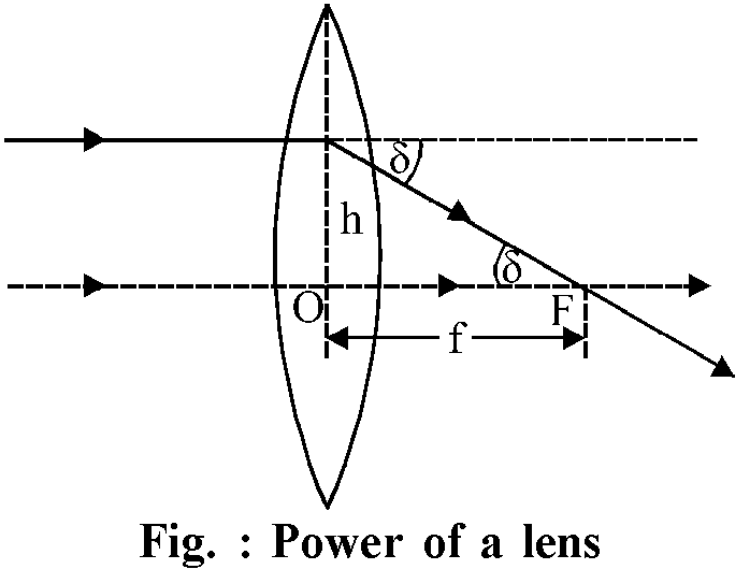
What is meant by power of lens? Explain this.
View full question & answer
Question 55 Marks
Define the following :
(a) Total internal reflection
(b) Diffraction of light
(c) Refraction of light.
Answer
(a) Total internal reflection : When the value of the angle of incidence in a dense medium is increased slightly beyond the critical angle, then the entire incident light gets reflected according to the laws of reflection and returns back to the dense medium as shown in the figure below. This phenomenon is called total internal reflection of light.

Image

Necessary conditions for total internal reflection :
(1) Light must pass from denser medium to rarer medium.
(2) In dense medium the value of angle of incidence should be larger than the critical angle.
(b) Diffraction of light : Diffraction of light is a characteristic property of diffraction wave. When there is any obstacle in the path of waves or the waves pass through a microscopic hole, they 'partially' bend at the edge of the obstacle or hole. This phenomenon is called diffraction.
The phenomenon of diffraction is seen in all types of waves, like light waves, sound waves etc. For diffraction of waves to occur, the size of the obstacle should be of the order of the wavelength of the waves.
(c) Refraction of light : These types of rays move in straight lines in a homogeneous and transparent medium, but when a ray of light passes from one such transparent medium to another transparent medium. So some part of the ray gets reflected on the boundary surface of the mediums and returns to the first medium and the remaining part goes to the second medium. When moving to another medium, the direction of the ray usually changes, i.e., the ray of light deviates from its initial direction.
"The deviation of a light ray from its path when it passes from one transparent medium to another is called refraction."

View full question & answer
Question 65 Marks
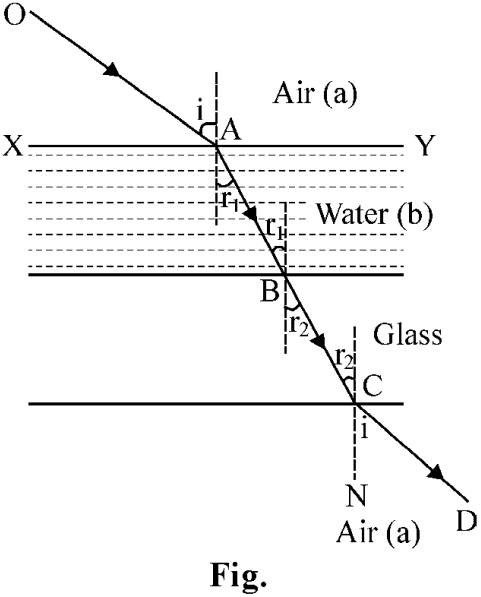
When a light ray passes from the atmosphere (a) through the combination of two mediums water (b) and glass (c), then find the relationship between the refractive indices of the three mediums.
View full question & answer
Question 75 Marks
Prove : $n_{12}=\frac{1}{n_{21}}$
View full question & answer
Question 85 Marks
(a) A point-image (object) is placed on the principal axis of a convex spherical surface of radius of curvature $R$, the refractive index of the medium on one side of this surface is $n _1$ and the refractive index of the medium on the other side is $n_2$, where $n_2>n_1$. For this, draw a ray diagram and derive the relation between object distance $(u)$, image distance $(v)$ and radius of curvature $( R )$ for refraction from rarer medium to denser medium on a convex spherical surface.
(b) Use the above relation in terms of $n_1$ and $n_2$, to obtain the condition for the position of the object and the radius of curvature when a real image is formed.
Answer
(a) For refraction on a convex spherical surface, distance of object $(u)$, distance of image $(v)$, refractive index of the medium $\left(n_1, n_2\right)$ and radius of curvature (R). Derive the relation $\frac{n_2}{v}-\frac{n_1}{u}=\frac{n_2-n_1}{ R }$.
(b) $\frac{n_2}{v}-\frac{n_1}{u}=\frac{n_2-n_1}{ R }$
For real image, $v$ is positive.
Therefore,$\frac{n_2}{v}=0$
$
\begin{array}{ll}
\text { So } \frac{n_1}{|u|}=\frac{n_2-n_1}{R} \\
\Rightarrow \frac{|u|}{n_1}>\frac{R}{n_2-n_1} \Rightarrow|u|>\frac{n_1 R}{n_2-n_1}
\end{array}
$
Which is a necessary condition.
View full question & answer
Question 95 Marks
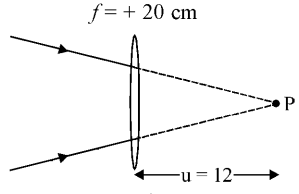
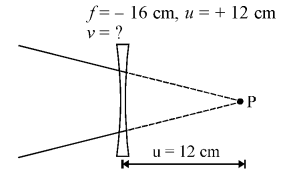
A beam of light converges at a point P. Now a lens is placed in the path of the convergent beam 12 cm from P. At what point does the beam converge if the lens is (a) a convex lens of focal length 20 cm, and (b) a concave lens of focal length 16 cm?
Answer
In this problem, the point works as imaging object towards R.H.S. of lens.
R.H.S. of lens.
$u=+12 cm, \quad v=?$
(a) For convex lens:
Image
Using the formula
$\frac{1}{f}=\frac{1}{v}-\frac{1}{u}$
or $\frac{1}{v}=\frac{1}{f}+\frac{1}{u}$
Putting the values
$\frac{1}{v}=\frac{1}{20}+\frac{1}{12}=\frac{3+5}{60}$
$\Rightarrow \quad \frac{1}{v}=\frac{8}{60}=\frac{2}{15}$
or $v=\frac{15}{2}=7 \cdot 5 cm$
Image is real and positioned at 7.5 cm towards R.H.S.
of lens.
(b) For concave lens:
Image

Using the formula:
$\frac{1}{f}=\frac{1}{v}-\frac{1}{u}$
We get, $\quad \frac{1}{v}=\frac{1}{f}+\frac{1}{u}$
or $\frac{1}{v}=\frac{1}{-16}+\frac{1}{12}=\frac{-3+4}{48}$
or $\frac{1}{v}=\frac{1}{48} \quad \therefore v=+48 cm$
Image will be real and will be at 48 cm distance at right side of lens.

View full question & answer
Question 105 Marks
A small bulb is placed at the bottom of a tank containing water to a depth of 80 cm. What is the area of the surface of water through which light from the bulb can emerge out? Refractive index of water is 1.33. (Consider the bulb to be a point source.)
Answer
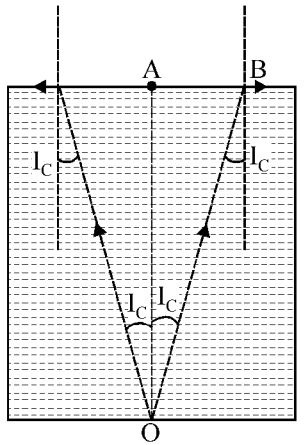
Let the light source 'O' be 80 cm below the water surface. i.e. Fig.
$OA =80 cm=\frac{80}{100} m$
${ }_a n_w=1.33$
The light ray emitted from O is refracted only in air, if the angle of incidence is smaller than the critical angle I_{C} then the light will not be refracted in air along the surface of water, but it will contact the air-water interface. The peak angle of the light come, which would appear to come from 2I_{C} If the angle of incidence at the water-air interface is greater than I_{C} then the light ray will be completely internally reflected.
Image
We know that: $\sin I _{ C }=\frac{1}{{ }_a n_w}$
$\Rightarrow$ $I _{ C }=\sin ^{-1}\left(\frac{1}{{ }_a n_w}\right)$
$I_C=\sin ^{-1}\left(\frac{1}{1.33}\right)=\sin ^{-1}(0.75)$
$I _{ C }=48.6^{\circ}$
Now, $\quad \tan I _{ C }=\frac{ AB }{ OA }$ or $AB = OA \tan I _{ C }$
$=\frac{80}{100} \times \tan 48.6^{\circ}=\frac{80}{100} \times 1.1345$
$=0.907 m=90.7 cm$
$\therefore$Area of surface of water from which light will emerge
$=\pi r^2=3.14 \times(0.907)^2$
$=3.14 \times 0.823$
$=2.584 m^2 \simeq 2.6 m^2$
View full question & answer
Question 115 Marks
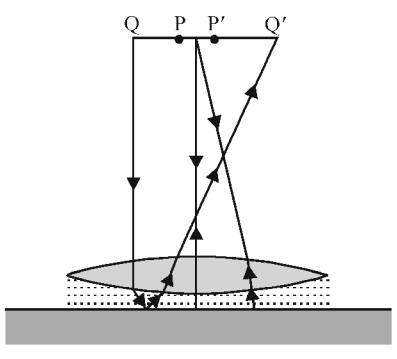
Fig. shows an equiconvex lens (of refractive index 1.50) in contact with a liquid layer on top of a plane mirror. A small needle with its tip on the principal axis is moved along the axis until its inverted image is found at the position of the needle. The distance of the needle from the lens is measured to be 45.0 cm. The liquid is removed and the experiment is repeated. The new distance is measured to be 30.0 cm. What is the refractive index of the liquid?Image
Answer
It is given that :
Focal length of biconvex lens L1, f1 = 30 cm.
The focal length of the combination of bi-convex lenses and plano-convex liquid lens is L2, F = 45 cm.
If the focal length of L2 2combinationthenis f2 then
$\frac{1}{f_2}=\frac{1}{F}-\frac{1}{f_1}$
$=\frac{1}{45}-\frac{1}{30}=\frac{2-3}{90}=-\frac{1}{90}$
or$\quad$$\quad$ $f_2=-90 cm$
For $L_1$ lens (for glass lens), $R_1=R$ and $R_2=-R$
$\frac{1}{30}=(1.5-1)\left(\frac{1}{ R }-\frac{1}{- R }\right)$
$\Rightarrow \quad R =30 cm$.
For lens $L _{ 2 }$ (for liquid lens),
$R _1=- R =-30 cm$
$R _2=\infty$
$-\frac{1}{90}=(n-1)\left(\frac{1}{-30}-\frac{1}{\infty}\right)$
$-\frac{1}{90}=(n-1)\left(\frac{1}{-30}-0\right)=\frac{-(n-1)}{30}$
$\Rightarrow \quad \frac{30}{90}=n-1$
$\Rightarrow \quad \frac{1}{3}=n-1$
$\Rightarrow \quad \frac{1}{3}+1=n$
$\Rightarrow \quad 0.33+1=n$
$\Rightarrow \quad n=1.33$
View full question & answer
Question 125 Marks
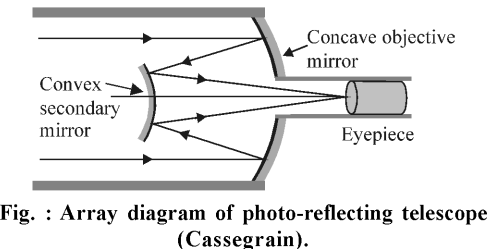
A Cassegrain telescope uses two mirrors as shown in Fig. Such a telescope is built with the mirrors 20 mm apart. If the radius of curvature of the large mirror is 220 mm and that of small mirror is 140 mm, where will the final image of an object at infinity be?
Image
Answer
Radius of curvature of concave mirror (i.e. of big mirror) = R1
Therefore R 2 = 140mm = 14cm
If the focal length of big and small mirrors are f1 and f2 respectively then
$f_1=\frac{ R _1}{2}=\frac{-22}{2}=-11 cm$.
And $f_2=\frac{ R _2}{2}=\frac{14}{2}=7 cm$.
The image formed by the larger mirror works as a virtual objective for the smaller mirror. Separation between mirrors
d = 20mm = 2 cm.
According to the sign convention, here f1, R1 have been taken as $-v_e$
Since the object is at infinity, so u = ∞
As shown in the diagram. The final image of the object is formed behind the objective mirror, which we see through the eyepiece.
The rays coming from the object located at infinity are about to meet at the main focus of the objective, but before this, a concave mirror of shorter focal length comes in between.
For objective:
$u=-\infty$,
Focal length, $f_1=-11 cm, v=$ ?
From mirror equation
$\frac{1}{u}+\frac{1}{v}=\frac{1}{f}$
or $\frac{1}{v}=\frac{1}{f}-\frac{1}{u}$
$=-\frac{1}{11}-\frac{1}{-\infty}=-\frac{1}{11}+\frac{1}{\infty}$
$=-\frac{1}{11}+0=-\frac{1}{11}$
or $v=-11 cm=$ Distance from objective
∴ Distance from convex lens
$=-(v+d)$
$=-(-11+2)=+9 cm$.
This work as virtual object for convex mirror.
$u^{\prime}=9 cm$.
f"= 7 cm.
v' = ?
$\therefore \quad \frac{1}{v^{\prime}}=\frac{1}{f^{\prime}}-\frac{1}{u^{\prime}}$
$=\frac{1}{7}-\frac{1}{9}=\frac{9-7}{63}=\frac{2}{63}$
$\therefore \quad v^{\prime}=\frac{63}{2}=31.5 cm$.
i.e. image is at 31.5 cm away from convex mirror.
View full question & answer
Question 135 Marks
An angular magnification (magnifying power) of 30X is desired using an objective of focal length 1.25 cm and an eyepiece of focal length 5 cm. How will you set up the compound microscope?
Answer
Given:
Focal length of objective $=f_o=1.25 cm$
Focal length of eyepiece $=f_e=5 cm$
Angular magnification (magnifying power) = m = 30
Let the microscope is in normal use ie, the image is at 25 cm.
Angular magnification of eyepiece
$\left(m_e\right)=\left(1+\frac{ D }{f}\right)=\left(1+\frac{25}{5}\right)=6$
Let angular magnification of objective lens $=m_o$
∴ $m=m_o \times m_e$
$m_o=\frac{m}{m_e}=\frac{30}{6}=5$
$\therefore$ From $m_o=\frac{v_o}{-u_o}$
$5=\frac{v_o}{-u_o}$
or $v_o=-5 u_o$
Using lens formula for objective lens:
$\frac{1}{v_o}-\frac{1}{u_o}=\frac{1}{f_o}$
$-\frac{1}{5 u_o}-\frac{1}{u_o}=\frac{1}{1.25}$
or $-\frac{6}{5 u_o}=\frac{100}{125}=\frac{4}{5}$
or $u _{ o }=-\frac{30}{20}=-1.5 cm$
i.e. objective should kept at 1.5 cm distant from objective lens.
$\because \quad v_o=-5 u_o$
$=-5(-1.5)=7.5 cm$
Lens formula for eye lens:
$v_e=-25 cm, f_e=5 cm$
$\frac{1}{v_e}-\frac{1}{u_e}=\frac{1}{f_e}$
or $\frac{1}{u_e}=\frac{1}{v_e}-\frac{1}{f_e}=-\frac{1}{25}-\frac{1}{5}=-\frac{6}{25}$
$\therefore \quad u_e=-\frac{25}{6}=-4.17 cm$
Therefore, the compound microscope should be arranged in such a way that the distance between the objective and the eye
$=\left|v_o\right|+\left|u_e\right|$
$=7.5+4.17=11.67 cm$
Distance between objective and eyepiece should bc = 11.67 cm. To obtain the required magnification, the object has to be placed 1.5 cm away from the objective.
View full question & answer
Question 145 Marks
A card sheet divided into squares each of size 1 mm2 is being viewed at a distance of 9 cm through a magnifying glass (a converging lens of focal length 9 cm) held close to the eye.
(a) What is the magnification produced by the lens? How much is the area of each square in the virtual image?
(b) What is the angular magnification (magnifying power) of the lens?
(c) Is the magnification in (a) equal to the magnifying power in (b)? Explain.
Answer
(a) Given that :$u=-9 cm, v=?, f=10 cm$.
From lens formula,
$\frac{1}{v}-\frac{1}{u}=\frac{1}{f}$
or $\frac{1}{v}-\frac{1}{(-9)}=\frac{1}{10}$
or $\frac{1}{v}+\frac{1}{9}=\frac{1}{10}$
or $\frac{1}{v}=\frac{1}{10}-\frac{1}{9}=\frac{9-10}{10 \times 9}=\frac{-1}{90}$
or $v=-90 cm$.
Produced magnification in lens $m=\frac{v}{u}=\frac{-90}{-9}$
$m=+10$ Virtual image
Area of each square in the virtual image = 1 mm²
i. e, 1mm × 1mm.
Since the lens produces a linear magnification of 10, the size of each square in the imaginary image will be appear$(10 \times 1 mm) \times(10 \times 1 mm)$.
or $A =100 mm^2=1 cm^2$
(b) Minimum distance of distinct vision D = - 25 cm
Therefore,
m = Angular magnification = Magnifying power
Thus, Magnifying power $=\frac{ D }{u}=\frac{-25}{-9}$
$=\frac{25}{9}=2.8$
(c) No, magnification by a lens and angular magnification (or magnifying power) of an optical instrument are two different concepts. Angular magnification is the ratio of the angular size of the object (which is equal to the angular size of the image when the image is magnified) and the angular size of the object in that position (when it is placed at the near point 25 cm), thus, $\left|\frac{v}{u}\right|$ is the magnitude of magnification and the magnification power is $\left(\frac{25}{|u|}\right)$.Only when the image is at the near point |v| = 25 only both the quantities are equal.
View full question & answer
Question 155 Marks
A screen is placed 90 cm from an object. The image of the object on the screen is formed by a convex lens at two different locations separated by 20 cm. Determine the focal length of the lens.
Answer
Given that:
$-u+v=90$ (According to sign convention)
$v=90+u$ ...(i)
Lens formula $\frac{1}{v}-\frac{1}{u}=\frac{1}{f}$ ...(ii)
From eqn. (i) and (ii)
$\frac{1}{90+u}-\frac{1}{u}=\frac{1}{f} \Rightarrow \frac{u-90-u}{(90+u) \times u}=\frac{1}{f}$
$\Rightarrow \quad \frac{-90}{\left(90 u+u^2\right)}=\frac{1}{f} \Rightarrow f=-\frac{\left(90 u+u^2\right)}{90}$
or $-90 f=90 u+u^2$
or $u^2+90 u+90 f=0....(iii)$
There is quadratic eqn in u ^ * in eqn (iii), let roots of this euqation u1 and u2
∴ Sum of roots $=u_1+u_2=-90$ ....(iv)
Multiplication of roots, $u_1+u_2=90 f$ ...(v)
Given that:
$u_1-u_2=20$ ...(vi)
Solving eqn (iv) and (vi) (adding them),
$2 u_1=-90+20=-70$
⇒ $u_1=-\frac{70}{2}=-35 cm$
On subtracting, $2 u_2=-90-20=-110$
or $u_2=-\frac{110}{2}=-55 cm$
Now, $u_1 u_2=90 f$
$(-35) \times(-55)=90 f$
or $f=\frac{35 \times 55}{90} \simeq 21.4 cm$
Therefore, focal length of lens = 21.4cm
Second method: Given that, a = 90cm, b = 20
$\therefore \quad f=\frac{a^2-b^2}{4 a} \Rightarrow f=\frac{(90)^2-(20)^2}{4 \times 90}$
$=\frac{(90+20)(90-20)}{4 \times 90}$
$\Rightarrow \quad \frac{110 \times 70}{4 \times 90}=\frac{11 \times 35}{9 \times 2}=\frac{385}{18}=21.4$
So, focal length $f=21.4 cm$
View full question & answer
Question 165 Marks
The image of a small electric bulb fixed on the wall of a room is to be obtained on the opposite wall 3 m away by means of a large convex lens. What is the maximum possible focal length of the lens required for the purpose?
Answer
From the lens formula
$\frac{1}{v}-\frac{1}{u}=\frac{1}{f}$ ...(i)
Given that : $\quad-u+v=3$
(According to sign convention.)
∴ $v=3+u$ ....(ii)
From eqn. (i) $\quad \frac{1}{3+u}-\frac{1}{u}=\frac{1}{f}$
or $\frac{u-3-u}{(3+u)(u)}=\frac{1}{f}$
or $f=\frac{u^2+3 u}{-3}$
For maximum of ' $f$ ', $\frac{d f}{d u}=0$
∴ $\frac{d}{d u}\left(\frac{u^2+3 u}{-3}\right)=0$ or $-\frac{1}{3}(2 u+3)=0$
or $2 u+3=0$ or $u=\frac{-3}{2}$
From eqn. (ii), $v=3-\frac{3}{2}=\frac{3}{2}$
Put the value of ' $u$ ' and ' $v$ ' in eqn. (i)
$\frac{1}{\frac{3}{2}}-\frac{1}{\frac{-3}{2}}=\frac{1}{f} \quad$ or $\frac{2}{3}+\frac{2}{3}=\frac{1}{f}$
or $\frac{2 \times 2}{3}=\frac{1}{f}$ or $f=\frac{3}{4}=0.75 m$
For this work the required max. focal length is $\frac{3}{4} m$ i.e. $f_{\max }=0.75 m$
Second method : Let the focal length of lens is ' $f$ ', then
$f=\frac{a^2-b^2}{4 a}$
where, $a=v+u$ (distance between oblect and image)
b = (v - u) distance between both positions of lens )
For maximum focal length
b = 0
∴ $f_{\max }=\frac{a^2-0}{4 a}=\frac{a^2}{4 a}=\frac{a}{4}$
$f_{\max }=\frac{3}{4}=0.75 m$
or $f_{\max }=0.75 m$.
View full question & answer
Question 175 Marks
Use the mirror equation to deduce that:
(a) an object placed between f and 2f of a concave mirror produces a real image beyond 2f.
(b) a convex mirror always produces a virtual image independent of the location of the object.
(c) the virtual image produced by a convex mirror is always diminished in size and is located between the focus and the pole.
(d) an object placed between the pole and focus of a concave mirror produces a virtual and enlarged image.
[Note: This exercise helps you deduce algebraically properties of image that one obtains from explicit ray diagrams.]
Answer
(a) $\frac{1}{v}+\frac{1}{u}=\frac{1}{f}$ (From concave mirror formula)
or $\frac{1}{v}=\frac{1}{f}-\frac{1}{u}, f<0$ (concave mirror)
$u<0$ (object placed towards left side)
For $\quad 2 for $\frac{1}{2 f}>\frac{1}{u}>\frac{1}{f}$ or $-\frac{1}{2 f}<-\frac{1}{u}<-\frac{1}{f}$
or $\frac{1}{f}-\frac{1}{2 f}<\frac{1}{f}-\frac{1}{u}<\frac{1}{f}-\frac{1}{f}$
From which, $\frac{1}{2 f}<\frac{1}{v}<0$
i.e. v will be negative and image will be real and beyond 2.f
(b) From the mirror formula of convex mirrori.
$\frac{1}{u}+\frac{1}{v}=\frac{1}{f} \quad$ Here $u<0$ and $f>0$
i.e. being less v always, image will be virtual and towards sight of mirror
(c) $\because$ Magnification $m=\frac{f}{f-u}$
$\because$ For convex mirror $u<0$ and $f<0$
Therefore $f-u>f$
from which m < 1 i.e. image will be smaller than objects.
(d) For concave mirror, u < 0 and f < 0
According to question
$f < u < 0 \Rightarrow \frac{1}{f}-\frac{1}{u}>0$
But from mirror formula $\frac{1}{v}=\frac{1}{f}-\frac{1}{u}$
$\frac{1}{v}>0$, in which $v$ is positive and situated left side of pole. Image is virtual and magnification
$m=-\frac{v}{u}=\frac{v}{|u|}$
But $\frac{1}{v}<\frac{1}{|u|}$ or $v>|u|$"
i.e. $m$ is positive and $m>1$, from which image becomes large.
View full question & answer
Question 185 Marks
A person with a normal near point (25 cm) using a compound microscope with objective of focal length 8.0 mm and an eyepiece of focal length 2.5 cm can bring an objective placed at 9.0 mm from the objective in sharp focus. What is the separation between the two lenses? Calculate the magnifying power of the microscope.
Answer
Given that:
D = 25cm
Focal length of objective lens $=f_o=8.0 mm$
∴ $f_o=0.8 cm$
Focal length of eyepiece $=f_e=2.5 cm$
$u_o=-9.0 mm=-0.9 cm$
$\begin{array}{r}\text { Distance between both lenses }= L =? \\ m=?\end{array}$
Lens formula for eyepiece :
$\frac{1}{f_e}=\frac{1}{v_e}-\frac{1}{u_e}$
or $-\frac{1}{u_e}=\frac{1}{f_e}-\frac{1}{v_e} \because v_e=- D =-25$
$=\frac{1}{2.5}-\left(-\frac{1}{25}\right)=\frac{10}{25}+\frac{1}{25}$
$=\frac{2}{5}+\frac{1}{25}=\frac{10+1}{25}$
$u_e=-\frac{25}{11} cm$
$\therefore \quad\left|u_e\right|=\left|-\frac{25}{11}\right|=\frac{25}{11} cm=2.27 cm$
For objective lens :
$\frac{1}{v_o}-\frac{1}{u_o}=\frac{1}{f_o}$
or $\frac{1}{v_o}=\frac{1}{f_o}+\frac{1}{u_o} \Rightarrow-\frac{1}{0.9}+\frac{1}{0.8}=\frac{-10}{9}+\frac{10}{8}$
$=\frac{-0.8+0.9}{072}=\frac{0.1}{072}$
or $\quad v_0=\frac{0.72}{0.1}=7.2 cm$
$\therefore \quad L =v_o+\left|u_e\right|$
$=7.2+2.27=9.47 cm$
Now magnification power of compound microscope :
$M =\frac{v_o}{\left|u_o\right|}\left(1+\frac{ D }{f_e}\right)=\frac{7.2}{0.9}\left(1+\frac{25}{2.5}\right)$
$=8 \times(1+10)=8 \times 11=88$

View full question & answer
Question 195 Marks
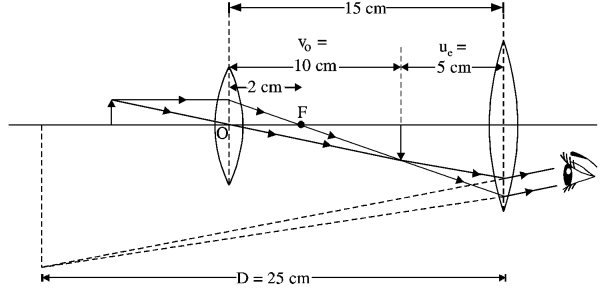
A compound microscope consists of an objective lens of focal length 2.0 cm and an eyepiece of focal length 6.25 cm separated by a distance of 15 cm. How far from the objective should an object be placed in order to obtain the final image at (a) the least distance of distinct vision (25 cm), and (b) at infinity? What is the magnifying power of the microscope in each case?
Answer
Given that:
$f_0=2 cm, \quad f_e=+6.25 cm$
$L =15 cm, \quad D =25 cm$
(a) $v_e=-25 cm, u_e=$ ?
From lens formula
$\frac{1}{v_e}-\frac{1}{u_e}=\frac{1}{f_e}$ or $-\frac{1}{u_e}=\frac{1}{f_e}-\frac{1}{v_e}$
$=\frac{1}{6.25}-\frac{1}{-25}=\frac{100}{625}+\frac{1}{25}$
or $-\frac{1}{u_e}=\frac{100+25}{625}=\frac{125}{625}$
or $-\frac{1}{u_e}=\frac{5}{25}=\frac{1}{5}$ or $u_e=-5 cm=|5| cm$.
Distance between eyepiece and objective lens
$=15 cm$
$\therefore \quad v_o=15-u_e=15-5=10 cm$
From formula of objective lens,
$\frac{1}{v_o}-\frac{1}{u_0}=\frac{1}{f_o} \therefore \frac{1}{u_o}=\frac{1}{v_o}-\frac{1}{f_o}$
$\Rightarrow \frac{1}{10}-\frac{1}{2}=-\frac{4}{10}$
or $u_o=\frac{-10}{4}=-2.5 cm=|2.5| cm$
Magnification power $m=\frac{v_e}{\left|u_e\right|}\left(1+\frac{ D }{f_e}\right)$
$=\frac{10}{2.5}\left(1+\frac{25}{6.25}\right)=\frac{10}{2.5} \times 5$
$m=20$
Image
(b) When final image forms at infinity .
$L =v_o+f_{ e }$
$v_o= L -f_e=15-6.25$
$v_o=+8.75 cm$
here $\begin{array}{l}u_e=f_e \\ u_e=\infty\end{array}$
$\frac{1}{f_o}=\frac{1}{v_o}-\frac{1}{u_0} \Rightarrow \frac{1}{u_o}=\frac{1}{v_o}-\frac{1}{f_0}=\frac{1}{8.75}-\frac{1}{2}=\frac{100}{875}-\frac{1}{2}$
$\frac{1}{u_o}=\frac{200-825}{1750}=\frac{-675}{1750}$
$u_o=-\frac{1750}{675}=-2.59 cm$
$\therefore u_o=|2.59| cm$
Magnification power
$m=\frac{-v_o}{u_o}\left[\frac{ D }{f_e}\right]=\frac{-8.75}{2.59} \times \frac{25}{6.25}=\frac{-875}{259} \times 4$
$m=-13.5=|13.5|=13.5$

View full question & answer