Question
(a) What is meant by compound microscope? Draw a ray diagram of image formation by a compound microscope. Briefly describe its working and derive the formula for its total magnification.
(b) How does the resolving power of a microscope change when :
(i) The diameter of the objective lens decreases,
(ii) The wavelength of incident light increases?Justify your answer in each case.
Answer

(a) Compound microscope : It is an optical instrument made of two lenses which forms a magnified image of a nearby microscopic object. The angle of view formed by this image on the observer's eye is very large, as a result the eye can see the big object.
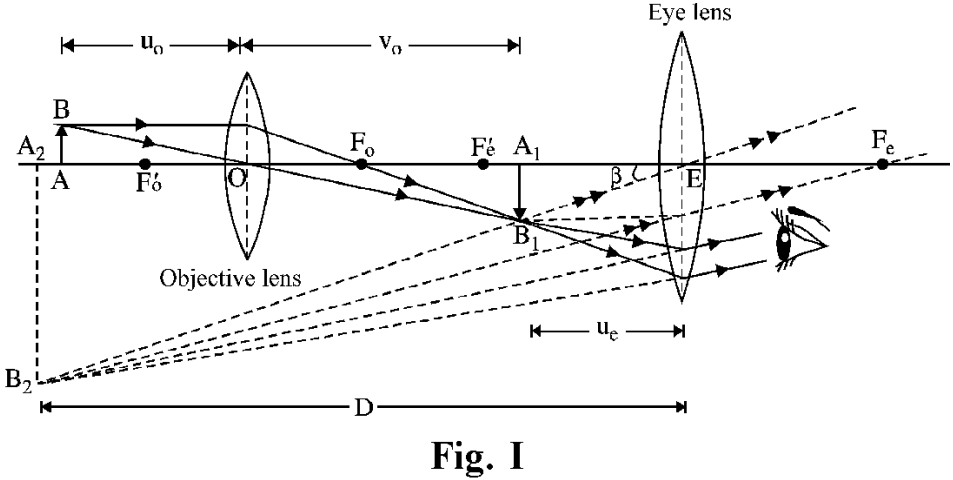
Ray diagram of image formation by compound microscope :
Image
Image
Working method: As shown in the figure, the object AB is placed in front of the objective lens at a distance beyond the focal length of the lens. The rays emanating from the object get refracted through this lens and form $A _1 B_1$ real, inverted and magnified images of the object. This image acts as an object for the eye lens.
Now we adjust the eye lens in such a way that images $A _1 B_1$ are formed between the focus of the eye lens and the center of light. The eye lens actually functions as a simple microscope and now its magnified virtual image $A _2 B_2$ is formed. The position of the eye lens is adjusted such that the final image $A _2 B_2$ formed at a distance D from the eye $A _2 B_2$ is erect with respect to the images $A _1 B_1$ but inverted with respect to the object AB .
Magnifying power : The magnifying power of a compound microscope is the ratio of the angle of view formed on the eye by the final image formed by it and the angle of view formed on the eye by the object (when the object is at the minimum is equal to distance of clear vision and is being seen directly without the instrument). Hence magnifying power i.e. angular magnification
$
\begin{array}{l}
m=\frac{\text { The angle made by the final image at the eye }}{\text { The angle made by the object at the eye }} \\
\text { (when the object is at distance D) }
\end{array}
$
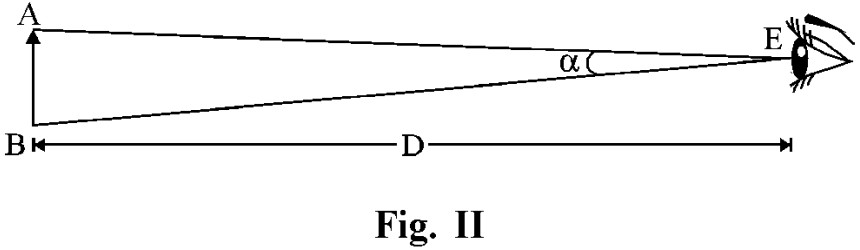
Suppose the last image $A _2 B_2$ make an angle B at eyepiece $E$. Since the eye is close to the eyepiece, hence $\beta$ can be considered as the angle formed by $A _2 B_2$ on the eye (Fig. I). If the object AB is placed at the minimum distance D of clear vision from the eye and makes an angle $\alpha$ at the eye when held straight by the eye (Fig. II), then the magnifying power of the microscope
$
m=\frac{\beta}{\alpha} \ldots(1)
$
Since the object is small, the angles $\alpha, \beta$ will also be very small. Therefore, in their place we can take their tangent $(\tan )$
Therefore $\alpha=\tan \alpha$ and $\beta=\tan \beta$
$
\therefore \quad m=\frac{\tan \beta}{\tan \alpha} \ldots(2)
$
But (Fig. II) from right angled triangle ABE,
$
\tan \alpha=\frac{A B}{D}\ldots(3)
$
and (Fig. I) from right angled triangle $B _1 A_1 E$,
$
\tan \beta=\frac{A_1 B_1}{EA_1}\ldots(4)
$
After putting the values of equation (3) and (4) in equation (2),
$ m=\frac{A_1 B_1 / EA_1}{AB / D}=\frac{A_1 B_1}{AB}\left(\frac{D}{EA_1}\right) \ldots(5)$
If the distances of the object AB and the images $A _1 B_1$ from the objective O are $u_0$ and $v_0$ respectively, then taking their proper signs,
$\frac{ A _1 B_1}{ AB }=\frac{+v_0}{-u_0}$
$\left(\because \frac{\text { Size of the image }}{\text { Size of the object }}=\frac{\begin{array}{c}\text { Distance of the lens from } \\ \text { image }\end{array}}{\begin{array}{c}\text { Distance of the object from } \\ \text { the lens }\end{array}}\right)$
If the distance of $A _1 B_1$ from the eyepiece E (for this, the virtual object) is $u_{ e }$ then with appropriate sign
$EA _1=-u_e$
$\therefore$ Putting these values in equation (5) and taking D as negative,
$m=\frac{+v_0}{-u_0}\left(\frac{- D }{-u_e}\right)$
or $\quad m=\left[\frac{v_0}{u_0}\left(\frac{D}{u_e}\right)\right] \ldots(6)$
(b) The resolving power of the microscope is $\propto \frac{n \sin \theta}{\lambda}$ where $\theta$ a half angle of the cone.
(i) If the diameter of the objective lens decreases then the resolving power of the microscope also decreases, since the resolving power is directly proportional to the diameter.
(ii) Resolving power $\propto \frac{1}{\lambda}$. This means that as the value of wavelength $(\lambda)$ increases, the resolution power of that decreases.

Need a full question paper?

Generate a complete, print-ready paper with questions like this in minutes — across 16+ boards, with answer keys.

Start Generating Free

Similar questions

Derive the lens formula $\frac{1}{\text{f}}=\frac{1}{\text{v}}-\frac{1}{\text{u}}$ for a thin concave lens, using the necessary ray diagram.
If neutrons exert only attractive force, why don't we have a nucleus containing neutrons alone?
The separation between the objective and the eyepiece of a compound microscope can be adjusted between 9.8cm to 11.8cm. If the focal lengths of the objective and the eyepiece are 1.0cm and 6cm respectively, find the range of the magnifying power if the image is always needed at 24cm from the eye.
  1. Draw a circuit diagram to study the input and output characteristics of an n-p-n transistor in its common emitter configuration. Draw the typical input and output characteristics.
  2. Explain, with the help of a circuit diagram, the working of n-p-n transistor as a common emitter amplifier.
A smooth wedge A is fitted in a chamber hanging from a fixed ceiling near the earth's surface. A block B placed at the top of the wedge takes a time T to slide down the length of the wedge. If the block is placed at the top of the wedge and the cable supporting the chamber is broken at the same instant, the block will:
  1. Take a time longer than T to slide down the wedge.
  2. Take a time shorter than T to slide down the wedge.
  3. Remain at the top of the wedge.
  4. Jump off the wedge.
A U-shaped wire is placed before a concave mirror having radius of curvature 20cm. Find the total length of the image.

A square loop PQRS carrying a current of 6.0A is placed near a long wire carrying 10A as shown in figure.

  1. Show that the magnetic force acting on the part PQ is equal and opposite to that on the part RS. 
  2. Find the magnetic force on the square loop.

In the LCR circuit shown in Fig, the ac driving voltage is $\text{v}=\text{v}_\text{m}\sin\omega\text{t}$.

  1. Write down the equation of motion for q(t).
  2. At t = t0, the voltage source stops and R is short circuited. Now write down how much energy is stored in each of L and C.
  3. Describe subsequent motion of charges

The difference in the frequencies of series limit of Lyman series and Balmer series is equal to the frequency of the first line of the Lyman series. Explain.
A wave travelling on a string, at a speed of 10m/s causes each particle of the string to oscillate with a time period of 20ms.
  1. What is the wavelength of the wave?
  2. If the displacement of a particle is 1.5mm at a certain instant, what will be the displacement of a particle 10cm away from it at the same instant?