A wind with speed $40\,\, m/s$ blows parallel to the roof of a house. The area of the roof is $250\, m^2.$ Assuming that the pressure inside the house is atmospheric pressure, the force exerted by the wind on the roof and the direction of the force will be $(\rho _{air} = 1.2 \,\,kg/m^3)$
AIPMT 2015Medium
Download our app for free and get started
Applying Bernoulli's theorem just above and just below the roof,
$P + \frac{1}{2}\rho {v^2} = {P_0} + 0$
$\left( {{P_0} - P} \right) = \frac{1}{2}\rho {v^2} = \Delta P$
Hence lift of the roof
$F = \Delta P \cdot A = \frac{1}{2}\rho A{v^2}$
$ = \frac{1}{2} \times 1.2 \times {\left( {40} \right)^2} \times 250 = 2.4 \times {10^5}N$
as pressure inside the roof is greater than outside the roof. so, force will act upward direction.

Download our appand get started for free
Experience the future of education. Simply download our apps or reach out to us for more information. Let's shape the future of learning together!No signup needed.*
Similar Questions
- 1The velocity of a small ball of mass $0.3\,g$ and density $8\,g / cc$ when dropped in a container filled with glycerine becomes constant after some time. If the density of glycerine is $1.3\,g / cc$, then the value of viscous force acting on the ball will be $x \times 10^{-4}\,N$, the value of $x$ is [use $g=10\,m / s ^{2}$ ]View Solution
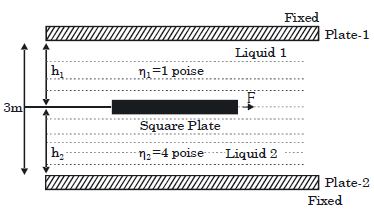
- 2A thin square plate of side $2\ m$ is moving at the interface of two very viscous liquids of viscosities ${\eta _1} = 1$ poise and ${\eta _2} = 4$ poise respectively as shown in the figure. Assume a linear velocity distribution in each fluid. The liquids are contained between two fixed plates. $h_1 + h_2 = 3\ m$ . A force $F$ is required to move the square plate with uniform velocity $10\ m/s$ horizontally then the value of minimum applied force will be ........ $N$View Solution
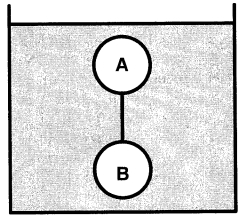
- 3Two solid spheres $A$ and $B$ of equal volumes but of different densities $d_A$ and $d_B$ are connected by a string. They are fully immersed in a fluid of density $d_F$. They get arranged into an equilibrium state as shown in the figure with a tension in the string. The arrangement is possible only ifView Solution
$(A)$ $d_Ad_F$ $(B)$ $d_B > d_F$ $(C)$ $d_A>d_F$ $(D)$ $d_A+d_B=2 d_F$
- 4A small metal sphere of radius $a$ is falling with a velocity $v$ through a vertical column of a viscous liquid. If the coefficient of viscosity of the liquid is $\eta $ , then the sphere encounters an opposing force ofView Solution
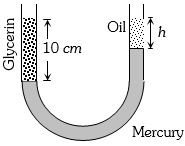
- 5A vertical $U-$ tube of uniform inner cross section contains mercury in both sides of its arms. A glycerin (density = $1.3 g/cm^3$) column of length $10 $ $cm $ is introduced into one of its arms. Oil of density $0.8 gm/cm^3$ is poured into the other arm until the upper surfaces of the oil and glycerin are in the same horizontal level. Find the length of the oil column ........ $cm$. Density of mercury = $13.6 g/cm^3$View Solution
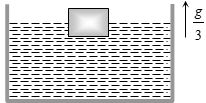
- 6A cubical block is floating in a liquid with half of its volume immersed in the liquid. When the whole system accelerates upwards with acceleration of $g/3,$ the fraction of volume immersed in the liquid will beView Solution
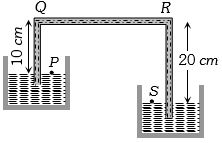
- 7A siphon in use is demonstrated in the following figure. The density of the liquid flowing in siphon is $ 1.5 gm/cc. $ The pressure difference between the point $P$ and $S$ will beView Solution
- 8A flat plate of area $10\,cm^2$ is separated from a large plate by a layer of glycerine $1\, mm$ thick. If the coefficient of viscosity of glycerine is $20$ poise, the force required to keep the plate moving with a velocity of $1\,cm/sec$ is .......... $dyne$View Solution
- 9A spherical marble of radius $1\, cm$ is stuck in a circular hole of radius slightly smaller than its own radius (for calculation purpose, both can be taken same) at the bottom of a bucket of height $40 \,cm$ and filled with water up to $10 \,cm$. If the mass of the marble is $20 \,g$, then the net force on the marble due to water is close toView Solution

- 10View SolutionWhich of the following is not the property of an ideal fluid?