Prove the result that the velocity v of translation of a rolling body (like a ring, disc, cylinder or sphere) at the bottom of an inclined plane of height h given by $\text{v}^2=\frac{2\text{gh}}{\big(1+\frac{\text{K}^2}{\text{R}^2}\big)}$ using dynamical consideration. Note K is the radius of gyration of the body about its symmetry axis, and R is the radius of the body. The body starts from rest at the top of the plane.
Download our app for free and get started
Consider a mass 'm' capable of rolling down the inclined plane from a vertical height 'h'. Rolling comprises of transitory motion of centre of mass and rotation produced by frictional force. Resolving the forces acting on the mass, we have Normal reaction force $\text{N}=\text{mg}\cos\theta\text{ and }$
$=\text{mg}\sin\theta-\text{F}_{\text{f}}=\text{ma}\dots(1)$ Torque = $F_f$ r and also $\tau=\text{I}\alpha=\frac{\text{l}\alpha}{\text{r}}\dots(2)$
$\text{F}_{\text{f}\text{r}}=\frac{\text{l}\alpha}{\text{r}}$
$\Rightarrow\text{F}_{\text{f}}=\frac{\text{I}\text{a}}{\text{r}}\dots(2)$ where, r is the radius of the body
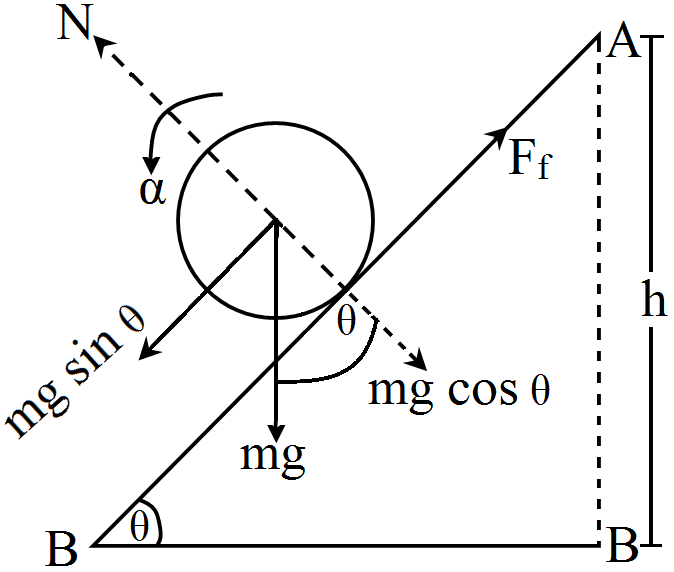
Using $F_f$_in (i), we have $\text{mg}\sin\theta=\Big(\text{m}+\frac{\text{l}}{\text{r}^2}\Big)\text{a}$
$\text{a}=\frac{\text{mg}\sin\theta}{\text{m}\Big(1+\frac{\text{K}^2}{\text{r}^2}\Big)}$
$=\frac{\text{g}\sin\theta}{\Big(1+\frac{\text{K}^2}{\text{r}^2}\Big)}[\therefore\text{I}=\text{mK}^2]$ Where K is the radius of gyration of the body about its symmetry axis using a, in $v^2 = u^2 + 2$
as, we have $\text{v}=\sqrt{\frac{2\text{g}\sin\theta\text{l}}{\Big(1+\frac{\text{K}^2}{\text{r}^2}\Big)}}$
$=\sqrt{\frac{2\text{gh}}{\Big(1+\frac{\text{K}^2}{\text{r}^2}\Big)}}[\therefore\text{i}\sin=\text{h}][\text{u}=0].$
$=\text{mg}\sin\theta-\text{F}_{\text{f}}=\text{ma}\dots(1)$ Torque = $F_f$ r and also $\tau=\text{I}\alpha=\frac{\text{l}\alpha}{\text{r}}\dots(2)$
$\text{F}_{\text{f}\text{r}}=\frac{\text{l}\alpha}{\text{r}}$
$\Rightarrow\text{F}_{\text{f}}=\frac{\text{I}\text{a}}{\text{r}}\dots(2)$ where, r is the radius of the body
Using $F_f$_in (i), we have $\text{mg}\sin\theta=\Big(\text{m}+\frac{\text{l}}{\text{r}^2}\Big)\text{a}$
$\text{a}=\frac{\text{mg}\sin\theta}{\text{m}\Big(1+\frac{\text{K}^2}{\text{r}^2}\Big)}$
$=\frac{\text{g}\sin\theta}{\Big(1+\frac{\text{K}^2}{\text{r}^2}\Big)}[\therefore\text{I}=\text{mK}^2]$ Where K is the radius of gyration of the body about its symmetry axis using a, in $v^2 = u^2 + 2$
as, we have $\text{v}=\sqrt{\frac{2\text{g}\sin\theta\text{l}}{\Big(1+\frac{\text{K}^2}{\text{r}^2}\Big)}}$
$=\sqrt{\frac{2\text{gh}}{\Big(1+\frac{\text{K}^2}{\text{r}^2}\Big)}}[\therefore\text{i}\sin=\text{h}][\text{u}=0].$

Download our appand get started for free
Experience the future of education. Simply download our apps or reach out to us for more information. Let's shape the future of learning together!No signup needed.*
Similar Questions
- 1View Solution
- Obtain an expression for moment of inertia of uniform circular disc about an axis perpendicular to the plane of disc and passing through its centre.
- Three point masses of 1kg, 2kg and 3kg lie at (1, 2), (0, -1) and (2, -3) respectively. Calculate the co-ordinates of centre of mass of the system.
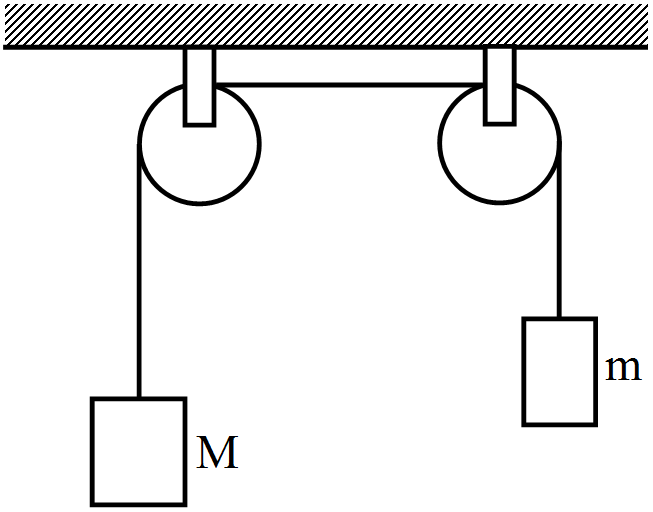
- 2View SolutionThe pulleys in figure are identical, each having a radius R and moment of inertia I. Find the acceleration of the block M.
- 3View SolutionA uniform disc of radius R and mass M is mounted on an axis supported in fixed frictionless bearing. A light chord is wrapped around the rim of the wheel and suppose that we hang a body of mass m from the chord. Find the angular acceleration of the disc and tangential acceleration of point on the rim.
- 4View SolutionThe door of an almirah is 6ft high, 1.5ft wide and weighs 8kg. The door is supported by two hinges situated at a distance of 1ft from the ends. If the magnitudes of the forces exerted by the hinges on the door are equal, find this magnitude.
- 5From a uniform disk of radius R, a circular hole of radius $\frac{\text{R}}{2}$ is cut out. The centre of the hole is at $\frac{\text{R}}{2}$ from the centre of the original disc. Locate the centre of gravity of the resulting flat body.View Solution
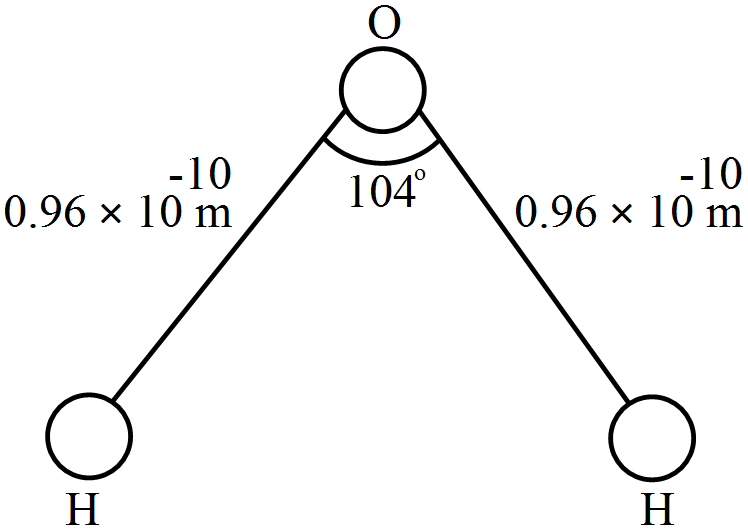
- 6View SolutionThe structure of a water molecule is shown in figure. Find the distance of the centre of mass of the molecule from the centre of the oxygen atom.
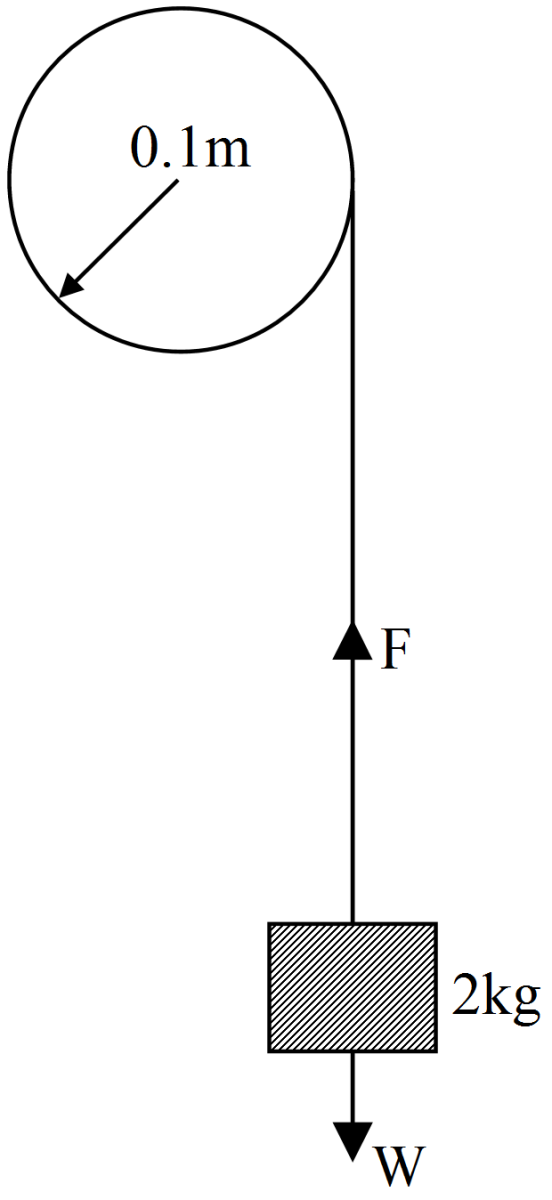
- 7The moment of inertia of a solid flywheel about its axis is $0.1kg-m^2$. A tangential force of $2kg/ wt$ is applied round the circumference of the flywheel with the help of a string and mass arrangement as shown in Fig. If the radius of the wheel is $0.1m$, find the acceleration of the mass.View Solution
- 8A hollow sphere is released from the top of an inclined plane of inclination $\theta.$View Solution
- What should be the minimum coefficient of friction between the sphere and the plane to prevent sliding?
- Find the kinetic energy of the ball as it moves down a length 1 on the incline if the friction coefficient is half the value calculated in part (a).
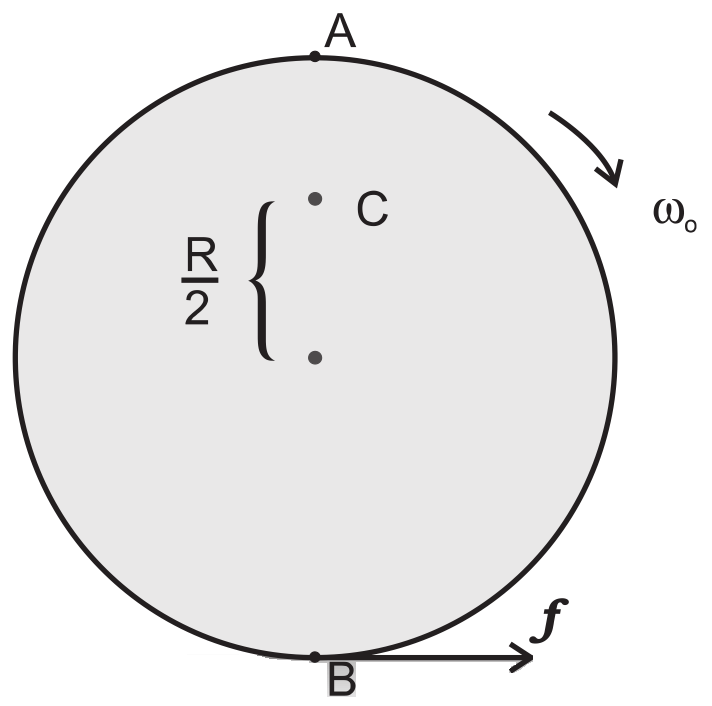
- 9A disc rotating about its axis with angular speed $\omega_0$ is placed lightly (without any translational push) on a perfectly frictionless table. The radius of the disc is R. What are the linear velocities of the points A, B and C on the disc shown in will the disc roll in the direction indicated?View Solution
- 10An electron of mass $9 \times 10^{-31}kg$ revolves in a circle of radius $0.53\mathring{\text{A}}$ around the nucleus of hydrogen with a velocity of $2.2 \times 10^6ms$. Show that angular momentum of elect ron is $\frac{\text{h}}{2\pi}$ where h is Planck's constant.View Solution