A wire of resistance $R_{1}$ is drawn out so that its length is increased by twice of its original length.The ratio of new resistance to original resistance is.
JEE MAIN 2022, Easy


Download our appand get started for free
Experience the future of education. Simply download our apps or reach out to us for more information. Let's shape the future of learning together!No signup needed.*
Similar Questions
- 1Four resistances $10$ $\Omega$, $5$ $\Omega$, $7$ $\Omega$ and $3$ $\Omega$ are connected so that they form the sides of a rectangle $AB$, $BC$, $CD$ and $DA$ respectively. Another resistance of $10$ $\Omega$ is connected across the diagonal $AC$. The equivalent resistance between $A$ and $B $ is .............. $\Omega$View Solution
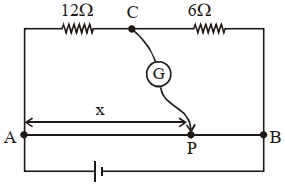
- 2Consider a $72\, cm$ long wire $AB$ as shown in the figure. The galvanometer jockey is placed at $P$ on $A B$ at a distance $x cm$ from $A$. The galvanometer shows zero deflection.View Solution
The value of $x,$ to the nearest integer, is ..... $cm$
- 3It is preferable to measure the $e.m.f.$ of a cell by potentiometer than by a voltmeter because of the following possible reasons.View Solution
$(i)$ In case of potentiometer, no current flows through the cell.
$(ii)$ The length of the potentiometer allows greater precision.
$(iii)$ Measurement by the potentiometer is quicker.
$(iv)$ The sensitivity of the galvanometer, when using a potentiometer is not relevant.
Which of these reasons are correct? - 4A null point is found at $200\,cm$ in potentiometer when cell in secondary circuit is shunted by $5\,\Omega$. When a resistance of $15\,\Omega$ is used for shunting null point moves to $300\,cm$. The internal resistance of the cell is $..............\,\Omega$.View Solution
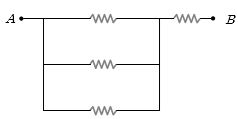
- 5If all the resistors shown have the value $2\, ohm$ each, the equivalent resistance over $AB$ isView Solution
- 6View SolutionA conductor behaves as a superconductor
- 7A current of $1.6\, A$ is flowing through a wire having cross-sectional area $1\, mm^2$. If density of free electrons in the material of the wire is $10^{29}\, per\, m^3$, the drift velocity of electrons will beView Solution
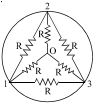
- 8Inside $a$ super conducting ring six identical resistors each of resistance $R$ are connected as shown in figure. Imagine a battery of $emf$ $E$ between the point $0$ and $1$, with its positive terminal connected with $O.$View Solution
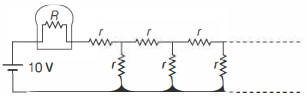
- 9A light bulb of resistance $R=16 \,\Omega$ is attached in series with an infinite resistor network with identical resistances $r$ as shown below. A $10 \,V$ battery drives current in the circuit. ............. $\Omega$ the value of $r$ such that the bulb dissipates about $1 \,W$ of power.View Solution
- 10Two identical cells, when connected either in parallel or in series gives same current in an external resistance $5\,\Omega$. The internal resistance of each cell will be $.............\,\Omega$.View Solution