Question
A wire stretched between two rigid supports vibrates in its fundamental mode with a frequency of 45Hz. The mass of the wire is 3.5 × 10⁻²kg and its linear mass density is 4.0 × 10⁻²kg m–1. What is
  1. The speed of a transverse wave on the string,
  2. The tension in the string?

Answer

  1. Mass of the wire, m = 3.5 × 10⁻²kg

Linear mass density, $\mu=\frac{\text{m}}{\text{l}}=4.0\times10^2\text{kg m}^{-1}$

Frequency of vibration, v = 45Hz

$\therefore$ length of the wire, $\text{l}=\frac{\text{m}}{\mu}=\frac{3.5\times10^{-2}}{4. 0\times10^{-2}}=0.875\text{m}$

The wavelength of the stationary wave $(\lambda)$ is related to the length of the wire by the relation:

$\lambda=\frac{2\text{l}}{\text{m}}$

where,

n = Number of nodes in the wire

For fundamental node, n = 1:

$\lambda=2\text{l}$

$\lambda=2\times0.875=1.75\text{m}$

The speed of the transverse wave in the string is given as:

$\text{v}=\text{v}\lambda=45\times1.75=78.75\text{m/s}$

  1. The tension produced in the string is given by the relation:

$\text{T}=\text{v}^2\mu$

$=(78.75)^2\times4.0\times10^{-2}=248.06\text{N}$
Need a full question paper?

Generate a complete, print-ready paper with questions like this in minutes — across 16+ boards, with answer keys.

Start Generating Free

Similar questions

A solid disc and a ring, both of radius 10cm are placed on a horizontal table simultaneously, with initial angular speed equal to 10 π rad s-1. Which of the two will start to roll earlier? The co-efficient of kinetic friction is $\mu_\text{k}=0.2$
A piston is fitted in a cylindrical tube of small cross-section with the other end of the tube open. The tube resonates with a tuning fork of frequency 512Hz. The piston is gradually pulled out of the tube and it is found that a second resonance occurs when the piston is pulled out through a distance of 32.0cm. Calculate the speed of sound in the air of the tube.
A marble rolls along a table at a constant speed of $1.00 m / s$ and then falls off the edge of the table to the floor 1.00 m below,
i. How long does the marble take to reach the floor?
ii. At what horizontal distance from the edge of the table does the marble land?
iii. What is its velocity as it strikes the floor?
A thin circular loop of radius R rotates about its vertical diameter with an angular frequency $\omega.$ Show that a small bead on the wire loop remains at its lowermost point for $\omega\le\sqrt{\frac{\text{g}}{\text{R}}}.$ What is the angle made by the radius vector joining the centre to the bead with the vertical downward direction for $\omega=\sqrt{\frac{2\text{g}}{\text{R}}}?$ Neglect friction.
The potential energy of a spring when stretched through a distance x is 25J. What is the amount of work done on the same spring so as to stretch it by an additional distance 5x ?
Particles of masses 1g, 2g, 3g, ........, 100g are kept at the marks 1cm, 2cm, 3cm, ........, 100cm respectively on a metre scale. Find the moment of inertia of the system of particles about a perpendicular bisector of the metre scale.
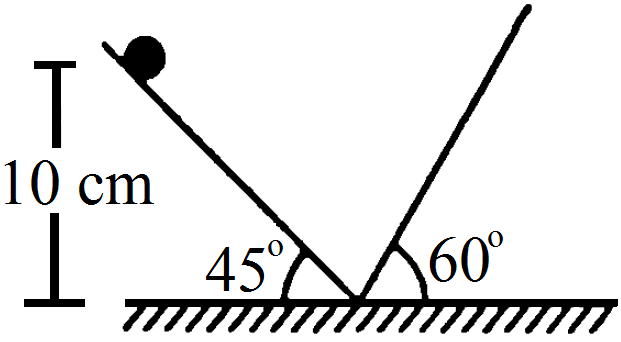
Find the time period of the motion of the particle shown in figure Neglect the small effect of the bend near the bottom.

Two Carnot engines A and B are operated in series. The first one A receives heat at 900K and rejects it to a reservoir at temperature T. The second engine B operates on this reservoir and rejects heat to a reservoir at 400K. Calculate temperature T when,
  1. Efficiencies of both A and B are equal.
  2. The work outputs of both A and B are equal.
Write Kelvin-Planck and Clausius statements for second law of thermodynamics. Define coefficient of efficiency and coefficient of performance. Show the heat flow in case of an engine and refrigerator using schematic diagrams.
In a Young's double slit interference experiment the fringe pattern is observed on a screen placed at a distance D from the slits. The slits are separated by a distance d and are illuminated by monochromatic light of wavelength $\lambda$. Find the distance from the central point where the intensity falls to,
  1. Half the maximum.
  2. One fourth of the maximum.