Question
In a Young's double slit interference experiment the fringe pattern is observed on a screen placed at a distance D from the slits. The slits are separated by a distance d and are illuminated by monochromatic light of wavelength $\lambda$. Find the distance from the central point where the intensity falls to,
  1. Half the maximum.
  2. One fourth of the maximum.

Answer

  1. When intensity is half the maximum $\frac{\text{I}}{\text{I}_\text{max}}=\frac{1}{2}$

$\Rightarrow\frac{4\text{a}^2\cos^2\big(\frac{\phi}{2}\big)}{4\text{a}^2}=\frac{1}{2}$

$\Rightarrow\cos^2\Big(\frac{\phi}{2}\Big)=\frac{1}{2}\Rightarrow\cos\Big(\frac{\phi}{2}\Big)=\frac{1}{\sqrt{2}}$

$\Rightarrow\frac{\phi}{2}=\frac{\pi}{4}\Rightarrow\phi=\frac{\pi}{2}$

$\Rightarrow$ Path difference, $\text{x}=\frac{\lambda}{4}$

$\Rightarrow\text{y}=\frac{\text{xD}}{\text{d}}=\frac{\lambda\text{D}}{4\text{d}}$

  1. When intensity is $\frac{1}{4}\text{th}$ of the maximum $\frac{\text{I}}{\text{I}_\text{max}}=\frac{1}{4}$

$\Rightarrow\frac{4\text{a}^2\cos^2\Big(\frac{\phi}{2}\Big)}{4\text{a}^2}=\frac{1}{4}$

$\Rightarrow\cos^2\Big(\frac{\phi}{2}\Big)=\frac{1}{4}\Rightarrow\cos\Big(\frac{\phi}{2}\Big)=\frac{1}{2}$

$\Rightarrow\frac{\phi}{2}=\frac{\pi}{3}\Rightarrow\phi=\frac{2\pi}{3}$

$\Rightarrow$ Path difference, $\text{x}=\frac{\lambda}{3}$

$\Rightarrow\text{y}=\frac{\text{xD}}{\text{d}}=\frac{\lambda\text{D}}{3\text{d}}$
Need a full question paper?

Generate a complete, print-ready paper with questions like this in minutes — across 16+ boards, with answer keys.

Start Generating Free

Similar questions

The magnetic field in a region is given by $\vec{\text{B}}=\vec{\text{k}}\frac{\text{B}_0}{\text{L}}\text{y}$ where L is a fixed length. A conductihg rod of of length lies along the Y-axis between the origin and the point (0, L, 0). If the rod moves with a velocity $\text{v}=\text{v}_0\vec{\text{i}},$ find the emf induced between the ends of the rod.
A thin lens made of a material of refractive index $\mu_2$ has a medium of refractive index $\mu_1$ on one side and a medium of refractive index $\mu_3$ on the other side. The lens is biconvex and the two radii of curvature have equal magnitude R. A beam of light travelling parallel to the principal axis is incident on the lens. Where will the image be formed if the beam is incident from:
  1. The medium $\mu_1$
  2. From the medium $\mu_3?$
Fe+ ions are accelerated through a potential difference of 500V and are injected normally into a homogeneous magnetic field B of strength 20.0mT. Find the radius of the circular paths followed by the isotopes with mass numbers 57 and 58. Take the mass of an ion = A (1.6 × 10⁻²⁷)kg, where A is the mass number.
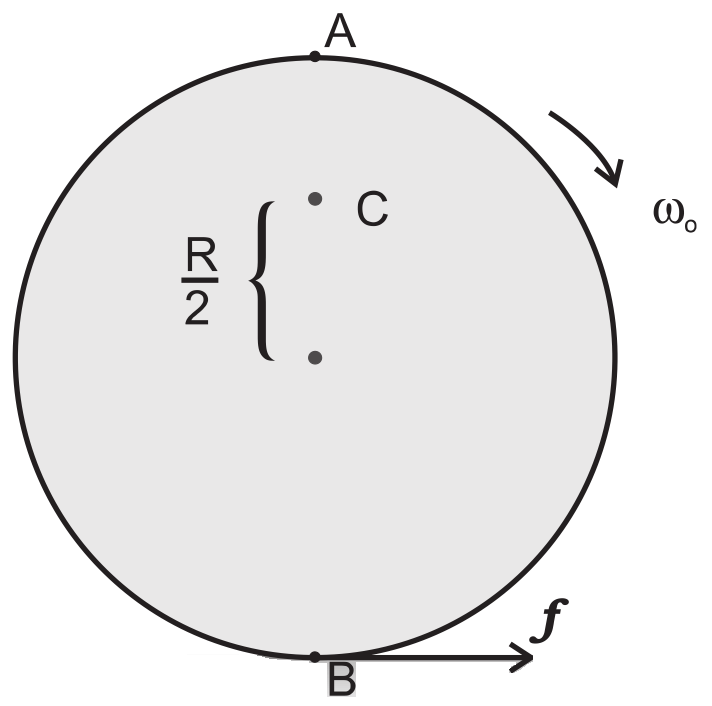
A disc rotating about its axis with angular speed $\omega_0$ is placed lightly (without any translational push) on a perfectly frictionless table. The radius of the disc is R. What are the linear velocities of the points A, B and C on the disc shown in will the disc roll in the direction indicated?

A girl riding a bicycle along a straight road with a speed of 5m s–1 throws a stone of mass 0.5kg which has a speed of 15m s–1 with respect to the ground along her direction of motion. The mass of the girl and bicycle is 50kg. Does the speed of the bicycle change after the stone is thrown? What is the change in speed, if so?
Two particles each of mass m and speed v travel in opposite direction along parallel lines, separated by a distance d. Show that vector angular momentum of the two particles system is same whatever be the point about which angular momentum is taken.
A thin rod having length L0 at 0°C and coefficient of linear expansion $\alpha$ has its two ends maintained at temperatures $\theta_1$ and $\theta_2,$ respectively. Find its new length.
A long spring of spring constant 500N/ m is attached to a wall horizontally and surface below the spring is rough with coefficient of friction 0.75. A 100kg mass block moving with a speed $10\sqrt{2}\text{ms}^{-2}$ strikes the spring. Find the maximum compression of the spring. (g = 10ms-2)
A smooth sphere of radius R is made to translate in a straight line with a constant acceleration a. A particle kept on the top of the sphere is released from there at zero velocity with respect to the sphere. Find the speed of the particle with respect to the sphere as a function of the angle $\theta$ it slides.
The separation between the objective and the eyepiece of a compound microscope can be adjusted between 9.8cm to 11.8cm. If the focal lengths of the objective and the eyepiece are 1.0cm and 6cm respectively, find the range of the magnifying power if the image is always needed at 24cm from the eye.