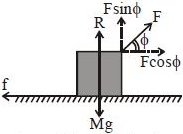
A wooden block of mass $M$ resting on a rough horizontal surface is pulled with a force $F$ at an angle $\phi $ with the horizontal. If $\mu $ is the coefficient of kinetic friction between the block and the surface, then acceleration of the block is
Diffcult


Download our appand get started for free
Experience the future of education. Simply download our apps or reach out to us for more information. Let's shape the future of learning together!No signup needed.*
Similar Questions
- 1A block is at rest on an inclined plane making an angle $\alpha $ with the horizontal. As the angle $\alpha $ of the incline is increased, the block starts slipping when the angle of inclination becomes $\theta $. The coefficient of static friction between the block and the surface of the inclined plane isView Solution
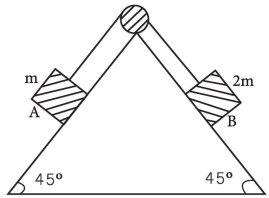
- 2Consider the diagram shown below in which two masses of $m$ and $2 m$ are placed on a fixed triangular wedge. The coefficient of friction between block $A$ and the wedge is $2 / 3$, while that for block $B$ and the wedge is $1 / 3$View Solution
- 3The maximum velocity (in $ms^{-1}$) with which a car driver must traverse a flat curve of radius $150 \,m$ and coefficient of friction $0.6$ to avoid skidding isView Solution
- 4Two blocks $A$ and $B$ of masses $5 \,kg$ and $3 \,kg$ respectively rest on a smooth horizontal surface with $B$ over $A$. The coefficient of friction between $A$ and $B$ is $0.5$. The maximum horizontal force (in $kg$ wt.) that can be applied to $A$, so that there will be motion of $A$ and $B$ without relative slipping, isView Solution
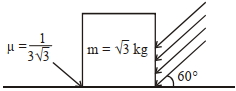
- 5As shown in the figure, a block of mass $\sqrt{3}\, kg$ is kept on a horizontal rough surface of coefficient of friction $\frac{1}{3 \sqrt{3}}$. The critical force to be applied on the vertical surface as shown at an angle $60^{\circ}$ with horizontal such that it does not move, will be $3 x$. The value of $3x$ will beView Solution
$\left[ g =10 m / s ^{2} ; \sin 60^{\circ}=\frac{\sqrt{3}}{2} ; \cos 60^{\circ}=\frac{1}{2}\right]$
- 6A uniform wooden stick of mass $1.6 \mathrm{~kg}$ and length $l$ rests in an inclined manner on a smooth, vertical wall of height $h( < l)$ such that a small portion of the stick extends beyond the wall. The reaction force of the wall on the stick is perpendicular to the stick. The stick makes an angle of $30^{\circ}$ with the wall and the bottom of the stick is on a rough focr. The reaction of the wall on the stick is equal in magnitude to the reaction of the floor on the st $ck$. The ratio $h / l$ and the frictional force $f$ at the bottom of the stick are $\left(g=10 \mathrm{~m} \mathrm{~s}^{-2}\right)$View Solution
- 7A car of $800 \mathrm{~kg}$ is taking turn on a banked road of radius $300 \mathrm{~m}$ and angle of banking $30^{\circ}$. If coefficient of static friction is $0.2$ then the maximum speed with which car can negotiate the turn safely : $\left(\mathrm{g}=10 \mathrm{~m} / \mathrm{s}^2, \sqrt{3}=1.73\right)$View Solution
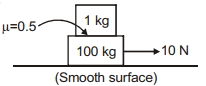
- 8The frictional force acting on $1 \,kg$ block is .................. $N$View Solution
- 9$A$ block of mass $M$ is placed on $a$ horizontal surface and it is tied with an inextensible string to $a$ block of mass, as shown in figure. A block of mass $m_0$ is also placed on $M$ If $\mu < \mu_{min}$ (the minimum friction required to keep the block $m$ stationary), then the downward acceleration of $m$ isView Solution

- 10A particle moves in a horizontal circle on the smooth inner surface of a hemispherical bowl of radius $R$. The plane of motion is at a depth $d$ below the centre of the hemisphere. The speed of the particle is :-View Solution