A uniform wooden stick of mass $1.6 \mathrm{~kg}$ and length $l$ rests in an inclined manner on a smooth, vertical wall of height $h( < l)$ such that a small portion of the stick extends beyond the wall. The reaction force of the wall on the stick is perpendicular to the stick. The stick makes an angle of $30^{\circ}$ with the wall and the bottom of the stick is on a rough focr. The reaction of the wall on the stick is equal in magnitude to the reaction of the floor on the st $ck$. The ratio $h / l$ and the frictional force $f$ at the bottom of the stick are $\left(g=10 \mathrm{~m} \mathrm{~s}^{-2}\right)$
IIT 2016, Advanced
Download our app for free and get started
$(d)$ Considering the normal reaction of the floor and wall to be $N$ and with reference to the figure.
$Image$
By vertical equilibrium.
$N+N \sin 30^{\circ}=1.6 g \Rightarrow N=\frac{3.2 g}{3} \ldots$
By horizontal equilibrium
$f=N \cos 30^{\circ}=\frac{\sqrt{3}}{2} N=\frac{16 \sqrt{3}}{3} \operatorname{From}(i)$
Taking torque about A we get
$1.6 g \times A B=N \times x$
$1.6 g \times \frac{l}{2} \cos 60^{\circ}=\frac{3.2 g}{3} \times x \therefore \frac{3 l}{8}=x \ldots .$
But $\cos 30^{\circ}=\frac{h}{x} \therefore x=\frac{h}{\cos 30^{\circ}} \ldots (iii)$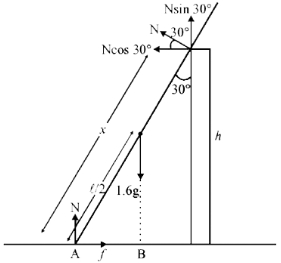

Download our appand get started for free
Experience the future of education. Simply download our apps or reach out to us for more information. Let's shape the future of learning together!No signup needed.*
Similar Questions
- 1$Assertion$ : There is a stage when frictional force is not needed at all to provide the necessary centripetal force on a banked road.View Solution
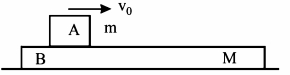
$Reason$ : On a banked road, due to its inclination the vehicle tends to remain inwards without any chances of skidding. - 2The masses of blocks A and B are $m$ and $M$ respectively. Between $A$ and $B$, there is a constant frictional force $F$ and $B$ can slide on a smooth horizontal surface. A is set in motion with velocity while $B$ is at rest. What is the distance moved by A relative to $B$ before they move with the same velocity?View Solution
- 3A block of mass $M$ rests on a rough horizontal table. A steadily increasing horizontal force is applied such that the block starts to slide on the table without toppling. The force is continued even after sliding has started. Assume the coefficients of static and kinetic friction between the table and the block to be equal. The correct representation of the variation of the frictional force $f$, exerted by the table on the block with time $t$ is given byView Solution
- 4The force required just to move a body up an inclined plane is double the force required just to prevent the body from sliding down. If $\mu $ is the coefficient of friction, the inclination of plane to the horizontal isView Solution
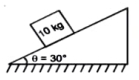
- 5A block of mass $10 \,kg$ is kept on a fixed rough $(\mu=0.8)$ inclined plane of angle of inclination $30^{\circ}$. The frictional force acting on the block is ........... $N$View Solution
- 6A car is moving on a horizontal circular track of radius $0.2 \,km$ with a constant speed. If coefficient of friction between tyres of car and road is $0.45$, then speed of car may be ........ $m / s$ [Take $g=10 \,m / s ^2$ ]View Solution
- 7A hemispherical bowl of radius $r$ is set rotating about its axis of symmetry in vertical. A small block kept in the bowl rotates with bowl without slipping on its surface. If the surface of the bowl is smooth and the angle made by the radius through the block with the vertical is $\theta$, then find the angular speed at which the ball is rotating.View Solution
- 8Pulling force making an angle $\theta $ to the horizontal is applied on a block of weight $W$ placed on a horizontal table. If the angle of friction is $\alpha $, then the magnitude of force required to move the body is equal toView Solution
- 9View SolutionMaximum force of friction is called
- 10$10\, kg$ block is placed as shown, if $F = 50$ newton find friction force ............ $N$View Solution