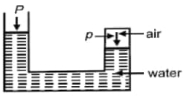
A beaker containing a liquid of density $\rho $ moves up with an acceleration $a$ ; the pressure due to the liquid at a depth $h$ below the free surface of the liquid is
Diffcult
Download our app for free and get started
Consider an element of the liquid of height $dh$ and area of cross$-$section $\mathrm{A}$ at a depth $\mathrm{h}$ below the surface of the liquid. Let $p$ and $p$ $+$ $\mathrm{dp}$ be the liquid pressures at the upper and lower surfaces of the element. Mass of the liquid in the element, $\mathrm{dm}=$ $Adh$$\rho$
Net upward force on the element
$=[(p+d p) A-p A]-g d m$
Or $\mathrm{A} \mathrm{dp}-\mathrm{g} \mathrm{dm}=\mathrm{a} \mathrm{dm}$
(As the element moves up with an acceleration a)
Or $\mathrm{A} \mathrm{dp}=(\mathrm{g}+\mathrm{a}) \mathrm{dm}=(\mathrm{g}+\mathrm{a})$ $Adh\rho.$
$\int \mathrm{d} \mathrm{p}=\int \rho(\mathrm{g}+\mathrm{a}) \mathrm{dh}$ Or $\mathrm{p}=\rho(\mathrm{g}+\mathrm{a}) \mathrm{h}$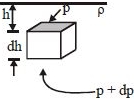

Download our appand get started for free
Experience the future of education. Simply download our apps or reach out to us for more information. Let's shape the future of learning together!No signup needed.*
Similar Questions
- 1A tank is filled with water of density $1\,g$ per $cm^3$ and oil of density $0.9\,g$ per $cm^3$ . The height of water layer is $100\,cm$ and of the oil layer is $400\,cm.$ If $g = 980\,cm/sec^2,$ then the velocity of efflux from an opening in the bottom of the tank isView Solution
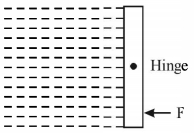
- 2A square gate of size $1\,m \times 1\,m$ is hinged at its mid-point. A fluid of density $\rho$ fills the space to the left of the gate. The force F required to hold the gate stationary isView Solution
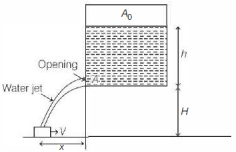
- 3Consider the configuration of a stationary water tank of cross-section area $A_{0}$ and a small bucket as shown in figure below; the speed $v$ is .......... $m/s$ of the bucket, so that the water leaking out of a hole of cross-section area $A$ (as shown) from the water tank does not fall outside the bucket? (Take, $h=5 \,m , H=5 \,m , g=10 \,m / s ^{2}, A=5 \,cm ^{2}$ and $\left.A_{0}=500 \,cm ^{2}\right)$.View Solution
- 4Three liquids of densities $d,\,2d$ and $3d$ are mixed in equal proportions of weights. The relative density of the mixture isView Solution
- 5Two capillary tubes of same radius $r$ but of lengths $l_1$ and $l_2$ are fitted in parallel to the bottom of a vessel. The pressure head is $P$. What should be the length of a single tube that can replace the two tubes so that the rate of flow is same as beforeView Solution
- 6Water flows in a horizontal tube (see figure). The pressure of water changes by $700\; \mathrm{Nm}^{-2}$ between $\mathrm{A}$ and $\mathrm{B}$ where the area of cross section are $40\; \mathrm{cm}^{2}$ and $20\; \mathrm{cm}^{2},$ respectively. Find the rate of flow of water through the tube. ........ $\mathrm{cm}^{3} / \mathrm{s}$View Solution
(density of water $=1000\; \mathrm{kgm}^{-3}$ )

- 7Two small spherical metal balls, having equal masses, are made from materials of densities $\rho_{1}$ and $\rho_{2}\left(\rho_{1}=8 \rho_{2}\right)$ and have radii of $1\; \mathrm{mm}$ and $2\; \mathrm{mm}$, respectively. They are made to fall vertically (from rest) in a viscous medum whose coefficient of viscosity equals $\eta$ and whose denstry is $0.1 \mathrm{\rho}_{2} .$ The ratio of their terminal velocitites would beView Solution
- 8A drinking straw is dipped in a pan of water to depth d from the surface (see figure below). Now water is sucked into it up to an initial height $h_0$ and then left to oscillate. As a result, its height $y$ from the surface of the water varies periodically. Ignoring damping, the equation for $y$ is ( $g$ is the acceleration due to gravity):View Solution
- 9If $W$ be the weight of a body of density $\rho $ in vacuum then its apparent weight in air of density $\sigma $ isView Solution
- 10The pressure of confined air is $p$. If the atmospheric pressure is $P$, thenView Solution