Question
A1. Simple Factual Activities:
Complete the following sentences using proper words from the passage:
(1) Father knew as much ______________.
(2) How can a man ______________?
(3) They had a teacher, but it wasn't ______________.
(4) Margie wouldn't want ______________ in her house to teach her.

    So she said to Tommy, “Why would anyone write about school ?”
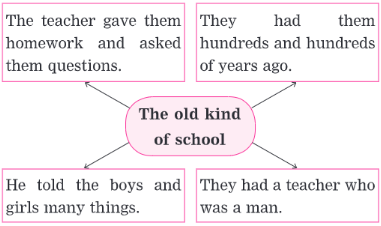
    Tommy looked at her with very superior eyes.“Because it’s not our kind of school, stupid. This is the old kind of school that they had hundreds and hundreds of years ago.” He added loftily, pronouncing the word carefully, “Centuries ago.”
    Margie was hurt. “Well, I don’t know what kind of school they had all that time ago.” She read the book over his shoulder for a while, then said, “Anyway, they had a teacher.”
    “Sure they had a teacher, but it wasn’t a regular teacher. It was a man.”
    “A man ? How could a man be a teacher ?” 
    “Well, he just told the boys and girls things and gave them homework and asked them questions.”
    “A man isn’t smart enough.”
    “Sure he is. My father knows as much as my teacher.”
     “He knows almost as much, I betcha.”
      Margie wasn’t prepared to dispute that. She said, “I wouldn’t want a strange man in my house to teach me.”  

A2. Complex Factual Activities:

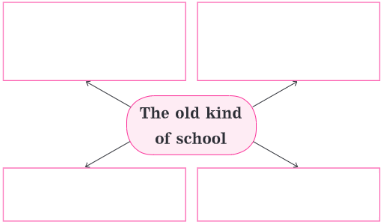
Complete the web about the 'Old School', using the information told by Tommy.
Image
A3. Activities based on Vocabulary:
Write what the following sentences would mean today, and what they mean in the context of the story: 

Column 'A'

Column 'B'

(1) betcha

(a) in superior manner

(2) pronouncing

(b) to debate

(3) loftily

(c) expressing the word strongly

(4) dispute

(d) surely, bet you

A4. Activities based on Contextual Grammar:
Rewrite the following using complete words instead of contracted forms:
(1) That wasn't so bad.
(2) It's not the little girl's fault.
A5. Personal Response:
Do you like to take tests? Give the reason for your answer.
Answer

A1. Simple Factual Activities:
(1) Father knew as much as his teachers.
(2) How can a man be a teacher?
(3) They had a teacher, but it wasn't a regular teacher.
(4) Margie wouldn't want a strange man in her house to teach her.
A2. Complex Factual Activities:
Image
A3. Activities based on Vocabulary:
(1) betcha - surely, bet you
(2) pronouncing - expressing the word strongly I strongly
(3) loftily - in superior manner
(4) dispute - to debate
A4. Activities based on Contextual Grammar:

(1) do not know.
(2) It was not a regular teacher.
A5. Personal Response:
Yes, I like to take tests, because the result of the tests shows our progress in learning. We know our drawbacks and we can try to improve our weak subjects.

Need a full question paper?

Generate a complete, print-ready paper with questions like this in minutes — across 16+ boards, with answer keys.

Start Generating Free

Similar questions

A1. Simple Factual Activities:
Complete the following sentences using the information given in the passage:
(1) Hidden by an island the Greeks waited for ___________.
(2) The ___________ when the side of the horse opened.
(3) The Trojans were taken ___________.
(4) ___________ had turned Helen's heart away from her home.

     The Greek ships had not sailed far. As soon as they were hidden by an island, they had lowered their sails and dropped anchor and waited for the night. In the darkness the fleet sailed back, and the leading ship, which was Agamemnon’s, bore a red light high on its mast. The Greek, who was watching for the return of the fleet, crept to the wooden horse and gave the signal. The side of the horse opened, the Greeks climbed out and opened the gates. The whole Greek army entered the sleeping city. Immediately the Greeks set fire to houses and towers and palaces, and began to burn and kill.
      Troy was filled with the sight of leaping flames and the sound of shouting and the noise of weapons and the cries of weeping women. The sleeping Trojans sprang out of their beds, but they were taken by surprise. Their enemies were right inside their walls, and many of the Trojans were killed before they could put on their armour and seize their weapons.
      A bright light lit up the night sky as palaces and houses, temples and towers, went up in flames. The Trojans fought as well as they could, but it was all in vain. Old King Priam was killed with all his brave sons. Hector’s wife and his old mother and sister were carried off as slaves by the conquerors. Their fate was in contrast to Helen’s when King Menelaus rushed through the city, looking for her and found her in her palace. She hung her head in shame and sorrow as she faced her former husband. Her voice was choked with emotion and she could not speak. But Menelaus forgave her and she went back with him, for it was only Aphrodite who had turned her heart away from her home and her husband and her child.
      When morning came, nothing was left of the proud, rich city that had resisted attack for ten years.

A2. Complex Factual Activities:
Put the following events in the order in which they took place. Number them accordingly:
(1) The Greeks climbed out of the horse and opened the gates of the city.
(2) Nothing of the proud, rich city of Troy was left behind.
(3) The Greek army entered the city.
(4) Troy was burnt down.
A3. Activities based on Vocabulary:
Write the meaningful sentences from the jumbled words:

Column 'A'

Column 'B'

(1) Agamemnon

(a) wife of King Menelaus

(2) Aphrodite

(b) Old Trojan King

(3) Priam

(c) sailing in the leading ship of Greeks

(4) Helen

(d) a Greek goddess


(e) tunnel

A4. Activities based on Contextual Grammar:
Choose the correct alternative from the brackets and complete the following sentences:
(1) They were killed ___________ their great heroes. (with/for)
(2) They found the car ___________ their own garage. (on/in)
(3) He jumped ___________ the river to save the child. (over/into)
(4) She was gazing ___________ the strange person. (on/at)
A5. Personal Response:

Do you think that the conquerors of war are happy after their victory?

A1. Simple Factual Activities:
Find the following matter in the passage and copy the missing words:
Statements
(1) Faraday's work on electricity is still a subject of study.
(2) Faraday as a child, had a speech defect.
(3) Faraday disliked reading.
(4) The first consistent light bulb was produced by Davy.

     Michael Faraday is regarded as one of the most distinguished scientists and inventors of modern times, and his work on electricity is still a subject of study, in the form of Faraday’s Laws. But few know his inspirational life story, which is all about courage and fighting against the odds.
      Michael Faraday was born into a poverty-stricken family in a dirty London suburb. He suffered from a speech defect as a child. He would pronounce ‘rabbit’ as ‘wabbit’. He could not even say his own name and would call himself ‘Fawaday’. Other children laughed at him and teachers did not help him either. When he was twelve, his mother was forced to take him out of school, thus putting an end to his formal education.
       At thirteen, however, he started working with a bookbinder, binding hundreds of books during the day and staying up all night to read them. Reading thus became his obsession. One day he came across a book on electricity which had been sent to his master for binding. He started reading it and was completely hooked. That was his first introduction to the subject of electricity, which soon became a lifelong fascination. Faraday was still poor at twenty-one. Once, a friend gave him a free ticket to a public lecture and demonstration by the renowned chemist Humphry Davy at London’s Royal Institution. Davy’s work on chemicals and electrical lighting was the subject of conversation among the scientists of that age. Seventy years later, across the Atlantic Ocean in the USA, the same work enabled Thomas Edison to produce the first consistent light bulb.

A2. Complex Factual Activities:
(1) What were the odds against Faraday in his childhood?
A3. Activities based on Vocabulary :
Write two compound words from the passage:
Example: bookbinder
A4. Activities based on Contextual Grammar:
Complete the following sentences using your own words/phrases:
(1) When he was twelve, ______________________.
(2) One day he came across a book on ______________________ .
A5. Personal Response:
(1) Why do you think Faraday's friend gave him a free ticket to Davy's programme?
A1. Simple Factual Activities:
Say whether the following statements are True or False:
Statements
(1) One day young Helen understood that everything has a name.
(2) Young Helen did not try to put the pieces of the doll together.
(3) Young Helen felt sorry that she had broken the doll.
(4) Helen's eyes filled with tears when she realised what she had done.

     We walked down the path to the well-house, attracted by the fragrance of the honeysuckle with which it was covered. Someone was drawing water and my teacher placed my hand under the spout. As the cool stream gushed over one hand she spelled into the other the word water, first slowly, then rapidly. I stood still, my whole attention fixed upon the motions of her fingers. Suddenly I felt a misty consciousness as of something forgotten - a thrill of returning thought; and somehow the mystery of language was revealed to me. I knew then that ‘w-a-t-e-r’ meant the wonderful cool something that was flowing over my hand. That living word awakened my soul, gave it light, hope, joy, set it free ! There were barriers still, it is true, but barriers that could in time be swept away.
     I left the well-house eager to learn. Everything had a name, and each name gave birth to a new thought. As we returned to the house, every object that I touched seemed to quiver with life. That was because I saw everything with the strange, new sight that had come to me. On entering the door I remembered the doll I had broken. I felt my way to the hearth and picked up the pieces. I tried vainly to put them together. Then my eyes filled with tears; for I realised what I had done, and for the first time I felt repentance and sorrow.
     I learned a great many new words that day. I do not remember what they all were; but I do know that mother, father, sister, teacher were among them - words that were to make the world blossom for me ‘like Aaron’s rod, with flower.’ It would have been difficult to find a happier child than I was as I lay in my crib at the close of that eventful day and lived over the joys it had brought me, and for the first time longed for a new day to come.
     Helen went on to become a graduate cum laude from Radcliffe. She then devoted the rest of her life to teaching and giving hope to the blind and deaf, as her teacher had done. She and Anne remained friends until  Anne’s death.

A2. Complex Factual Activities:
(1) What were the barriers? How could they be swept away? 
A3. Activities based on Vocabulary:
Classify the following words in the given columns:
fragrance, attract, stream, learn, hearth, enter, sorrow, realise
A4. Activities based on Contextual Grammar:
Rewrite the following sentences using 'Helen Keller/Young Helen' appropriately in place of 'T' and making other necessary changes in the sentences:
(1) On entering the door, I remembered the doll I had broken
(2) Then my eyes filled with tears: for I realised what I had done, and for the first time I felt repentance and sorrow.
A5. Personal Response:
(1) Why should we help disabled people?
A1. Simple Factual Activities:
State whether the following statements are True or False:
Statements
(1) The huge wooden horse was an offering to the god of the sea.
(2) The man left by the Greeks told the false story of the horse.
(3) Their wise priest told the Trojans not to make a hole in the wall.
(4) The Greeks were tired of the long war and had sailed away.

     As they were wondering how the horse had been built and why it had been left behind, they found a Greek with his hands tied together lying under it. When the Trojans dragged him out, the man pretended to be very frightened of them. When he was commanded to tell them why the Greeks had gone and why they had left this horse behind, he pretended to tremble very much and refused to speak. When at last they threatened to kill him, he spoke and told them this false tale.
     “The Greeks are tired of the long war and have sailed away in their ships,” he said. “But they are afraid of the long voyage home too, and so they have made this horse and left it as an offering to the god of the sea. They wanted also to kill me and offer me as a sacrifice to the sea-god; but I escaped and hid from them.”
      “But why did the Greeks make such a huge horse ?” some of the Trojans asked. And the cunning Greek made this reply : “If they had made a smaller offering, you might have taken it into your city. Then the luck would have gone to the Trojans and not to the Greeks. That is why they made it too big to go inside your gates.”
     The Trojans were delighted to hear this. “The Greeks have gone,” they said, “and the walls are no longer necessary. Let us make a hole in the wall and drag the horse in.”
     Their wise priest warned them not to do so. “It may be a trick that will ruin us,” he said. “You will bring disaster on the city if you break down the walls.” But they were so excited that they paid no attention to his words. They broke down part of their strong wall in order to drag the horse in.
     All that day the Trojans feasted and drank and celebrated. After all their celebrations, they went to sleep and slept soundly. But that day of rejoicing was soon followed by a night of terror and death.ss

A2. Complex Factual Activities:
Put the following events in the order in which they took place. Number them accordingly:
(1) The priest warned the Trojans not to break the wall.
(2) The Trojans found a Greek man under the big wooden horse.
(3) They broke down a part of the wall and brought the horse in.
(4) The Trojans slept soundly.
A3. Activities based on Vocabulary:
Write the meaningful sentences from the jumbled words:
(1) the Greeks did a large such Why horse make?
(2) wise their them priest warned not so to do.
A4. Activities based on Contextual Grammar:
Read the following constructions carefully and then use them to express your ideas:
(1) They went to sleep. (Write the sentence in past progressive tense.)
(2) Why did the Greeks make such a huge horse? (Rewrite the sentence using past perfect tense.)
A5. Personal Response:
Was the big wooden horse really an offering to the god of the sea? 
A1. Simple Factual Activities:
Complete the following sentences:
(1) The thieves were ______________ and ______________.
(2) Both the thieves were true ______________.

King : Let the court begin !
Fourth Guard Messenger : The first complainant !
Thief : (rushes forward and wails loudly) Justice ! Oh, Most Great King ! I beg for Justice.
King : And what is your complaint ?
Thief : In this great land of Andher Nagari, my friend and I have been truly hard-working honest thieves. All these years we have been true to our profession. And what is our reward ? Last night, with great efforts, we made a hole in the wall of a merchant’s house, when all his family were away. My friend peered through that hole into the house, when suddenly the wall collapsed (Wails louder).... and .... and my friend was instantly killed. I’ve lost my only friend and partner. O King ! It’s the merchant’s fault for living in a house with such weak walls.
King : Fetch the merchant at once. A life for life ! The merchant must be hanged ! (Third Guard leaves and returns with the merchant who bows before the king.)
Merchant : Mercy, O Noble King ! I had no intention of killing these skilled professionals. It is not my fault that the wall of my house collapsed. My house has been recently built. It is the fault of the bricklayer, who carelessly built such a weak wall.
King : Bring the careless bricklayer immediately. He must hang for his fault.
Bricklayer : O Most Kind Lord and King ! (kneeling to the king) Have mercy. I beg you, don’t send me to the gallows. I agree that I built the wall which collapsed and killed a man. But it was not due to my carelessness. The mortar which I used to lay the bricks was of very poor quality. There was too much of water mixed in it. It is entirely the mortar-maker’s fault.

A2. Complex Factual Activities:
Arrange the following sentences in chronological order:
(1) The wall collapsed while entering the house and the thief's friend was instantly killed.
(2) One day they made a hole in the wall of a merchant's house.
(3) There were two hardworking and honest thieves in the great land of Andher Nagari.
(4) They were very true to their profession from the last several years.
A3. Activities based on Vocabulary:
Find out the adverbs which are used along with the following verbs:
(1) ______________ killed
(2) ______________ built
(3) ______________ bring
(4) ______________ collapsed
A4. Activities based on Contextual Grammar:
Frame Verbal Questions:
(1) There was too much of water mixed in it.
(2) My friend was instantly killed.
A5. Personal Response:
Will a thief appear in a court on his own? Why does this thief dare to do so?
A1. Simple Factual Activities:
State whether the following statements are True or False:
Statements
(1) Prospero was the duke of Milan, in the kingdom of Naples.
(2) Prospero's brother Gonzalo was a very treacherous man.
(3) Books were Prospero's most valued possessions.
(4) The king Antonio landed safely on an enchanted island.

      Prospero was the Duke of Milan, in the kingdom of Naples. He was such a studious and learned scholar that he spent most of his time reading books, while his brother Antonio managed the business of ruling his dukedom.
      Now, Antonio was a treacherous man, and he wanted to become Duke of Milan in his brother place. In fact, Antonio would not have hesitated to kill Prospero - but he knew that the people loved their Duke, and would never forgive his murderer. So Antonio got together with Alonso, the king of Naples who was Prospero’s enemy. They took Prospero to sea, and when they were far away from land, they put Prospero and his baby daughter Miranda into a broken, old boat and sailed away. Prospero and Miranda were left to drift into the wide, open sea Thus Antonio managed to take over the Dukedom of Milan, with all its wealth and power.
      Now, among Prospero’s courtiers was a true and loyal Lord called Gonzalo. Out of love and loyalty for the rightful Duke, Gonzalo had secretly placed in the boat fresh water, food and clothes - and along with them, Prospero’s most valued possessions, his books.
       You can imagine the hardships faced by Prospero cast adrift in an oarless boat, with a baby girl to care for! However, they were fortunate that the boat reached an island, and they landed in safety.
      The island was an enchanted island. For years together, it had come under the spell of an evil witch Sycorax, who had imprisoned all the good spirits she found on the island. She herself had died before Propspero arrived on the island, but the spirits remained trapped in their ‘prisons’ - the trunks of the large trees on the island.

A2. Complex Factual Activity:
What had the faithful Lord Gonzalo done to help Prospero? 
A3. Activities based on Vocabulary:
Choose the correct alternative given for the synonym of the words given below:
(1) studious: ___________
(a) outstanding (b) concerned (c) bookish (d) clever
(2) treacherous: ___________
(a) foolish (b) tricky (c) unreliable (d) favourite
A4. Activities based on Contextual Grammar:
Add a question tag:
(1) Prospero was the Duke of Milan, ___________?
(2) Antonio would not have hesitated to kill Prospero, ___________?
A5. Personal Response:
What will you do if you are left alone on an isolated island by your friends?
A1. Simple Factual Activities:
Write if the following statements are True or False:
(1) Margie's school was in her house.
(2) In those old days kids went to a special building for learning.
(3) Margie was not interested in reading the old book.
(4) Tommy went home with the book.

    Tommy screamed with laughter. “You don’t know much, Margie. The teachers didn’t live in the house. They had a special building and all the kids went there.”
    “And all the kids learned the same things ?”
    “Sure, if they were the same age.”
    “But my mother says a teacher has to be adjusted to fit the mind of each boy and girl it teaches and that each kid has to be taught differently.” 
    “Just the same they didn’t do it that way then. If you don’t like it, you don’t have to read the book.”
    “I didn’t say I didn’t like it”, Margie said quickly. She wanted to read about those funny schools.
    They weren’t even half finished when Margie’s mother called, “Margie ! School !”
Margie looked up. “Not yet, Mamma.”
   “Now !” said Mrs Jones. “And it’s probably time for Tommy, too.”
    Margie said to Tommy, “Can I read the book some more with you after school ?”
   “May be.” he said nonchalantly. He walked away whistling, the dusty old book tucked beneath his arm. 
   Margie went into the schoolroom. It was right next to her bedroom, and the mechanical teacher was on and waiting for her. It was always on at the same time every day except Saturday and Sunday, because her mother said little girls learned better if they learned at regular hours.

A2. Complex Factual Activities:

(1) What do you know from the passage about the teachers, the school and the students of the old times? 
A3. Activities based on Vocabulary:
What do the following words describe in the passage.
(1) same (2) funny (3) dusty (4) special.
A4. Activities based on Contextual Grammar:
Rewrite the sentences with a different word for the underlined word:
(1) It is probably time for Tommy.
(2) They had a special building.'
A5. Personal Response:
Would you like your own mechanical teacher? Support your answer.
A1. Simple Factual Activities:
Write whether the following statements are True or False:
(1) The first Indian tea was sent to England for public sale in 1823.
(2) Tea became a fashionable and popular drink in Europe.
(3) Our body produces chemicals called free radicals.
(4) The word 'chai' is now sometimes used in English to refer to China tea.

      Thus the habit of drinking tea spread to Japan, Europe and England, where it became a fashionable and popular drink among the people.
     How did this magical beverage get its name? The Chinese character t’u was first used in early inscriptions to describe tea. But later, a new character, ch’a, was developed to refer specifically to tea. The word ch’a is now sometimes used in English to refer to China tea. And, as we all know, it is very close to the Hindi word chai, which is used all over India to refer to tea.
      How did tea first come to India? Historians think that tea had been known in India as a medicinal plant since ancient times, but tea was not drunk for pleasure until the British began to establish plantations in the 19th century. In the 1770s, the British East India Company made several unsuccessful attempts to grow tea in Bhutan and Assam, with seeds from China. Although these attempts failed, the botanist Robert Bruce in 1823 discovered tea plants growing wild in the Upper Brahmaputra valley. In May 1838, the first Indian tea from Assam was sent to England for public sale. Since then India has gone on to become one of the leading producers of tea in the world.
      Tea lovers claim that tea may be able to reduce the risk of cancer, control blood pressure, fight viruses in our body and actually help us live longer!
      Our body produces chemicals called free radicals. They can damage our body and our health. Tea contains antioxidants called flavonoids. Scientists believe these help to protect our system against free radicals.

A2. Complex Factual Activities:

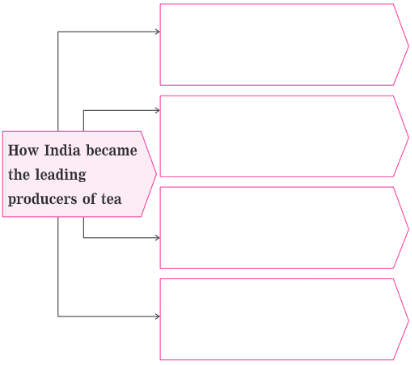
Complete the web :
Image
A3. Activities based on Vocabulary:
Match the verbs in 'A' with the related phrases/words in 'B' from the passage:

 'A' 'B'
(1) reduce(a) viruses in our body
(2) control(b) us live longer
(3) fight(c) the risk of cancer
(4) help(d) blood pressure

A4. Activities based on Contextual Grammar:
Underline the infinitives in the following sentences:
(1) The word ch'a' is used in English to refer to China tea.
(2) Tea may be able to reduce the risk of cancer
A5. Personal Response:
What is the difference between 'claim' and 'fact'?

A1. Simple Factual Activities:
Write down the relation between the characters given below: 
(1) Sycorax and Caliban - ___________
(2) Alonso and Sebastian - ___________

     Prospero was a great magician, for his life had been devoted to the study of magic. The power of his art enabled him to set free the imprisoned spirits, of whom Ariel was the chief. The spirits were so grateful to Prospero that they promised to be ever obedient to his will.
     In the woods nearby, Prospero found Caliban, a twisted, ugly monster. He was the son of Sycorax, the witch. Caliban became Prospero’s servant. Apart from being hideous and horrible in appearance, he was also vicious and brutal in his habits. No matter how hard he tired, Prospero could not make him change his ways for the better. And so it was Ariel’s job to see that he carried out his tasks properly.
      Time passed, and Miranda grew up to be a sweet and beautiful girl. The spirits of the island were loyal and faithful to Prospero, who ruled them wisely and well.
     Now, it came to pass that Alonso, king of Naples, his brother Sebastian and Antonio, the wicked brother of Prospero were sailing in a ship, close to the enchanted island. The ship was also carrying Prince Ferdinand of Naples, and the old, loyal courtier Gonzalo. The entire party was returning after the marriage celebrations of their Princess in a far-off kingdom.
     Knowing that his enemies were near his island, Prospero raised a great tempest with the power of his magic. The royal ship was turned and tossed on the stormy waves. It seemed as if it would sink any moment, along with all the people on board.

A2. Complex Factual Activity:
What good deed did Prospero do on the enchanted island? 
A3. Activities based on Vocabulary:
(1) disillusioned × ___________
(2) kindhearted × ___________
(3) thankless × ___________
(4) sympathetic × ___________
A4. Activities based on Contextual Grammar:
Identify the tense :
(1) The ship was carrying Prince Ferdinand of Naples.
(2) He had devoted his life to the study of magic.
A5. Personal Response:
Why did Prospero raise a great tempest?
A1. Simple Factual Activities:
Answer the following in words:
(1) How many times did Mark Twain hear the story?
(2) Who was telling the story?

     One day Henry Irving, in the midst of telling Mark Twain a humorous story, abruptly stopped and examined his friend’s face. “You haven’t heard this, have you ?” he asked. Twain assured him that he had not. 
     When, some time later, Irving again paused, and again posed the question, Twain again reassured him. Then, approaching the climax, Irving broke off once more. “Are you quite sure you haven’t heard this?” he demanded suspiciously. “I can lie once,” Twain finally replied. “I can lie twice for courtesy’s sake, but I draw the line there. I can’t lie the third time at any price. I not only heard the story, I invented it !”
Mark Twain once proposed a ‘Plan for the Improvement of English Spelling’: 
     For example, in Year 1 that useless letter ‘c’ would be dropped to be replased either by ‘k’ or 
‘s,’ and likewise, ‘x’ would no longer be part of the alphabet. 
The only kase in which ‘c’ would be retained  would be the ‘ch’ formation, which will be dealt with later.
     Year 2 might reform ‘w’ spelling, so that ‘which’ and ‘one’ would take the same konsonant, wile Year 3 might well abolish ‘y’ replasing it with ‘i’ and Iear 4 might fiks the ‘g/j’ anomali wonse and for all. 
     Jenerally, then, the improvement would kontinue iear bai iear with Iear 5 doing awai with useless double konsonants, and Iears 6-12 or so modifaiing vowlz and the rimeining voist and unvoist konsonants. Bai Iear 15 or sou, it wud fainali bi posibl to meik ius ov thi ridandant letez ‘c,’ ‘y’ and ‘x’ — bai now jast a memori in the maindz ov ould doderez — tu riplais ‘ch,’ ‘sh,’ and ‘th’ rispektivli. 
     Fainali, xen, aafte sam 20 iers ov orxogrefkl riform, wi wud hev a lojikl, kohirnt speling in ius xrewawt xe Ingliy-spiking werld. 

A2. Complex Factual Activities:
(1) Why was Henry Irving asking Mark Twain the same question again and again?
A3. Activities based on Vocabulary:
Find out any four wrongly spelled words from the passage and correct them:
(1) Iear - 
(2) konsonant - 
(3) fainali -
(4) lojikl -
A4. Activities based on Contextual Grammar:
Identify the mistakes in the following sentences and write the correct sentences:
(1) Jenerally, then, the improvement would kontinue iear bai iear.
(2) it wud fainali bi posibl to meik ius ov thi ridandant letez.
A5. Personal Response:
(1) Why should we avoid spelling mistakes while writing?